A mathematical expression combines symbols according to formation rules, such as , , or . With values for its variables and meanings for its algebraic operations, it can be evaluated. An equation relates two mathematical expressions; an expression alone need not assert anything.
For example, evaluates to seven at and nine at . Neither value solves anything until a condition is imposed: the equation selects from the real numbers. This distinction is useful when moving from a formula to a question about which inputs satisfy it. Evaluation by replacing the variables with assigned values is described in College Algebra 2e, §1.1: Evaluating Algebraic Expressions.
Different written mathematical expressions can have the same value for every input in a common domain of a function. The distributive property expands to , while factorizing reverses that change of form. The mathematical identity between them lets one choose the form suited to the next task: the factored form exposes a multiple root at , and the expanded form exposes its coefficients. Simplifying should preserve values on the stated domain, rather than silently enlarging it.
An equation asserts that two mathematical expressions have the same value. Solving it means finding all allowed assignments to its variables that make that assertion true. It converts a relationship into a constraint: a measurement, a geometric intersection, or an equilibrium model can leave an unknown value to determine.
The allowed values matter. The equation has solution set over the rational numbers, but the empty set over the integers. Over the real numbers, has two solutions, and . A mathematical identity, such as , holds for every permitted real . The familiar equality sign therefore does not by itself say whether one is checking a particular value, solving for an unknown, or stating an identity.
For a worked linear equation over the real numbers,The first step subtracts three from both sides; the second divides both sides by the nonzero number two. Reversing the steps recovers the original equation, so these are equivalent equations with the same solution set . Checking the value gives . The role of reversible operations and the classification by solution sets are described in College Algebra 2e, §2.2: Solving Linear Equations in One Variable.
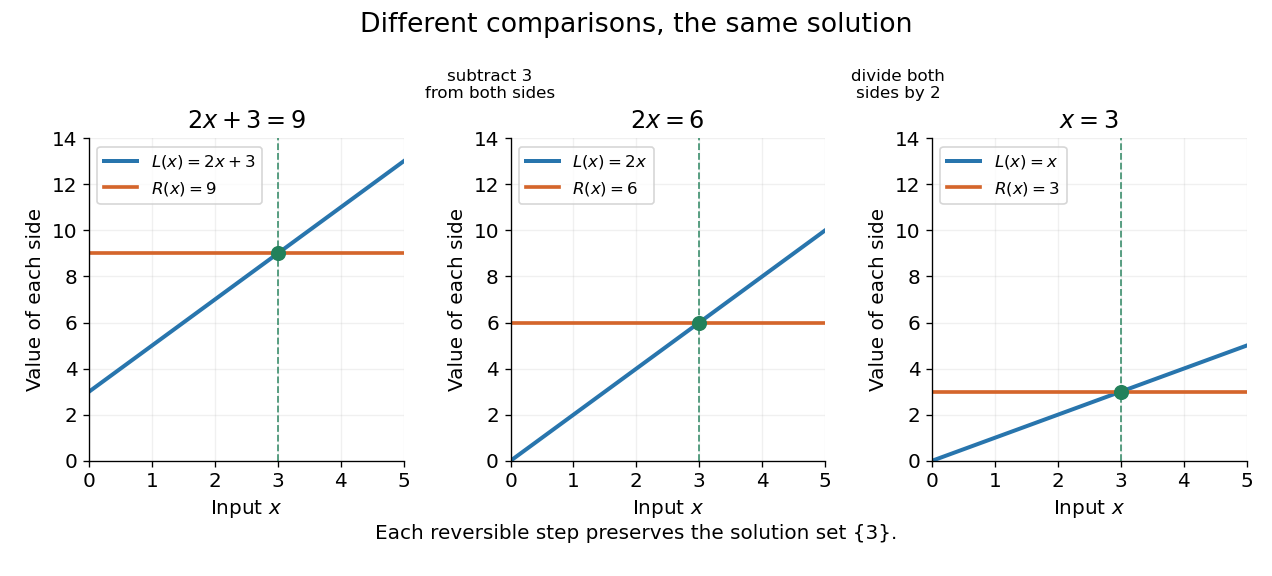
Reversible operations change the graphs of the two sides but preserve the intersection's input value
. Details. 
When the two sides define real-valued functions and on a common domain of a function, solutions are exactly the input values at which their function graphs intersect. Equivalently, they are the zeros of a function . This gives a useful connection between symbolic algebra and geometry: rearranging an equation can simplify the comparison without changing the inputs where equality holds.
Not every operation is reversible on every domain of a function. Dividing by gives only after restricting to ; it loses the solution if that restriction is forgotten. Squaring both sides can instead introduce an extraneous solution, because distinct real numbers can have the same square. The source equation, its domain of a function, and the direction of each implication should travel together.
Advanced Topics in Statistical Learning, Spring 2023 High-Dimensional Regression: Ridge by  Codex 0 2026-10-13
By Ryan Tibshirani.
An infinitely long circular cylinder of radius translating across its axis through otherwise stationary, inviscid incompressible fluid has added mass per unit length. The decaying, circulation-free velocity potential is . In moving centre coordinates, the fixed-laboratory derivative is . The Unsteady Bernoulli equation gives . Integrating around yields ; the transverse force vanishes. Taking a derivative at fixed centre coordinates would omit the necessary convective correction.
Conformational selection is a binding mechanism in which a ligand preferentially binds one of the conformations already sampled by an unbound protein. Binding shifts the conformational population toward that conformation. It differs from a pure induced-fit description, where the relevant structural rearrangement follows the initial encounter, although both contributions can occur in one system. Demonstrating a pre-existing state supports its availability; kinetic measurements are needed to determine how much binding flux actually follows that route. [ref]
Intrinsic dynamics of an enzyme underlies catalysis by Elan Z. Eisenmesser and others. 2005, pre-existing conformational exchange in cyclophilin A
An enzyme-substrate complex is the bound association of an enzyme with a substrate before or during catalysis, commonly written . In the scheme , binding, unbinding and product formation are distinct steps. The amount of need not increase indefinitely with substrate concentration because the supply of enzyme is finite. A bound complex also need not be the transition state or proceed to product on every encounter. [ref]
There are unlisted articles, also show them or only show them.