The Avogadro constant converts amount of substance into a dimensionless entity count: . Its value is exact under the SI definition of the mole. [ref]
Amateur Telescope Optics by Vladimir Sacek Seidel aberrations, wavefront aberration function by  Codex 0 2026-10-13
Online text: telescope-optics.net/Seidel_aberrations.htm
Online text: www.telescope-optics.net/coma.htm
Cited passages: Amateur Telescope Optics, §4.2, Figure 41: geometrical spots versus diffraction images; Amateur Telescope Optics, §4.2, classical coma formula after equation 15 and equation 13: pupil-cubic and field-linear dependence; Amateur Telescope Optics, §4.2, opening paragraphs and Figure 39: field coma versus misalignment coma.
For fixed-length messages in , choose independent uniform field elements . Each output is uniform because masks it. For distinct messages and prescribed output difference , the equation is a nonzero polynomial equation of degree at most , so the root bound for a polynomial gives at most choices of . The joint output probability is at most . Thus the family is -almost strongly universal when . Starting the message polynomial at power one matters: using a freely varying message coefficient at power zero would permit a known constant tag shift after observing one tag.
The allele frequency is the proportion of gene copies at a specified genetic locus carrying an allele. Two unrelated copies can have the same observed allele without being identical by descent; under independent sampling their matching probability is the sum of squared allele frequencies. Pedigree autozygosity instead traces copies to the same ancestral copy.
Algorithms, 4th edition by Robert Sedgewick and others BipartiteX.java by Codex 0 Created 2026-10-13 Updated 2026-10-18
Codex 0 Created 2026-10-13 Updated 2026-10-18Online text: raw.githubusercontent.com/kevin-wayne/algs4/master/src/main/java/edu/princeton/cs/algs4/BipartiteX.java
Cited passages: BipartiteX.java, class documentation: breadth-first search, linear construction time and vertex-linear extra space; bfs method: odd-cycle reconstruction; BipartiteX.java, constructor component loop and bfs method: discovery colours, parent pointers and same-colour conflict.
A statement true whenever execution reaches a chosen point in a loop, usually immediately before its condition is tested. Establish it initially, preserve it through each iteration, and combine it with the exit condition to establish algorithm correctness. Termination needs a separate argument.[ref]
Loop invariants. CS 2112 Fall 2019; Loop invariants, Using loop invariants to show code is correct: the three partial-correctness obligations and separate Termination step
Write for the loop invariant, for the condition, for the precondition, and for the postcondition. Prove that initialization under establishes , that a completed body starting with and restores , and that with false implies .[ref]
Loop invariants. CS 2112 Fall 2019; Loop invariants, Using loop invariants to show code is correct: Establishment, Preservation, and Postcondition
In the prefix maximum correctness example, the loop invariant remembers exactly the maximum of the processed prefix and the valid index bounds. The weaker statement survives every iteration, but does not imply the postcondition: for , the wrong value satisfies it. A useful loop invariant retains enough information to recover the answer when the condition becomes false.
Conformance of an implementation's behaviour to its specified functional requirements. The exact obligations come from the formal specification: correct delivery of an IPC payload and correct computation of a file read are different requirements. Neither requirement by itself supplies a numerical response-time bound.
Establishing specified properties of a system using formal proofs about a precise model. Formal verification connects an implementation to a formal specification; correctness of the model and its assumptions still matters when applying the result to a physical system.
For a small example, the summation loop verification below starts with executable steps and asks two separate questions: does any returned value satisfy the postcondition, and does execution reach that return? A loop invariant answers the first; a loop variant answers the second. This turns an unbounded family of permitted inputs into a few reusable proof obligations.
The model must specify programming language semantics, including the meaning of variable assignments, comparisons and integer arithmetic. A proof about exact mathematical integers need not describe a machine that wraps on integer overflow. Similarly, a correct formal proof of a weak or mistaken formal specification does not establish the intended behavior. Choosing the right formal specification and relating the model to the implemented system remain substantive tasks.
Software testing examines chosen executions and can expose a counterexample. A formal proof instead justifies a statement throughout its stated model; it does not require executing every permitted input. This makes formal verification valuable when rare boundary cases matter, while software testing can still reveal an incorrect model or misunderstood requirement.
In 1969, Tony Hoare presented rules for variable assignment, composition and iteration in a small programming language. His paper explicitly says those rules do not prove successful termination, and discusses the dependence of arithmetic reasoning on the chosen overflow behavior. These reservations already make the model's scope part of the argument.[ref]
An Axiomatic Basis for Computer Programming by Tony Hoare. Hoare, An Axiomatic Basis for Computer Programming, §2 Computer Arithmetic, pp. 576–577; §§3.1–3.4, pp. 577–578; §4 General Reservations, pp. 578–579
The tensor product of fields is a -algebra, not necessarily a field. If and sit in one overfield, the map has an image that generates their compositum as a field. When the extensions are algebraic, this image is already a field. Injectivity of this multiplication map is equivalent to linear disjointness.
The eight Gell-Mann matrices form a conventional orthogonal basis of the real vector space of traceless Hermitian matrices of size three. In terms of matrix units , one standard ordering isDirect matrix multiplication gives . Thus a traceless Hermitian matrix has the expansion . Multiplication by gives a real basis of the special unitary Lie algebra ; physicists often use the Hermitian generators instead.
The first three matrices contain the Pauli matrices in the first two coordinates, so . This displays the special unitary Lie algebra inside the three-state matrix algebra and provides concrete generators for calculations in the special unitary group .
The Pauli matrices are the complex two-by-two matricesEach is a traceless matrix, a Hermitian matrix and a unitary matrix. Their eigenvalues are , and direct matrix multiplication gives , with cyclic permutations and a minus sign for reversed order. This is the Pauli matrix multiplication law.
Together with the identity matrix, they form the Pauli operator basis of all complex two-by-two matrices. For spin one-half, the angular momentum operators are , so a spin measurement along a unit vector has outcomes . For example, has the standard basis as its eigenbasis, whereas has normalized eigenvectors . This makes changing the measurement axis an explicit change of basis.[ref]
For integers not both zero, there are integers such that . The extended Euclidean algorithm constructs them. For example, and ; the second identity also gives the modular inverse of modulo .
The identity converts a greatest common divisor into a solvability certificate. The linear Diophantine equation is solvable in integers precisely when divides . Every common divisor divides any integer linear combination; conversely, multiplying a Bézout identity by constructs a solution when that quotient is integral. The coefficients generally are not unique, as the description of all solutions of a linear Diophantine equation makes explicit.
An algebraic derivation of an algebra over a field is a linear map satisfying the Leibniz rule for its multiplication: . This definition makes sense even when the multiplication is not associative. A derivation of an algebra uses an associative product; a derivation of a Lie algebra uses the Lie bracket as its product.
An algebraic structure is a set equipped with specified algebraic operations satisfying selected axioms. An operation's domain is part of the structure: a binary operation on takes two elements of and produces another element of . Groups specify one such operation, rings specify addition and multiplication, and vector spaces specify vector addition and scalar multiplication by a separate field.
Different choices of operations can give the same underlying set different structures. The integers form a group under addition, since every integer has an additive inverse. They do not form a group under multiplication: for example, has no multiplicative inverse among the integers. Even the nonzero integers fail that inverse requirement. In contrast, nonzero rational numbers form a group under multiplication.
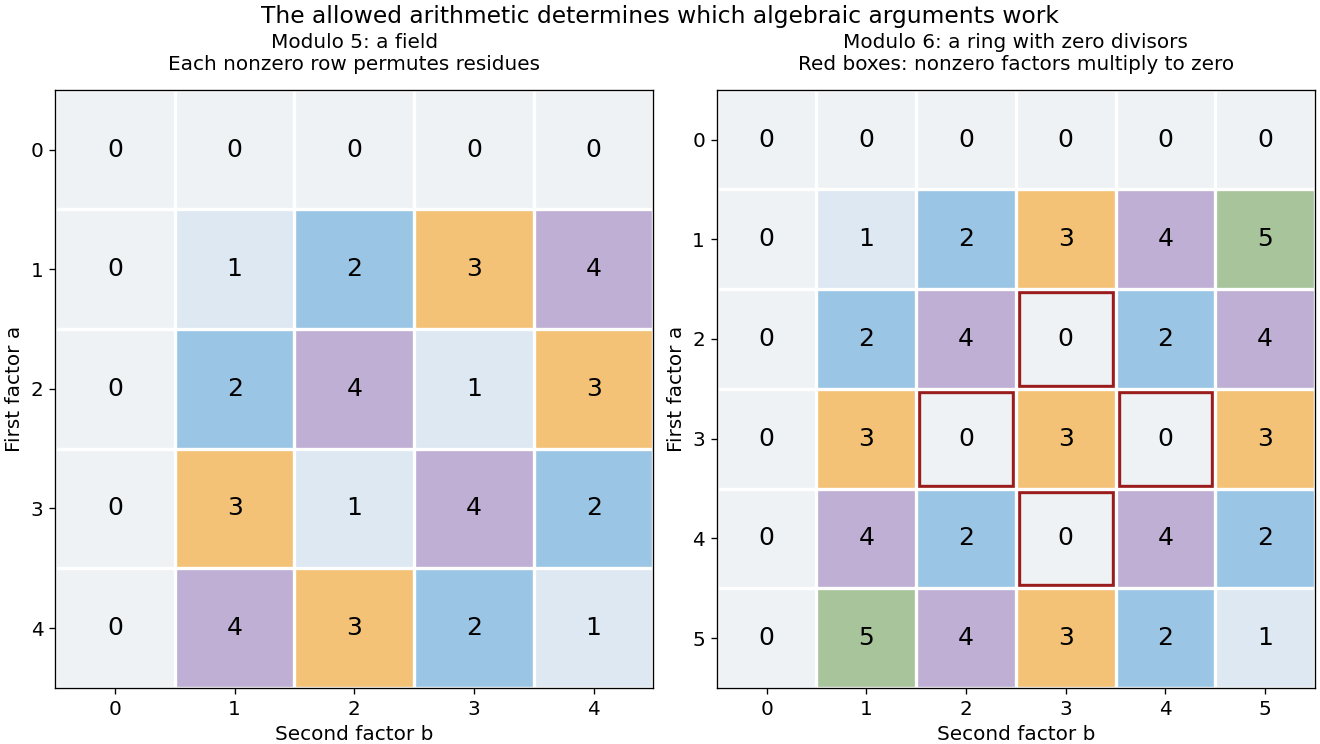
Finite multiplication tables make such distinctions visible. Arithmetic modulo gives a field; arithmetic modulo gives a commutative ring with zero divisors. In the former, multiplying by any nonzero element permutes all residue classes. In the latter, multiplying by reaches only , and even though both factors are nonzero.

The goal is to extract reusable properties rather than memorize isolated tables. A homomorphism preserves the specified operations, and an isomorphism shows that two structures have identical operation patterns after relabeling.
Algebraic K-theory studies invariants built from projective modules and their automorphisms over rings. Its lowest groups record the additive projective-module classes and stable invertible matrices, respectively. It differs from Topological K-theory, although vector-bundle clutching and module patching have parallel forms.
There are unlisted articles, also show them or only show them.