
The International System of Units defines a common system for expressing physical quantities. Its base units include the kelvin for thermodynamic temperature; derived units combine them to describe quantities such as force and energy.[ref]
Invariance of an action, equation or configuration under a translation. For a continuous spatial translation symmetry, Noether's theorem supplies the conserved momentum; spacetime translation gives the canonical stress-energy tensor.
In a Fischer projection, each cross represents a carbon position: horizontal chemical bonds point toward the viewer and vertical chemical bonds point away. For the open-chain aldehyde sugars illustrated here, place at the top and at the bottom. This is a convention for stereochemistry, not a measured molecular shape. See Moss, IUPAC Recommendations 1996: Fischer projection.
In these Fischer projections, D specifies that the hydroxy group at the lowest stereocenter lies on the right: C4 for ribose and deoxyribose, C5 for glucose. D does not specify every other stereocenter, and it does not specify the direction of rotation of polarized light. See McMurry: the meaning of D and L.
At a stereocenter, exchanging two attached groups produces a different spatial configuration. The open-chain ribose and glucose examples have carbon stereocenters bearing four different groups; C2 of deoxyribose has two identical hydrogen substituents and is not a stereocenter. See Moss, Basic Terminology of Stereochemistry, IUPAC Recommendations 1996: stereogenic units.
Chirality means that a molecule cannot be superposed on its mirror image. A carbon attached to four different groups is a common source of chirality; the definition concerns the whole molecule, rather than requiring this particular structural feature.
The test is spatial: apply a translation and a rotation to the entire molecule until corresponding chemical atoms coincide, keeping their identities and chemical bonds. A mirror operation is a reflection; physically turning a model is a rotation. They are different operations. If no such superposition exists, the two forms are enantiomers; if one succeeds, the molecule is achiral. A different-looking flat drawing alone establishes neither conclusion.
For a simple molecule with exactly one tetrahedral stereocenter and four constitutionally different substituents, the mirror forms cannot superpose. Compare entire attached groups, including paths around a ring, rather than just the first chemical atom. Several tetrahedral stereocenters require a whole-molecule check: a meso compound can be achiral. Conversely, axial chirality needs no tetrahedral stereocenter.[ref]
5.2 The Reason for Handedness in Molecules: Chirality. McMurry, Organic Chemistry, §5.2: whole-molecule chirality, four different groups and equivalent ring paths
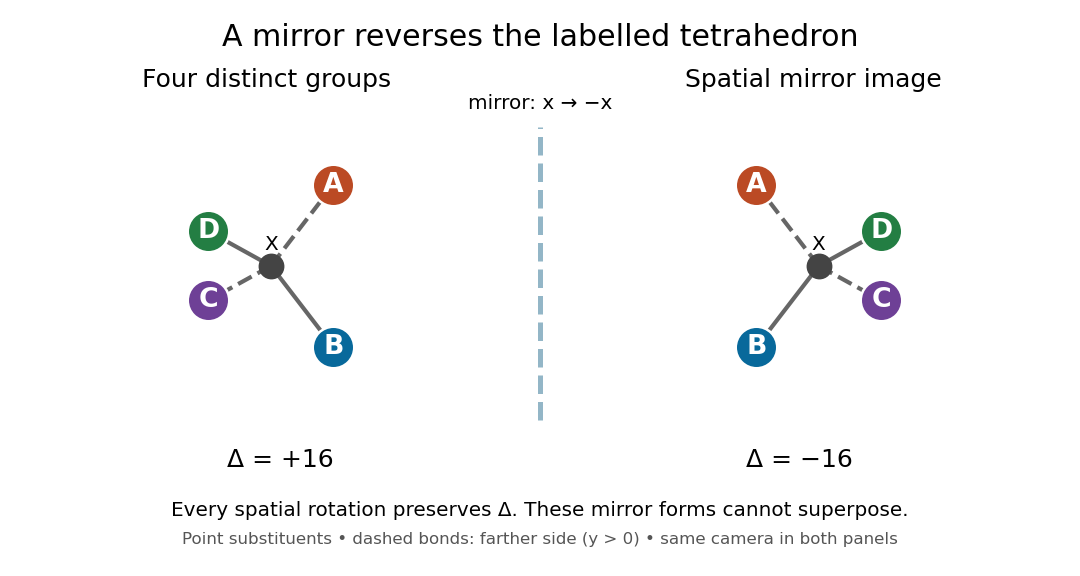

Why care about this distinction? Two enantiomers can fit differently into an already chiral molecule, just as two opposite hands fit differently into one glove. Thus a protein's spatial arrangement can distinguish a mirror pair even when an achiral measurement cannot. Polarimetry provides a different kind of test: it measures a sample's net optical rotation, which depends on the populations of its enantiomers.
An addressed entry of a spreadsheet, such as
A1. Here it stores either a literal numerical input or a spreadsheet formula; its current value is distinct from the stored formula. A cached cell value records a previously computed value, not an instruction to compute it again.In a spreadsheet tabular model,
D2 can store =C2*(1+$F$1) while displaying 9. The spreadsheet cell reference D2 identifies the location, the spreadsheet formula describes the calculation, and 9 is the value obtained from the present inputs. Keeping those three ideas distinct makes copying and checking a model much easier.Evaluate numeric formula dependencies using depth-first search and memoization, or a topological ordering. Marking active evaluations detects cycles; repeated numerical sweeps need not terminate or determine a unique result.
A spreadsheet dependency graph turns a page of spreadsheet formulas into a plan: compute each prerequisite before the spreadsheet cell that consumes it. This section uses a deliberately small model with explicit cell references, fixed spreadsheet formulas, and deterministic computation from numerical inputs. There are no external data changes or formulas that change their references while running. Within these assumptions, a topological order gives a reproducible answer without repeatedly sweeping the visible grid.
Take two input spreadsheet cells and five spreadsheet formulas:
| Spreadsheet cell | Stored input or spreadsheet formula | Initial value | Value after changing A1 to 5 |
|---|---|---|---|
A1 | 3, later 5 | ||
A2 | 4 | ||
B1 | =A1+A2 | ||
B2 | =2*A1 | ||
C1 | =B1+B2 | ||
D1 | =C1/2 | ||
E1 | =A2^2 |
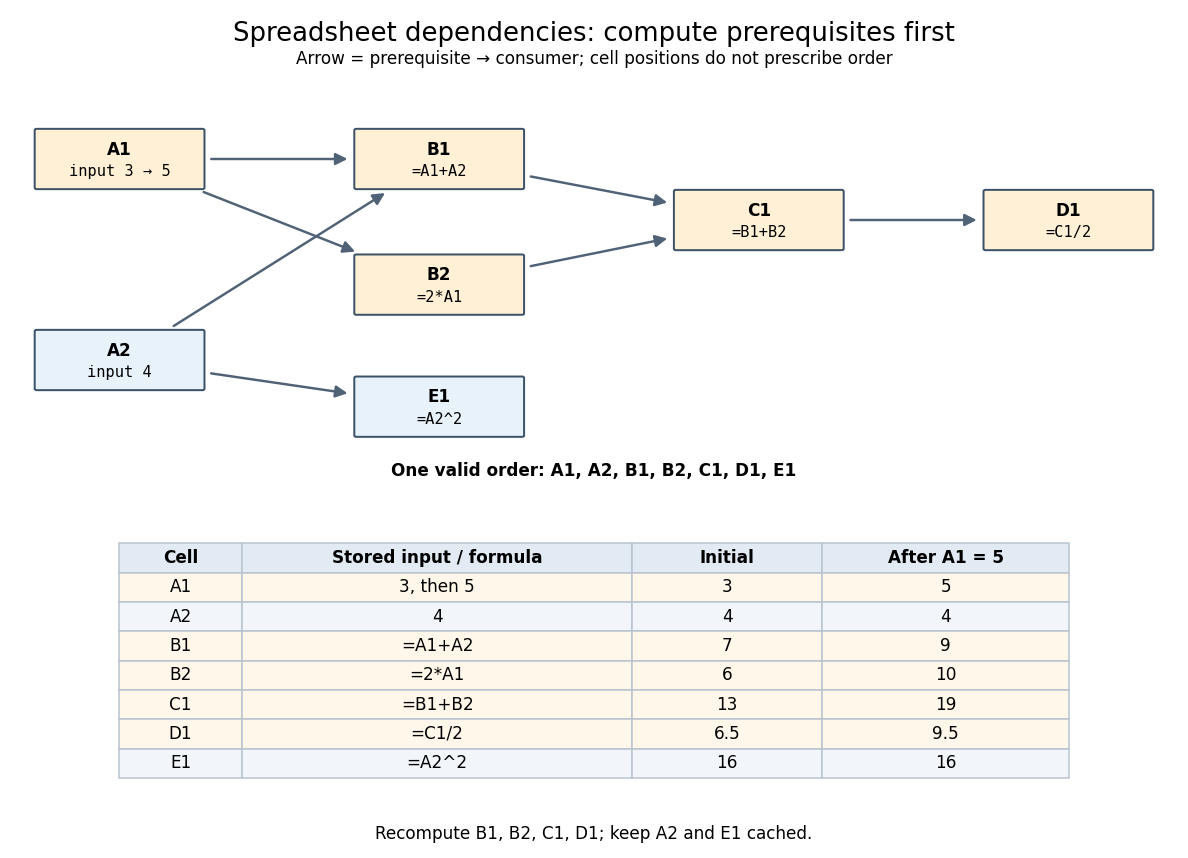
An original spreadsheet dependency graph and a topological order with values before and after one edit
. Details. 
Our directed edge convention is prerequisite to consumer:
A1 B1 means that B1 reads A1, not the reverse. The seven directed edges are A1 B1, A2 B1, A1 B2, B1 C1, B2 C1, C1 D1, and A2 E1. This spreadsheet dependency graph is a directed acyclic graph. One topological order is A1,A2,B1,B2,C1,D1,E1; E1 could instead be computed immediately after A2. A topological order constrains prerequisites, not the physical positions of spreadsheet cells.In that order, the initial arithmetic operations give , , , , and . The spreadsheet formulas define one value per spreadsheet cell: an outline by induction along any topological order shows that every prerequisite already has its uniquely determined value when its consumer is computed. Different permitted orders therefore agree in this model. The useful idea is that information flows through the directed acyclic graph even when the visible grid does not display that flow.
A concrete implementation history illustrates this separation. Microsoft's documentation distinguishes the per-worksheet calculation chains used in Excel 2002 and earlier from calculation using multiple software threads introduced in Excel 2007 for independent chain sections. This is a documented implementation example, not a definition of spreadsheet dependency evaluation.[ref]
Excel Recalculation by Microsoft. Dependence, Dirty Cells, and Recalculated Cells: paragraphs beginning “In Excel 2002 and earlier versions” and “In Excel 2007”
An application programming interface defines the operations available to client code and their promised behavior, including inputs, outputs and failure cases. For a FIFO queue, operation names alone do not specify what happens on an empty or full queue. An API should state those cases before clients depend on them.
An incoherent feedforward loop carries influences from a shared input to a shared output along routes with opposite net signs. In the signaling adaptation toy, drives fast and slow , which contribute with opposite signs to . Despite the conventional word "loop", those routes do not return the output to an earlier stage: this arrangement is distinct from negative feedback. Opposing routes alone do not guarantee complete signaling adaptation. [ref]
https://cqb.pku.edu.cn/tanglab/pdf/78.pdf. Ma et al., Cell 138 (2009), p. 764: definition of an incoherent feedforward loop
Signaling adaptation is a decline of a response toward its earlier level while the initiating signal remains present. Specify which response is measured and its baseline: complete signaling adaptation means eventual return to that baseline; partial signaling adaptation leaves a lasting displacement. The continuing signal distinguishes signaling adaptation from simply switching off the stimulus. Signaling adaptation describes behavior, while signaling feedback describes a causal arrangement, so neither implies the other.
By reducing a persistent response to background ligand concentration, signaling adaptation can make a biological cell sensitive to changes rather than only to absolute levels. Resetting the response helps leave room for another change over a useful range of ligand concentrations. This is valuable in chemotaxis: swimming bacteria encounter changing chemical conditions, and their signal transduction influences whether a run continues or a tumble occurs. Signaling adaptation helps separate a change encountered during motion from a lasting background. This usefulness does not imply exact return or equal sensitivity at every possible concentration. [ref] [ref]
https://groups.csail.mit.edu/mac/projects/amorphous/6.978/papers/doyle-PNAS-2000.pdf. Yi, Huang, Simon and Doyle, PNAS 97 (2000), pp. 4649–4653: chemotaxis and adaptation
Here is a solvable incoherent feedforward loop toy that exhibits complete signaling adaptation without signaling feedback. The input jumps from to at and remains , a Heaviside step function. Let be a fast activating branch, a slower inhibitory branch, and a readout. The activities are dimensionless variables; physical time is in seconds. Choose time constants second and seconds, with initial conditions :Both branches read directly. Neither branch depends on , and does not change : the subtraction only defines the readout. Thus the slow opposing influence is feedforward, with no closed feedback control loop.
For , solving the two ordinary differential equations givesWriting for the numerical time in seconds, these are , and . Initially , then rises faster than , producing a pulse. At long times and both approach , so returns to despite sustained . For this upward step , hence . The striking feature of this signaling adaptation toy is that both branches remain active while the readout becomes quiet: the continuing background and the response to its arrival are separable.
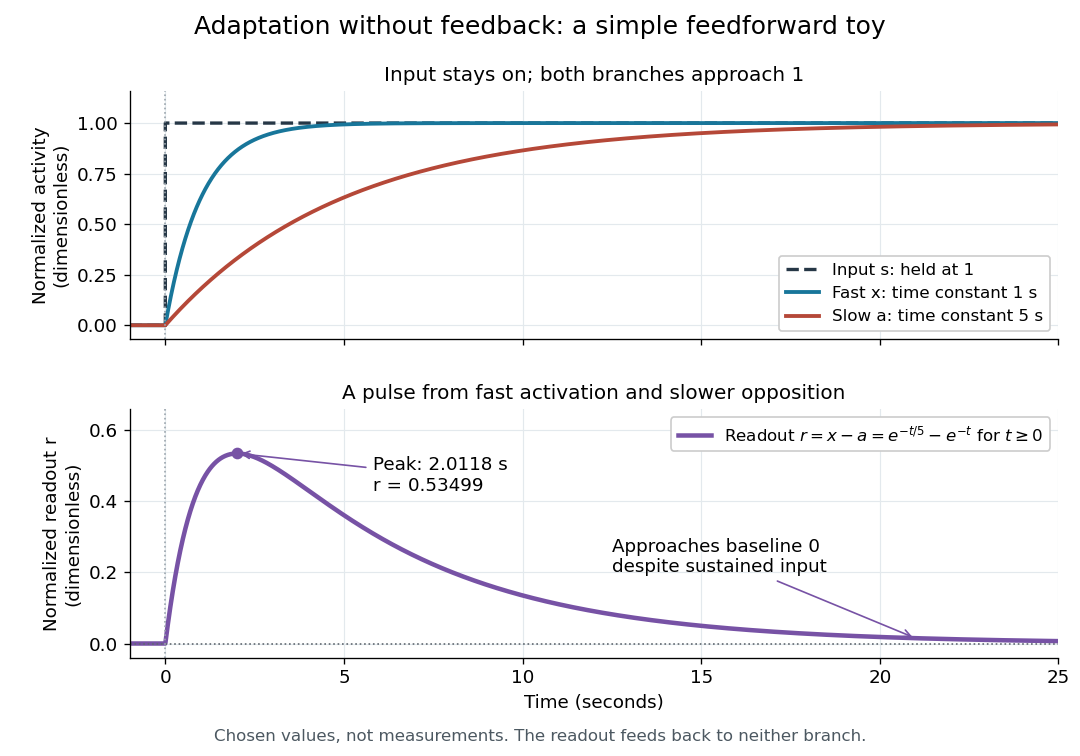

Find the pulse maximum by differentiating the exponential functions. With numerical time in seconds, the derivative isThe stationary condition is , so the natural logarithm givesBefore this time the derivative is positive; afterwards it is negative. Together with and , this proves that it is the unique pulse maximum. As another numerical check, at seconds , and : the slow branch is still catching up.
The subtraction is a mathematical readout, not a claim that an actual chemical concentration equals this difference for arbitrary inputs. Nonnegativity was established only for the specified upward step; other input histories can give a negative signed readout. Complete signaling adaptation here also relies on equal eventual branch gains: changing the readout to leaves for . This toy illustrates cancellation and different time constants; it does not establish molecular implementation or robustness to arbitrary parameter changes. Ma and colleagues' 2009 study separately analyzed biochemical mathematical models with negative feedback and incoherent feedforward loops, identifying additional conditions for signaling adaptation in those models. [ref]
https://cqb.pku.edu.cn/tanglab/pdf/78.pdf. Ma et al., Cell 138 (2009): adaptive architectures and their kinetic conditions
A historical connection to feedback control comes from Yi, Huang, Simon and Doyle's 2000 analysis of a bacterial chemotaxis model. They identified integral action in its regulation of receptor activity: accumulated deviations alter a slower adjustment, which in turn changes the measured activity. At a stationary state, an adjustment that integrates a nonzero error cannot remain constant, explaining how zero error can follow. Their conclusion depended on stated biochemical assumptions and stable behavior; it was not a claim that every biological cell uses that mechanism. A transient pulse alone, as the incoherent feedforward loop toy shows, cannot identify the underlying signaling feedback architecture. [ref]
https://groups.csail.mit.edu/mac/projects/amorphous/6.978/papers/doyle-PNAS-2000.pdf. Yi et al., Robust perfect adaptation in bacterial chemotaxis through integral feedback control, PNAS 97 (2000): Results and Discussion
Signaling feedback returns the effect of a downstream event to an earlier stage of signal transduction, closing a loop analogous to feedback control. Trace the causal arrows: if an earlier relay activates a later relay and the later relay changes the earlier relay's activity, the return path closes the loop. Negative feedback opposes the initiating change; positive feedback reinforces it. Signaling feedback is a possible property of signal transduction, not a requirement of every pathway.
For a schematic example, let relay activate relay . If inhibits , increased eventually produces an opposing influence: negative feedback. If activates , increased produces a reinforcing influence: positive feedback. These signs describe effects on activity, rather than the direction in which molecules travel. A closed loop containing two inhibitions can have positive feedback, because inhibiting an inhibitor reinforces the original change. The sign belongs to the whole loop.
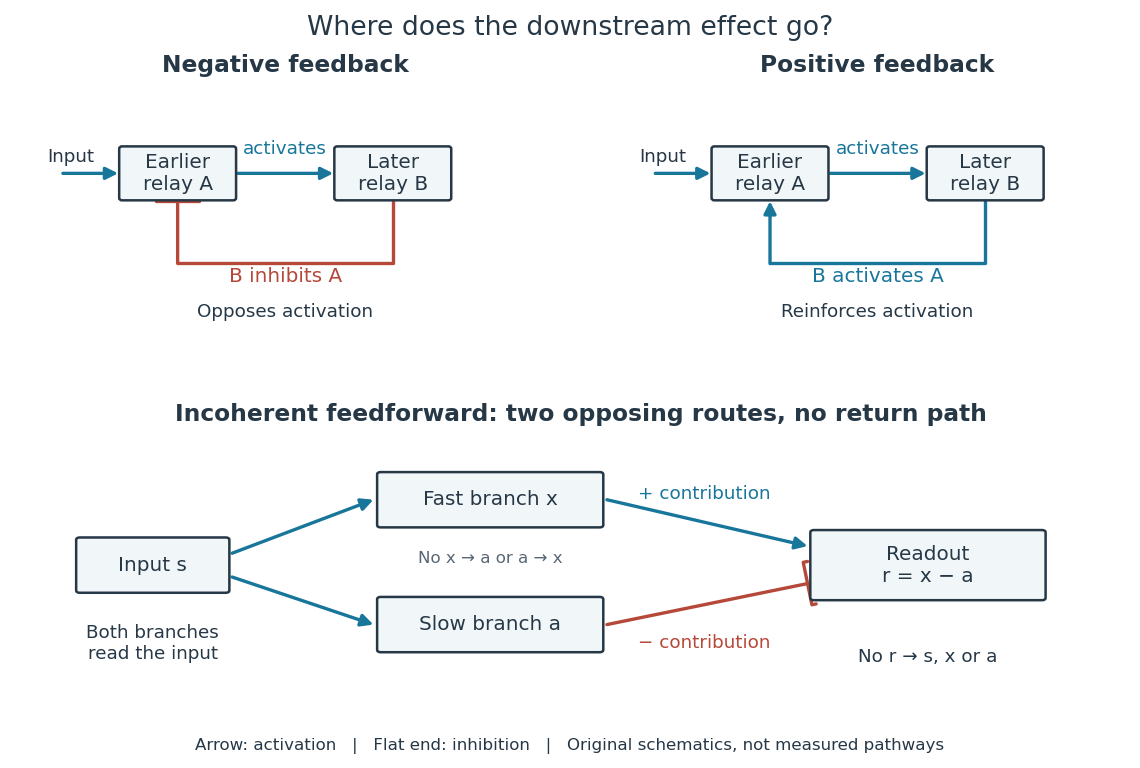

Negative feedback can restrain excessive activation and help preserve a usable range of responses. Positive feedback can support a decisive transition: Alberts and colleagues describe an enzyme whose product increases its own activity. Such reinforcement can contribute to switchlike behavior, but a positive feedback arrow alone does not prove bistability. A different structure, an incoherent feedforward loop, sends opposing influences forward from the same input; inhibition there is not a downstream return. [ref] [ref]
https://cqb.pku.edu.cn/tanglab/pdf/78.pdf. Ma et al., Defining Network Topologies that Can Achieve Biochemical Adaptation, Cell 138 (2009), pp. 760–773: definitions on p. 764
A worked mathematical model shows why negative feedback does not automatically produce complete signaling adaptation. Let be a fixed normalized input, a normalized response, a dimensionless feedback gain, and a time constant. Suppose response removal contributes and a return proportional to the response contributes . The ordinary differential equation isSetting the derivative to zero gives the equilibrium point . A displacement obeys , so its decaying exponential function establishes asymptotic stability. For a unit input switched on at , initial condition , and second,The negative feedback reduces the eventual response from to , but this response rises monotonically and never returns to its zero baseline. Attenuation and complete signaling adaptation are different properties. This deliberately simple mathematical model specifies no molecular pathway; integral action provides a contrasting way to remove a lasting offset in a stable feedback control system. [ref]
https://www.fbswiki.org/wiki/index.php/Feedback_Principles. Åström and Murray, Feedback Systems, Chapter 2: proportional and integral feedback
A hormone is a chemical messenger released by biological cells that regulates target biological cells bearing suitable receptors. In endocrine signaling, hormones travel to distant targets through the bloodstream. The extract-transfer experiment under second messenger isolates part of this signal transduction from intact biological cells. [ref]
https://openstax.org/books/biology-2e/pages/9-1-signaling-molecules-and-cellular-receptors. Clark, Douglas and Choi, Biology 2e, 9.1: hormonal signaling
Signal amplification is an increase in a specified downstream response relative to an initiating signal. In a molecular-count description, one activated component can generate or activate many downstream molecules. Repeated catalysis by an enzyme supplies a mechanism: the enzyme remains available for another chemical reaction. Successive stages can multiply the response. For a biological example, Cooper describes the epinephrine-to-glycogen phosphorylase pathway, where production of many cAMP molecules and repeated downstream protein phosphorylation provide opportunities for signal amplification. This is an example, not a claim that every signal transduction pathway has the same stages or gain. [ref]
Here is a counting toy extending the example under signal transduction. Suppose activated receptors each activate distinct relay proteins during a first interval. During a subsequent interval, each relay activates distinct target proteins. Assume enough inactive relays and targets, no shared targets, and no loss of activity during the count. ThenFor , this gives and : the target-to-receptor count ratio is . These are assumed integer counts, not measured rates or a universal physiological amplification factor. The intervals are sequential; the equations do not specify a time course.
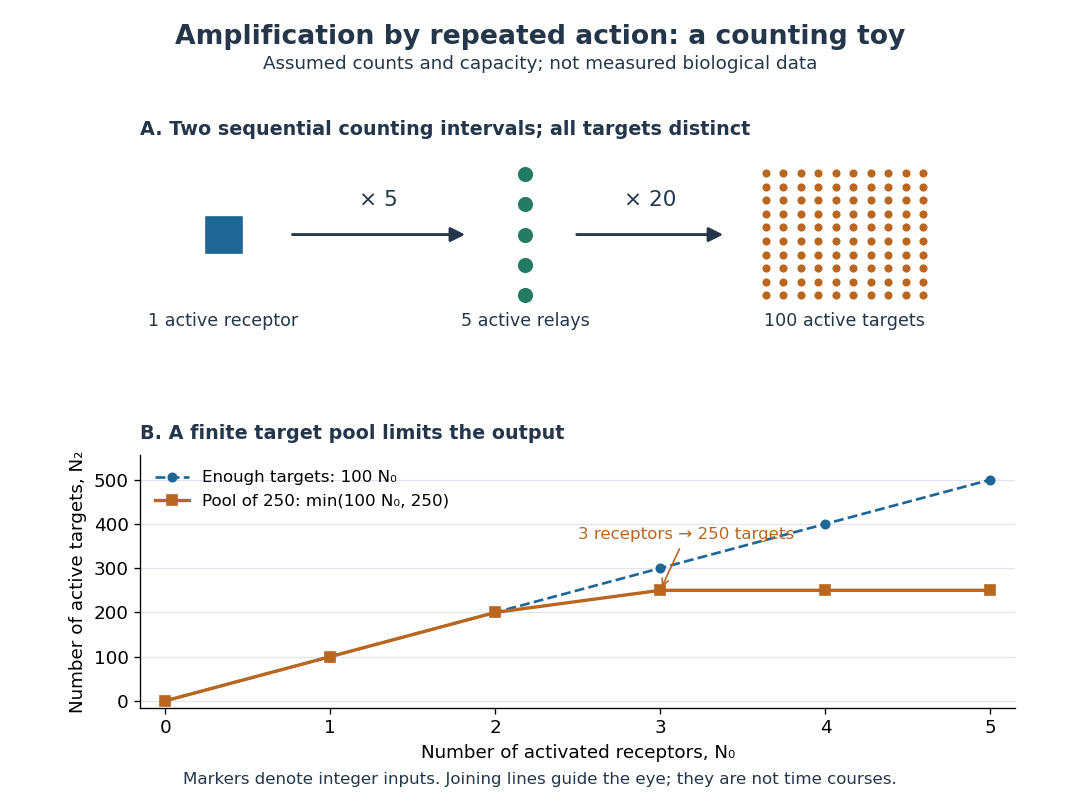

Availability limits the multiplication. As a second toy assumption, let there be only initially inactive target proteins shared by all branches, and suppose the branches can activate distinct targets until this pool is exhausted. ThenTwo activated receptors give active targets, whereas three give , not . At three activated receptors, the total count ratio is ; adding a fourth activates no additional targets. Thus total output per input and the increment caused by an extra input are different notions of gain. This finite-pool rule is an illustrative bound, not an enzyme kinetics law.
Signal amplification makes a small initiating signal capable of a larger response, but it does not supply the material or energy for downstream chemical reactions. In the second messenger transfer experiment, both stages still required added ATP and magnesium ions. Counts, changes in concentration, and changes in enzyme activity are different readouts; an amplification claim should name its input, output and observation interval. [ref]
https://doi.org/10.1016/S0021-9258(19)77422-5. Rall and Sutherland (1958), methods: production and assay of cAMP
A second messenger is a small intracellular molecule or ion that relays a received signal to target proteins. Its production, release, removal or binding changes its availability after signal reception. For a cell-surface receptor, distinguish the extracellular ligand, often called the first messenger, from the intracellular second messenger. An activated relay protein is not thereby a second messenger: the term identifies small chemical mediators, rather than every downstream component of signal transduction. [ref]
https://pubmed.ncbi.nlm.nih.gov/27481708/. Newton, Bootman and Scott, Second Messengers (2016): definition and classes
Two examples clarify what changes. A biological cell can make cAMP from ATP; alternatively, release of stored calcium ions can raise the free calcium concentration in its cytoplasm. The latter need not increase the total calcium content of the biological cell. Availability to target proteins, not merely the total amount present, carries the message. Removal and sequestration help terminate such signals. [ref]
https://www.ncbi.nlm.nih.gov/books/NBK10794/. Purves et al., Neuroscience, 2nd edition: second messengers and calcium storage
[ref]The experimental motivation is unusually tangible: can a hormone's effect be transferred to machinery that barely responds to the hormone itself? In Rall, Sutherland and Berthet's 1957 experiment, washed cat-liver particles were incubated with ATP and magnesium ions, with or without epinephrine and glucagon, two hormones. After five minutes at , the mixtures were heated in boiling water for three minutes, chilled, and separated to remove insoluble material. Small samples of the clarified extracts were transferred to a separate soluble dog-liver preparation, again supplied with ATP and magnesium ions. The readout was the change in glycogen phosphorylase activity over five minutes, not the amount of newly synthesized protein. [ref]
https://doi.org/10.1016/S0021-9258(18)65045-8. Rall, Sutherland and Berthet (1957), Figure 4 and pp. 470–471: preparation and transfer
The hormone-conditioned extract caused a larger increase in glycogen phosphorylase activity. Water, extract made without hormones, and hormones added directly to the soluble preparation produced smaller effects. These comparisons distinguish transferred activity from baseline activity, preparation effects and simple hormone carryover. [ref]
https://doi.org/10.1016/S0021-9258(18)65045-8. Rall, Sutherland and Berthet (1957), Figure 4: controls and observations
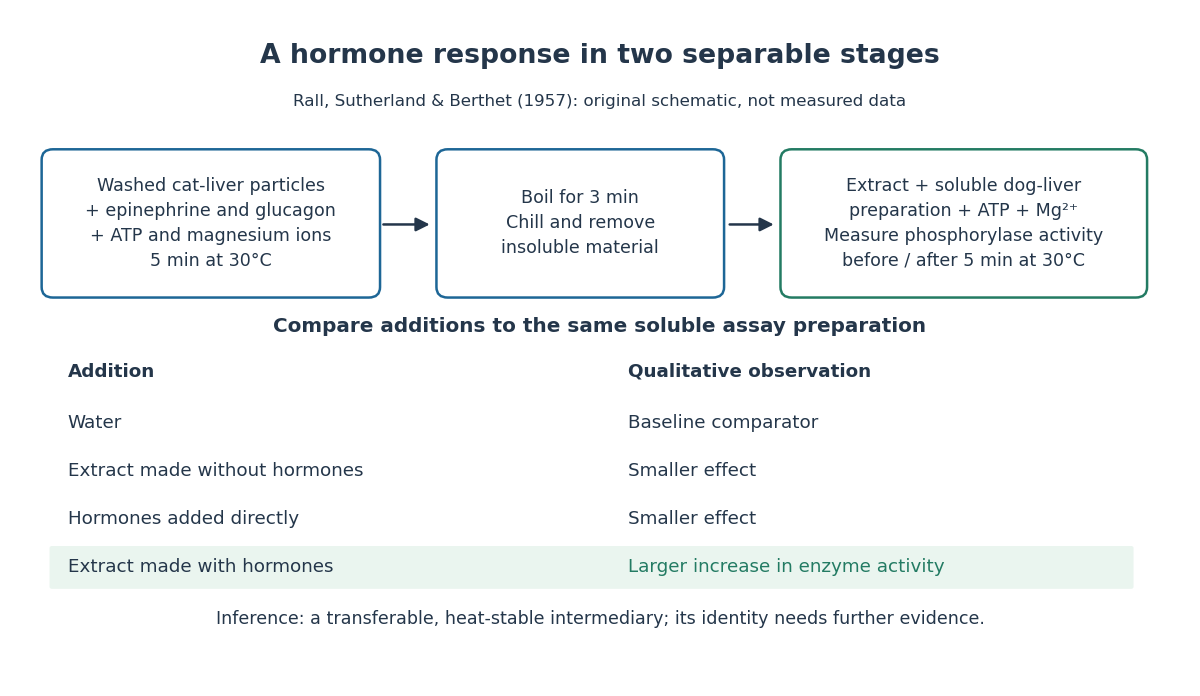

The inference is a transferable, heat-stable intermediary between the hormone-sensitive particles and the soluble machinery. This does not identify the intermediary merely from heat resistance, establish its direct target, or show that every hormone uses the same mechanism. Rall and Sutherland's 1958 paper reports the factor's identification as cAMP in accompanying chemical work, and follows its production from ATP. It also reports an important limit: washed heart and skeletal-muscle particles produced detectable cAMP with epinephrine under their test conditions, whereas brain particles produced similar amounts with and without it. Tissue and preparation matter. [ref]
https://doi.org/10.1016/S0021-9258(19)77422-5. Rall and Sutherland (1958), introduction and Table IV: cAMP identity and tissue-dependent responses
The useful and beautiful separation is between recognition and execution: an extracellular ligand can control intracellular enzymes through a chemically different intermediary. Making many second messenger molecules can support signal amplification, while different target proteins give the same mediator different consequences. A second messenger identifies a mode of relaying information; its presence alone does not specify the size or direction of the response. [ref]
https://pubmed.ncbi.nlm.nih.gov/27481708/. Newton, Bootman and Scott (2016): second messengers and their targets
A linear time-invariant system combines two properties. Linearity means that the output from a linear combination of inputs is the same linear combination of their outputs. Time invariance means that shifting an input by an integer delay shifts its output by exactly that delay. The operation has no preference for a particular time origin.
For discrete time, write the unit impulse as at and zero otherwise, a Kronecker delta. Its response is the impulse response. A finite input can be decomposed into shifted impulses, givingThe superposition principle supplies the sum and time invariance supplies the shifted copies of . Infinite sums need convergence assumptions; for a bounded input and an impulse response with absolute summability, the discrete convolution converges absolutely. For a physical system with stored initial energy, this construction describes the response with zero initial state; a separate free response accounts for nonzero initial conditions.
The gain is reuse. Measure or calculate one impulse response, and the convolution predicts the response to every allowed signal without solving a new dynamical problem each time. Alternatively, the frequency response predicts how each oscillatory component changes. [ref]
https://ocw.mit.edu/courses/res-6-007-signals-and-systems-spring-2011/0400ba59406d52d94c079d99928156ee_MITRES_6_007S11_lec04.pdf. Oppenheim, lecture 4: convolution from shifted impulses
.A linear filter obeys the superposition principle: filtering gives . Many familiar examples are also linear time-invariant systems, represented by an impulse response and convolution. Linearity alone does not imply time invariance: multiplying by the index is linear but changes its behavior when the same input is shifted.
The moving average is a finite impulse response example implemented by arithmetic; a band-pass filter can instead be built from a series RLC circuit. Their frequency responses explain which oscillations pass through. Choosing a filter means choosing how much amplitude, timing and detail may change, not simply removing every visible fluctuation.
A signal is a function or sequence representing a quantity that carries information. An electric potential difference measured over time can be written ; regularly recorded values give a discrete-time signal . The meaning includes the measured quantity, units, time reference and sampling interval. The same list of numbers sampled once per second or once per millisecond describes different physical frequencies.
An impurity that can supply an electron to the conduction band. A shallow donor has a localized occupied impurity level in a crystal near and below the conduction-band edge; thermal or other ionization releases its electron. The binding energy depends on the host dielectric response and effective mass.
An impurity that can accept an electron from the valence band, leaving a mobile hole. A shallow acceptor creates an impurity level in a crystal near and above the valence-band edge. Donor and acceptor levels are descriptions of appropriate dopants, not universal features of every impurity species.
A segment retained in the mature RNA after RNA splicing, or the corresponding segment of a gene. An exon need not encode a protein: the ribosomal RNA exons in the Tetrahymena ribozyme experiment are an example.
There are unlisted articles, also show them or only show them.