18.303 Linear Partial Differential Equations, Fall 2006 by Matthew J. Hancock The 1-D Wave Equation by  Codex 0 2026-10-13
 18.102 Introduction to Functional Analysis, Spring 2021 (lecture notes) by Andrew Lin Lecture 12: Lebesgue Integrable Functions, the Lebesgue Integral and the Dominated Convergence Theorem by Codex 0 2026-10-13
Codex 0 2026-10-13The course notes page attributes 2021 student notes to Andrew Lin and identifies Casey Rodriguez as instructor; the individual PDF has no author byline.
Cited passages: Lecture 12, Definition 120, Proposition 123(2), Remark 124 and Theorem 126; Lecture 12, printed page 59, Definitions 120–121 and Proposition 122.
18.03SC Differential Equations, Fall 2011 Direction Fields, Isoclines, Integral Curves by Codex 0 2026-10-13
Codex 0 2026-10-13By J. Peraire, S. Widnall.
Online text: ocw.mit.edu/courses/16-07-dynamics-fall-2009/dd277ec654440f4c2b5b07d6c286c3fd_MIT16_07F09_Lec26.pdf
Cited passages: J. Peraire and S. Widnall, Lecture L26, printed pages 2–3, moments and products of inertia; Lecture L26, printed page 1, velocities and angular momentum relative to the centre of mass.
The wave phase specifies position within an oscillation cycle. For a sinusoidal travelling wave,where is the wavenumber, the angular frequency and an initial phase shift. Adding to leaves the field unchanged; one complete cycle advances the wave phase by radians.
A surface of equal wave phase is a wavefront. Tracking one such surface gives the phase velocity, whereas comparing two fields at the same point gives their phase difference. Two equal-frequency disturbances add constructively when their wave phases agree and can cancel when their phase difference is . The sign assigned to a phase lag depends on the chosen time convention. In a complex amplitude, the complex argument carries this information while the modulus sets the wave amplitude.
The angular spectrum is the transverse Fourier transform of a monochromatic field on a reference plane. In a uniform medium, each transverse wavevector component propagates with a longitudinal wavenumber satisfying the Helmholtz equation. Components beyond the propagating wavenumber range are evanescent waves. The outgoing angular spectrum chooses the longitudinal branch that propagates or decays away from the plane.
An oscillation is repeated variation around a central state, such as the displacement of a mass on a spring, the pressure near a vibrating source or the electric field in a light signal. In simple harmonic motion,the amplitude , angular frequency and wave phase specify the motion. The period of an oscillation is for .
A mechanical oscillator repeatedly exchanges kinetic energy and potential energy. Damping removes mechanical energy, while a periodic applied force can replenish it and produce resonance. Not all oscillations are sinusoidal or keep constant amplitude; anharmonicity can make the period of an oscillation depend on amplitude. Measuring successive peaks in a recorded trace distinguishes the repetition time from the rate at which the envelope decays.
Polarization of waves describes the direction and time-dependent geometry of a transverse wave's vector during its oscillation at a fixed position. In three spatial dimensions, a transverse wave can have two independent directions of oscillation, both perpendicular to its direction of propagation. For polarization of an electromagnetic wave, the relevant vector is the transverse electric field; for a mechanical transverse wave, it can be the transverse displacement. A purely longitudinal wave has no choice between these transverse directions, and the orientation of a static electric field is not polarization of waves.
Choose transverse axes in a Cartesian coordinate system. A monochromatic wave with a fixed phase difference has the real electric fieldHere are wave amplitudes, is the angular frequency, and is the phase difference of the oscillation relative to the oscillation. The vector's tip traces its path during the wave period . Both plotted coordinates are real electric field components; neither axis represents the imaginary part of a complex amplitude.
For nonzero wave amplitudes, or modulo gives linear polarization: the vector moves back and forth along a fixed line. Equal nonzero wave amplitudes and modulo give circular polarization: the tip traces a circle of constant radius. Unequal nonzero wave amplitudes with give a noncircular ellipse whose axes coincide with . More generally, nonzero wave amplitudes and give elliptical polarization, with circular polarization as a special case. If exactly one wave amplitude vanishes, the nonzero wave has linear polarization for every ; if both vanish, there is no nonzero wave to assign a polarization of waves. [ref]
https://www.feynmanlectures.caltech.edu/I_33.html#Ch33-S1. Feynman Lectures, I §33–1: the electric vector of light
.For example, take , so the wave period is . The choices , and , with electric field wave amplitudes in , produce respectively the line segment , the circle and the ellipse , when coordinates are measured in . At , their tips are respectively , and . The last two share a point without having the same path.
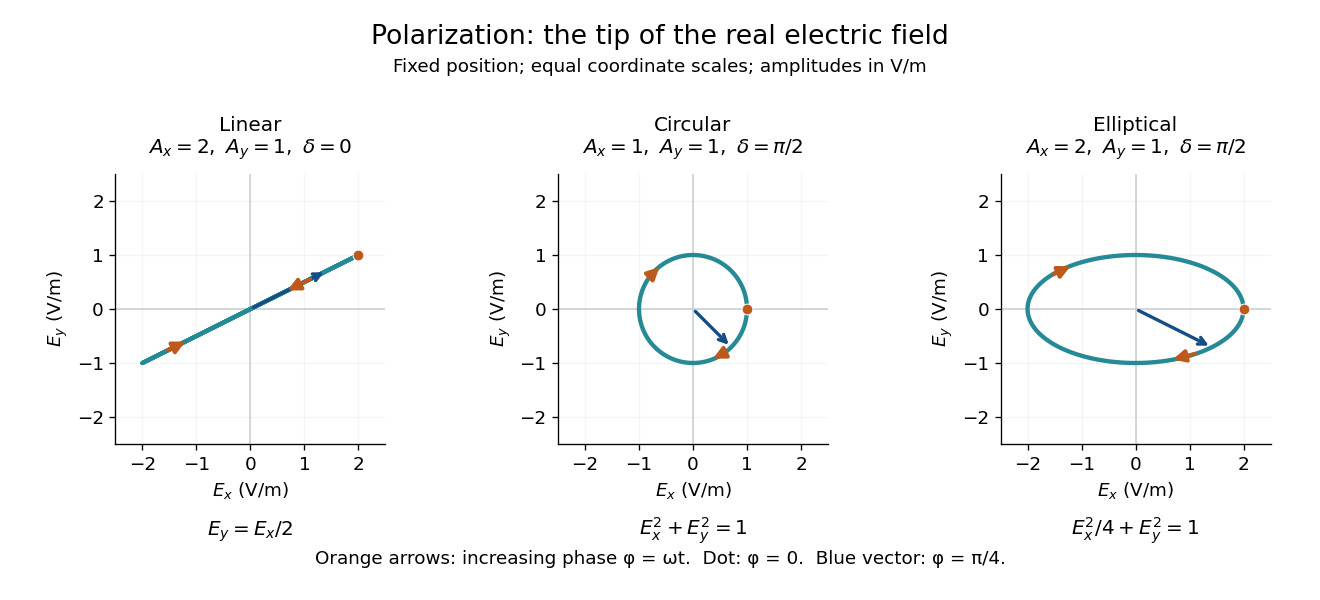
Real transverse electric field trajectories for linear polarization, circular polarization and elliptical polarization
. All panels use the same coordinate scale. Orange arrows follow increasing wave phase ; the dot marks . The blue vector is the electric field at . These are paths at one fixed position, rather than spatial drawings of a propagating wave. Details.
Resolving the electric field into two transverse components makes polarization of waves useful: the same frequency and wave amplitudes can describe different paths when their phase difference changes. An ideal linear polarizer selects the component along its pass axis, letting its orientation probe the direction of linear polarization through Malus's law. A fixed pair of wave amplitudes and a fixed phase difference describe one stable path; unpolarized light requires a statistical description rather than one fixed ellipse.
Wave intensity is the time-averaged power carried through unit area perpendicular to the transport direction. It has SI units . For a uniform beam carrying power through a perpendicular area , ; a nonuniform beam instead requires integration of its local energy flux.
For a progressive plane acoustic wave in a lossless fluid,where is the peak pressure amplitude, its root mean square, the mean mass density and the speed of sound. Doubling the wave amplitude therefore quadruples the wave intensity in the same medium. A standing wave can have large local pressure amplitude with zero net averaged sound intensity, so the progressive-wave formula must not be applied to an arbitrary field.
A monochromatic wave has one angular frequency , so its physical field can be writtenThe spatial complex amplitude contains the local wave amplitude and wave phase. It can describe a travelling wave, a standing wave, or a more complicated pattern: a single temporal frequency does not require a single propagation direction.
Exact monochromaticity is an infinite-duration idealization. A finite pulse has a nonzero bandwidth, while a sufficiently long, stable tone can be treated as approximately monochromatic over a measurement interval. This idealization is powerful because linear, time-independent equations can be solved separately at each frequency and the results recombined by a Fourier transform. A monochromatic wave is therefore a building block for broadband signals as well as a useful approximation to narrowband illumination.
A longitudinal wave has oscillating displacement parallel to its propagation direction. Push and pull one end of a long spring along its axis: compressed and expanded regions travel along the spring while individual turns move back and forth. In a small-amplitude acoustic wave in a uniform fluid, the corresponding pressure and mass density variations drive neighbouring fluid elements through pressure gradients.
For a plane acoustic wave, can describe the particle velocity along . The separation between a particle's small excursion and the distance travelled by the disturbance is essential: the speed of sound is the propagation rate, not the particle velocity. Compressional waves in an solid with elasticity provide another example; their speed depends on both the bulk modulus and resistance to shear strain. A longitudinal polarization leaves no independent choice of transverse direction of the kind available to a transverse wave.
A transverse wave has an oscillating vector perpendicular to its direction of propagation. For a mechanical string running along , a small displacement is transverse. A succession of transverse forces from the tension accelerates neighbouring string elements, carrying the disturbance along the string. Their motion is across the string while the pattern travels along it.
A plane electromagnetic wave in vacuum also has transverse electric field and magnetic field. Two independent transverse directions permit different wave polarizations, including linear polarization and circular polarization. A fluid's ordinary bulk acoustic wave is instead a longitudinal wave. A water-surface gravity wave generally combines vertical and horizontal particle motion, so its visible vertical motion alone does not make the full motion purely transverse. Marking one position on a string and filming a passing pulse makes the distinction between particle motion and pattern motion directly visible.
On , use reduced representations of rational numbers with positive denominator. This reverses the nonzero values of the Thomae function, while leaving its values at irrational numbers zero. Every interval of positive length contains rational numbers of arbitrarily large reduced denominator: there are only finitely many fractions in with denominator at most a fixed , whereas any open interval contains infinitely many rational numbers. Thus this function taking finite real number values is unbounded on every nondegenerate subinterval.
An enthalpy of solution is an enthalpy difference for dissolution into a specified solvent at stated temperature and final concentration. Keep a measured finite-dilution value distinct from an infinite-dilution reference value.
An enthalpy of atomization is the enthalpy change for making one mole of separated gaseous chemical atoms from a specified starting chemical substance. For sodium, the relevant step is sublimation to monatomic gas; for diatomic chlorine, it is half the compatible molar bond-dissociation energy expressed as an enthalpy.
The standard enthalpy of formation is the enthalpy change for forming one mole of a specified chemical substance from its chemical elements in their reference states at the stated temperature. For sodium chloride at , those reactant states are solid sodium and diatomic gaseous chlorine. Standard state specifies conditions; it does not by itself select a temperature.
Hess's law states that compatible chemical reaction enthalpies add when their equations add. Reversing a chemical reaction reverses its enthalpy change; multiplying the entire chemical reaction equation by a factor multiplies that change by the same factor. The reason is that enthalpy is a state function: intermediate states cancel from the differences. A cycle supplies one independent balance relation; it cannot determine two unknown inputs without further information.
The law is named after Germain Henri Hess.
For specified initial and final thermodynamic states, the change is . Because enthalpy is an extensive variable, a quoted reaction belongs to the amount of substance specified for each species in its chemical equation. Reversing the equation changes the sign; scaling every coefficient scales ; adding compatible equations adds their values. A per-mole value must say which chemical equation and normalization it uses. Match temperature, pressure, thermodynamic phases, chemical solution compositions and reference states before cancellation; the same formula in a gas and a liquid represents different states.[ref]
The value of Hess's law is that an inaccessible reaction enthalpy can be obtained from measurable transformations. The algebra does not require those transformations to be steps of the actual reaction mechanism. Neither an activation energy nor a reaction rate follows from the endpoint difference: a catalyst may change the reaction rate while preserving the compatible initial and final enthalpies.
A species is a named unit of biological classification. The useful criteria vary among groups: reproductive compatibility can inform classification in many animals, while microbial comparisons also use genomes and other characters. Escherichia coli is a species; K-12 MG1655 identifies a particular strain within it. See OpenStax Biology 2e, 18.2: species concepts.
A biological domain is a high-level rank used to classify organisms in the three-domain system. Distinguish a taxonomic rank from a primary branch in an inferred phylogenetic tree: retaining familiar names does not settle the branching relationships.
There are unlisted articles, also show them or only show them.