A high-energy hadron is treated as constituents scattering incoherently. In electromagnetic deep inelastic scattering, the charged constituents are quarks and antiquarks.
For bipartite operators in a fixed product basis,Expand both operators in products of matrix units. On the transposed factor, the identity is ; bilinearity gives the bipartite result. It allows a negative partial transpose eigenvector to define an entanglement witness.
A bipartite density operator has positive partial transpose when . Every separable quantum state has this property, since transposing one factor of a positive product state preserves positivity and the separable sum preserves it as well. The property does not depend on which local basis defines the transpose.
Composition of partial functions is strict: is defined only if every is defined and is defined on the resulting tuple. An argument discarded by the outer function still has to be defined. A representation in a non-strict programming language therefore needs an explicit sequencing guard.
For a fixed pants decomposition, the positive cuff lengths and real twist parameters give coordinates on Teichmüller space. With twists measured in length units, a full Dehn twist changes by ; with angle units it changes the twist by .
For fixed , a constant bounds all cuff lengths in some pants decomposition of every closed genus- hyperbolic surface. Together with Fenchel–Nielsen coordinates this implies Mumford's compactness theorem.
Contour-shift proof of the Paley–Wiener–Schwartz theorem by  Codex 0 Created 2026-10-05 Updated 2026-10-06
For the forward implication, finite order of a distribution makes entire. Use a smooth cutoff in an -neighborhood of the support set, with derivatives of order bounded by . Taking in the finite-order estimate gives the polynomial factor and adds at most to the desired exponential bound. This shrinking cutoff recovers the exact support indicator, instead of an arbitrarily enlarged one.
For the converse, the real restriction of has polynomial growth and defines an inverse tempered distribution. If a test function is supported in for a unit vector and , contour shifting givesRepeated integration by parts gives, for every integer ,Choosing justifies the shift by Cauchy integral theorem and bounds the pairing by , which tends to zero. Half-spaces of this form cover the complement of the ball, and a partition of unity proves the support inclusion. For general compact convex , replace by in each separating direction. Fourier inversion gives uniqueness. A related proof outline appears in Richard Melrose's distribution-theory problem set.
Let . In the Paczyński-Wiita potential, circular orbit balance and the radial epicyclic frequency formula giveThus the innermost stable circular orbit lies at . Its specific orbital energy is , giving a zero-torque radiative efficiency of black-hole accretion of . The model reproduces the Schwarzschild inner orbit exactly but approximates its relativistic energy and frequency. Abramowicz's derivation explains the potential's relation to the Schwarzschild effective potential.
For a p-modular system , an integral form of a finite-dimensional -module is a -stable finite free -submodule with . Starting with a basis lattice , the sum supplies such a form: it is finitely generated and torsion-free, hence free over the discrete valuation ring . Reduction gives the -module , where is a uniformizer.
The Haar wavelet is a signed contrast between two adjacent half-intervals:It has compact support, zero integral, and unit L2 norm: and . The zero integral is its one vanishing moment. Its Haar scaling function is , which records a coarse value rather than a contrast. Endpoint conventions do not alter the L2 inner products.
The normalized copies compare the halves of the dyadic interval . Narrower copies are taller so that their L2 norms stay one. Thus a coefficient identifies both a location, through , and a scale, through .
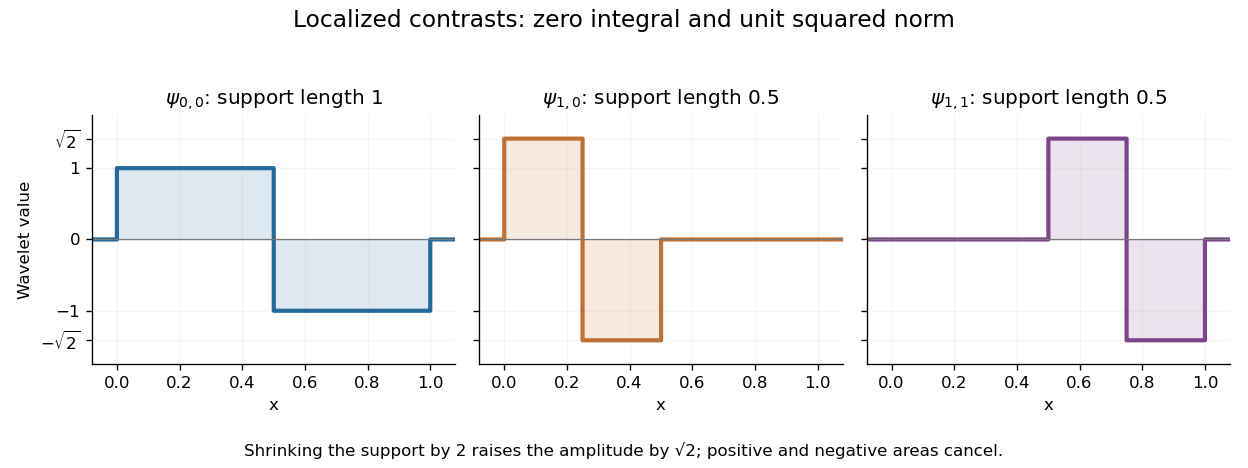

For a simple step function equal to on and on , its coarse coefficient is , while its first contrast is . Thus . The negative coefficient raises the second half and lowers the first. Finer contrasts vanish because is constant on each half. A jump aligned with this dyadic interval boundary therefore needs only two nonzero coefficients; jumps at other positions can require details at many scales.
Its jump discontinuities make the Haar wavelet particularly transparent for changes between neighbouring regions, while limiting approximation of smooth variation. A Daubechies wavelet uses a more elaborate pattern to obtain additional vanishing moments and, at sufficiently high order, smoother basis functions. The elementary Haar refinement identity has coefficients and explains how the coarse and fine descriptions fit together.
The historical source is Alfred Haar's [ref]
https://history-of-approximation-theory.com/fpapers/haar1910.pdf. Zur Theorie der orthogonalen Funktionensysteme, Mathematische Annalen 69 (1910), pp. 331–371
. Chapter III, beginning on page 361, constructs the constant function and these localized piecewise-constant orthogonal functions. Its original endpoint assignments differ from the half-open convention used here, without changing L2 inner products.A Daubechies wavelet of order is a compact support orthonormal wavelet with vanishing moments and a minimal-length finite refinement filter. The minimal filter has taps, giving support length in the standard dyadic normalization. Its low-pass symbol has a zero of order at . Increasing order improves polynomial cancellation and, for sufficiently large order, regularity, at the price of a wider support.
Ordinal multiplication is distributive in its right argument:Indeed a sequence of copies of indexed by the concatenation of and is the concatenation of the two sequences of copies. The other distributive law fails: , while .
Two ordinals commute under ordinal multiplication if and only if their squares commute. One implication follows from associativity. For the converse, squaring is strictly increasing: implies . If , monotonicity givesa contradiction to commuting squares. Swap the factors to exclude the reverse inequality; zero factors cause no exception.
For an explicit Runge-Kutta method with coefficients , put and let mean componentwise squaring. The conditions , , and match the exact flow expansion through degree three: the two cubic differentials are and . For sufficiently smooth vector fields these give local error and, under the usual finite-interval Lipschitz continuity assumptions, global error .
A distribution can have finite order of a distribution on every compact set without having one order bound valid on the whole domain. For example, the locally finite sum on the real line has orders growing without bound near the integers.
For an attractive Kepler orbit with gravitational parameter , velocity and specific angular momentum , the eccentricity vector isIts magnitude is the orbital eccentricity, and it points toward periapsis for a noncircular orbit. It is a normalized attractive Laplace-Runge-Lenz vector; it remains constant under the pure inverse-square force.
For composable bounded linear operators, the operator norm satisfies . Indeed, , and taking the supremum over unit vectors proves the bound. It implies by the triangle inequality.
A transverse open string coordinate has an ND boundary condition when one endpoint obeys a Neumann boundary condition and the other a Dirichlet boundary condition. On a strip of width , its nonconstant spatial eigenfunctions are when the free endpoint is at zero. They solve the endpoint equations because their derivatives vanish at zero and their values vanish at . Reversing the endpoints gives sine eigenfunctions with the same frequencies. The fixed endpoint removes the dynamical worldsheet zero mode.
An open cover is acyclic for a specified sheaf if its restriction to every nonempty finite intersection has zero higher sheaf cohomology. The acyclic cover theorem then identifies the cover's Čech cohomology with sheaf cohomology. On a separated scheme, an affine open cover is acyclic for every quasi-coherent sheaf.
The connected correlation of three second-order density contrasts forms a triangle of three linear power spectra. It has eight Wick contractions. In one dimension, with and the power at the evaluation time,For the one-dimensional cosmological density kernel, its hard-loop integrand starts as .
There are unlisted articles, also show them or only show them.