
Within-family Mendelian randomization uses genetic contrasts within families, such as differences between siblings. Conditioning on shared parental background can reduce population stratification and family-level sources of confounding, although the exclusion restriction and sufficient instrument relevance remain necessary.
An atom of a measure is a measurable set of positive measure for which every measurable has either or . A singleton of positive mass is an example. A transport map cannot split the mass of a singleton among several destinations.
On a measurable space , the Dirac measure at assigns unit mass according to whether a measurable set contains that point:Here is the indicator function. This is a probability measure, since . For pairwise disjoint measurable sets , at most one contains , so : countable additivity reduces to a membership test. The definition works even when the singleton is not a measurable set. [ref]
To assert that its support of a measure is exactly , assume that is a metric space and is its Borel sigma-algebra. The singleton is then a closed set and a Borel set, with . Every open neighbourhood of has mass one; every other point has an open ball of radius less than its distance from , with mass zero. Thus . An abstract measurable space has no specified topology, so this topological conclusion is not part of the bare definition. Indeed, on the sigma-algebra , all Dirac measures coincide: the available measurable sets cannot distinguish points.
The Lebesgue integral against a Dirac measure is evaluation:This holds for every nonnegative measurable function, allowing an infinite value, and for real or complex measurable functions satisfying , which are precisely the integrable functions for . For a nonnegative simple function, only the cell containing contributes to its integral; increasing simple functions and the monotone convergence theorem extend the identity. Splitting into positive and negative parts, and then real and imaginary parts, gives the remaining cases. This is why a Dirac measure turns integration into a point query.
For a measurable function , its pushforward measure satisfiesConsequently for nonnegative or integrable measurable functions . For example, on the real numbers with their Borel sigma-algebra, sends to , so integrating against that pushforward measure gives . [ref]
https://terrytao.wordpress.com/2009/01/01/245b-notes-0-a-quick-review-of-measure-and-integration-theory/. Terence Tao, 245B notes 0, Example 10 and Theorem 2(8): pushforward and change of variables
Finite weighted sums of Dirac measures give useful measures with finitely many point masses. For finite nonnegative weights ,for nonnegative measurable functions , or whenever , with zero-weight terms omitted. Repeated locations have their weights added. On the real numbers, this is the finite version of the measure underlying the left-continuous cumulative function of an atomic measure; a positive-weight singleton is an atom of a measure. Unit weights at the distinct points of a finite set recover counting measure on that set. [ref]
https://terrytao.wordpress.com/2010/09/25/245a-notes-3-integration-on-abstract-measure-spaces-and-the-convergence-theorems/. Terence Tao, 245A notes 3, Exercises 21 and 25: representation by weighted Dirac measures
The same function can have sharply different integrals for different measures. On with its Borel sigma-algebra, defineHere is Lebesgue measure and is counting measure. The singleton is a Lebesgue null set, so its changed value leaves the Lebesgue integral equal to . For counting measure on the whole interval, on an infinite set, forcing an infinite integral. On the smaller measure space with its power set and counting measure, the restricted function instead has integral .
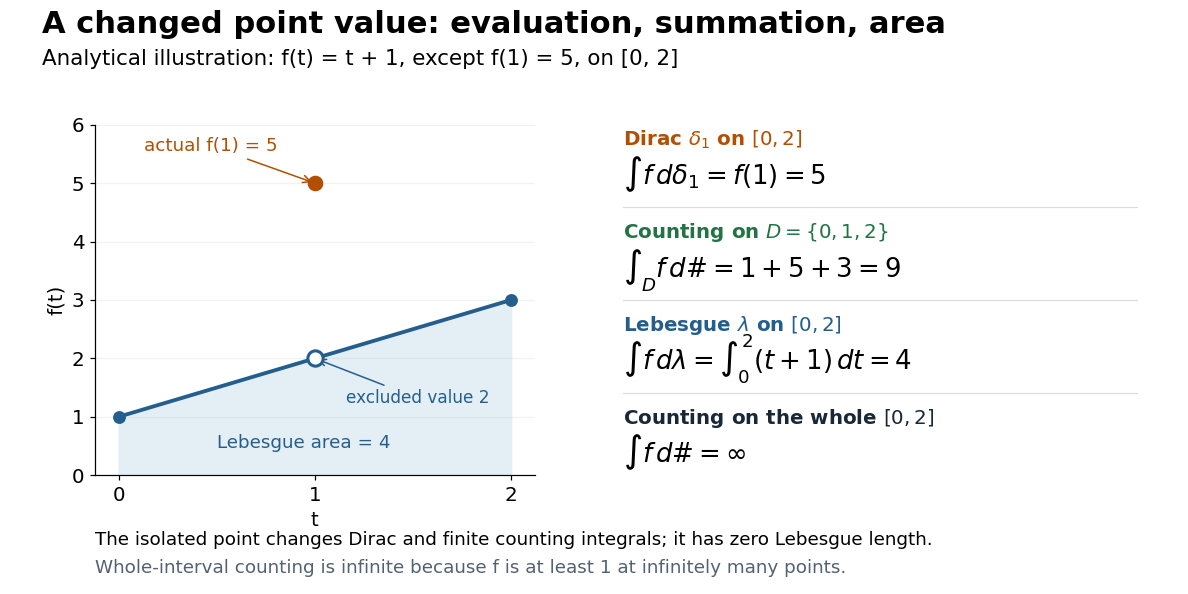

This also explains the almost everywhere convention in Lp spaces: equality almost everywhere for requires equality at , whereas equality almost everywhere for Lebesgue measure allows different values at that singleton. A point value therefore cannot be read unambiguously from an equivalence class in an Lp space formed using Lebesgue measure.
On the real numbers, a Dirac measure gives the Dirac delta distribution by for every test function. The name Dirac delta function does not mean an ordinary function that is zero away from and infinitely high at . Such a nonnegative measurable function still has Lebesgue integral zero, because its nonzero values occur on a Lebesgue null set. More generally, no nonnegative density with respect to Lebesgue measure can represent : it would give , contradicting unit mass. The measure and its associated distribution act on different kinds of inputs, namely measurable sets and test functions, but express the same point evaluation. [ref]
https://terrytao.wordpress.com/2009/04/19/245c-notes-3-distributions/. Terence Tao, 245C notes 3: Radon measures, test functions, and the Dirac delta distribution
A signed measure is a countably additive real-valued set function, allowing negative values. A finite signed measure has a variation measure, whose total mass is its total variation norm of a measure.
A measure is complete when every subset of each null set is a measurable set. Such a subset also has measure zero by monotonicity. The completion of a measure extends it to a complete measure by adjoining all subsets of measurable null sets to its sigma-algebra.
For measurable sets , a measure satisfiesReplace by the disjoint sets , use countable additivity, and then monotonicity. The same property is an axiom for an outer measure on arbitrary sets.
The join is the common refinement of two measurable partitions, with atoms given by their nonempty intersections. For a measure-preserving transformation, the block partition is .
For a countable measurable partition, its entropy is , with . This extends entropy of a finite measurable partition and is allowed to be infinite.
A partition atom is a member of a measurable partition. For a finite or countable partition, each cell is an atom of a sigma-algebra generated by that partition, whose measurable sets are unions of cells. A partition atom need not be an atom of a measure: an interval cell with positive Lebesgue measure can be split into smaller positive-measure sets that lie outside the generated partition sigma-algebra.
If is a harmonic function on a neighbourhood of , thenFor , use and the mean value property for harmonic functions. Nonnegativity lets us enlarge the integral, and the ratio of volumes is . This compares values without requiring derivative bounds.
The mean molecular weight per electron is the mass carried per free electron in units of atomic mass . Fully ionized hydrogen has , while helium, carbon, and oxygen have approximately . It converts electron number density to bulk mass density in the equation of state of a cold electron gas.
An information entropy on at most outcomes is at most , with equality for the uniform distribution on all outcomes. For the uniform reference , the Kullback-Leibler divergence is , proving the bound.
For an absolutely continuous distribution function with positive probability density function near its right endpoint of a distribution, write for its hazard function. The limits at an infinite endpoint or at a finite endpoint imply attraction to the Fréchet distribution or negative Weibull distribution, respectively. A continuously differentiable reciprocal hazard function with implies attraction to the Gumbel distribution, provided the survival function tends to zero at the endpoint.
If every directed edge capacity increases by , a cut of a flow network with outgoing edges gains . By the max-flow min-cut theorem, the new maximum flow value isFor a finite flow network, this is a nondecreasing concave piecewise-linear function, and its active cut can change as varies. Two unit-capacity edge-disjoint two-edge source-to-sink paths gain , refuting an invariably exact increase. If there is a directed source-to-sink path, every cut has at least one outgoing edge and the increase is at least ; without a path it can be zero.
A payoff matrix records the row player's gains when row meets column . In a zero-sum game the other player's payoff is the negative. For mixed strategies , the expected row payoff is .
For a four-dimensional massless supermultiplet with independent supercharges and highest helicity , level has helicity and multiplicity . The total is states and the helicity range has width , before any necessary CPT completion of a supermultiplet.
For supersymmetries and saturated two-by-two central-charge blocks, complex oscillators act trivially. A spin- Clifford vacuum therefore gives states and preserves of the real supercharges. With and a scalar vacuum, the shortened multiplet has two boson states and two fermion states, before any CPT completion of a supermultiplet.
For a specified age and irradiation, a hydrogen–helium sequence rises at low mass, has radii near Jupiter's across giant planets and brown dwarfs, and declines as electron degeneracy pressure becomes important. Above the hydrogen-burning minimum mass, sustained fusion supports a rising low-mass stellar branch.
Thinning keeps every th state of a Markov chain. The retained chain has transition kernel and the same stationary distribution. It is generally still dependent, and reducing correlation between retained draws does not by itself improve precision per original transition. Keep all post-warmup draws unless storage or later processing requires thinning; assess precision using the effective sample size of a Markov chain.
There are unlisted articles, also show them or only show them.