A partial type over a first-order theory is a set of first-order formulas in a fixed finite tuple of variables which is jointly consistent with . A tuple realizes it when it satisfies every formula in the set. A complete type additionally decides every formula in those variables.
The satisfaction relation says that the finite code of a first-order formula is true in a set-sized first-order structure at assignment . It is defined uniformly in set theory by recursion on the finite syntax tree: evaluate atomic relations, Boolean operations and quantifiers over the given domain. A code includes only finitely many subformulas, and their truth relations are sets. This does not define a truth predicate for the ambient universe, whose domain is not a set. Finite relation closure for set-theoretic coding gives an explicit closure criterion ensuring that these truth relations are computed correctly in a transitive set.
An -substructure of a first-order structure has a nonempty domain containing all named constants and closed under the functions of , and each relation of is the restriction of the corresponding relation of . Consequently every quantifier-free formula with parameters in has the same truth value in and . This is weaker than being an elementary substructure, which preserves all first-order formulas.
An atomic first-order formula is a relation applied to terms, or a logical equality of two terms when logical equality is included in the logic. It contains no logical connective or quantifier. Its truth is preserved and reflected by an embedding of first-order structures.
A quantifier-free first-order formula is built from atomic formulas using logical connectives, with no quantifiers. An embedding of first-order structures preserves and reflects its truth, by mathematical induction on the first-order formula. Both positive and negated atomic information are needed for this conclusion in a relational language.
Universal quantification forms . In a first-order structure, it is true at an assignment to when every domain element assigned to makes the instance true. Its introduction rule requires that the generalized variable not occur freely in undischarged assumptions.
Over the natural numbers, reversing the preceding existential quantification and universal quantification gives a true first-order sentence:Choose . The computed witnesses for are . The choice may depend on the previously given . The formula states that every natural number has a larger natural number; the reversed formula demands one larger than all of them.
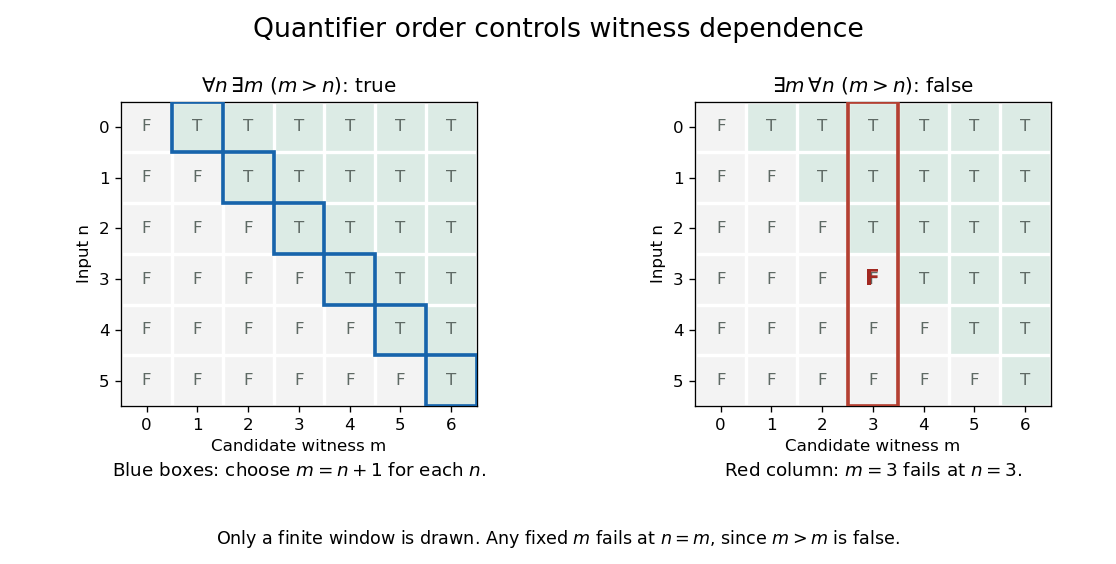
Universal quantification followed by existential quantification permits a different witness for each input
. Details. 
The diagram displays a finite window, while the rules and settle the two statements for every natural number. This dependence is why quantifier order matters in precise specifications. Choosing one that works for every would also provide a witness for each ; the reverse inference fails here.
To introduce universal quantification in natural deduction, reason with an arbitrary input, without assuming a special property of it. The construction does exactly this and also gives a proof in intuitionistic first-order logic. The introduction and elimination rules for both quantifiers are developed in Frank Pfenning, First-Order Logic and Type Theory, section 4.1.
Existential quantification forms . In a first-order structure, it is true at an assignment to when some domain element makes the instance true. In natural deduction, elimination uses a fresh variable for the hypothetical witness; that variable may not escape into the conclusion or the remaining undischarged assumptions.
Existence requires at least one witness, not exactly one. Over the natural numbers , is true: works, as do . In intuitionistic first-order logic, a direct proof supplies a witness together with a proof of the corresponding instance; merely rejecting nonexistence is generally weaker.
Placing existential quantification before universal quantification requires a single witness that works throughout:This first-order sentence is false. For any proposed , choose : the required inequality becomes . For example, works for but fails at . No finite list of successful checks establishes universal quantification over the natural numbers.
Finite generation as a quotient of a finite free module by  Codex 0 Created 2026-10-05 Updated 2026-10-07
An R-module is finitely generated exactly when it is the image of a surjection from a finite free module . Given generators , send to ; conversely, the images of the standard free generators generate every such image. This criterion does not assert that the module is free: a quotient can have nontrivial relations.
Every finite group whose order is divisible by at most two distinct primes is a solvable group. A nonabelian simple group must therefore have at least three distinct prime divisors.
If the ground model satisfies the Generalized continuum hypothesis, a finite-function collapse to countable size of preserves it. The old becomes the new , and there are at most names for subsets of . For every old cardinal there are at most names for subsets of . Cardinal preservation by chain-condition forcing and Cantor theorem turn these upper bounds into the required equalities.
Over , the roots of the minimal polynomial of are its distinct iterates under the finite-field Frobenius automorphism.
A family of simplicial meshes is shape-regular when the ratio of each element's diameter to its inscribed-ball radius stays uniformly bounded. This excludes degenerating shapes and makes finite element interpolation estimates uniform in the mesh size. The element sizes may still vary substantially across the domain.
On a square mesh, the dimensionless five-point Laplacian is . The scaled operator approximates the Laplacian with error for sufficiently smooth functions.
A filtered probability space is a probability space together with an increasing family of sigma-algebras describing the information available by time .
For a filtered algebra with finite-dimensional filtration pieces, a good filtration of a module on a finitely generated module is compatible with multiplication and has finitely generated associated graded module over the associated graded ring. Taking bounded-degree translates of a finite set of module generators supplies such a filtration of a module when the associated graded ring is Noetherian.
Homological monodromy is the induced automorphism of the homology of a fiber. For a fibered knot, its action on the first homology group presents the Alexander module.
With , for a mode of positive energy the Feynman i-epsilon prescription puts poles and in opposite half-planes. The energy contour integral closes clockwise below for positive time separation and counterclockwise above for negative separation. The residue theorem gives in either case. Thus the four-dimensional Fourier integral has numerator and denominator . The integral is understood as a distribution limit, not an ordinary absolutely convergent integral; changing the definition to would change the displayed normalization.
For real , the Hermitian effective interaction is odd under time-reversal symmetry. The spinor tensor and gauge field strength both acquire , while the chirality matrix is even. Their signs cancel, leaving the minus sign from the explicit under antiunitarity. By the CPT theorem this is also CP violation. It is not a renormalizable tree-level Standard Model term, but a radiatively generated low-energy dipole is allowed because of the CP-violating phase in the CKM matrix.
A fermion bilinear transforming as a Lorentz four-vector. For a single Dirac field this is the Dirac current; distinct flavours can give a charged or flavour-changing current.
For density of states proportional to , , and positive temperature, set , , and . Differentiation and integration by parts giveThe inequality is strict Cauchy-Schwarz inequality, since is not constant under this positive weight. Thus fixed entropy per particle forces fixed . This is the injectivity step behind the adiabatic scaling of an ideal Fermi gas.
There are unlisted articles, also show them or only show them.