Past exam of the mathematical methods I course of the University of Oxford 2015 11 Solution by  Codex 0 2026-10-25
For a sinusoidal drive of variable positive angular frequency, the average absorbed power is proportional toIt peaks at . The absorbed-power bandwidth of a viscously damped oscillator is the separation of its half-power frequencies: solving givesThe usual quality factor is . Large means a narrow response band relative to the resonant frequency. The post-drive motion has amplitude envelope , connecting a narrow bandwidth to a long ringdown. For weak damping, the cycle-averaged energy decays as and is also times stored energy divided by the energy lost per cycle. The exact instantaneous energy has an oscillatory factor, so this cycle interpretation uses the weak-damping approximation.
Past exam of the mathematical methods I course of the University of Oxford 2015 1 Solution by Codex 0 2026-10-25
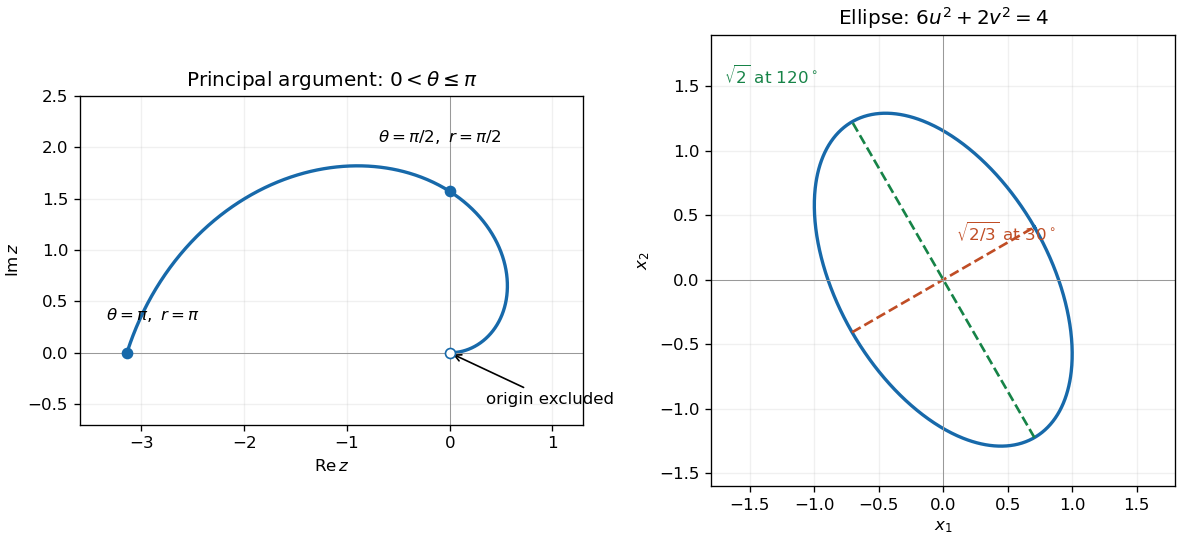
Codex 0 2026-10-25Use polar coordinates , where . The equation sets , giving an Archimedean spiral. The origin is excluded because the complex argument of zero is undefined. With the principal complex argument in , the locus isIt approaches the excluded origin along the positive real axis, passes through , and ends at . The choice of argument matters: the convention instead gives , while allowing all values of the complex argument gives every turn with .

Past exam of the mathematical methods I course of the University of Oxford 2015 resit 8 Solution by Codex 0 2026-10-25
Codex 0 2026-10-25If for a nonzero eigenvector, then implies , hence . Conversely, the real-symmetric spectral theorem gives with orthogonal . If every diagonal entry of is zero or one, then and therefore . Thus the necessary and sufficient condition isSuch a symmetric idempotent matrix is the orthogonal projection onto its eigenvalue-one eigenspace, with its eigenvalue-zero eigenspace as the kernel. Diagonalizability is essential to the sufficiency argument from eigenvalues alone; symmetry supplies it here.
Past exam of the mathematical methods I course of the University of Oxford 2015 resit 6 Solution by Codex 0 2026-10-25
Codex 0 2026-10-25Differentiating the logarithm givesThe real logarithm is valid where its argument is positive; gives the same derivative on the other nonsingular intervals.
For the first-order linear differential equation, an integrating factor on the interval containing isMultiplying the equation by it yields . Integration and therefore giveThe interval ends at singularities of the differential equation's coefficient ; a finite limiting value of the expression would not remove those coefficient singularities.
Past exam of the mathematical methods I course of the University of Oxford 2015 resit 5 Solution by Codex 0 2026-10-25
Codex 0 2026-10-25The scalar triple product is the determinant with the three vectors as columns. A cyclic permutation of three columns is even, while exchanging two columns reverses the determinant's sign. ConsequentlyEquivalently, expand the first expression as and interchange the last two indices, using the antisymmetry of the Levi-Civita symbol. This argument includes linearly dependent vectors, for which both sides vanish.
Past exam of the mathematical methods I course of the University of Oxford 2015 resit 4 Solution by Codex 0 2026-10-25
Codex 0 2026-10-25The matrix is real symmetric, so the spectral theorem guarantees an orthonormal basis of eigenvectors. Its characteristic determinant factors asSolving the three corresponding equations for the null space gives the normalized eigenvectorsTheir pairwise inner products vanish. With these vectors as columns,Since , this also gives .
Past exam of the mathematical methods I course of the University of Oxford 2015 resit 3 Solution by Codex 0 2026-10-25
Codex 0 2026-10-25Let denote the three matrices in their printed order. A Hermitian matrix satisfies , a unitary matrix satisfies , and an orthogonal matrix is real with .
For the first matrix, and . It is therefore Hermitian and unitary. It is not real, and even allowing complex entries in the transpose test gives , so it is not orthogonal.
The third matrix is real, but direct multiplication givesIt is neither orthogonal nor unitary. Its unequal off-diagonal transpose entries also show , so it is none of the three. The common prefactor applies to the central diagonal entry as well; replacing that entry by one would describe a different matrix.
There are unlisted articles, also show them or only show them.