Past exam of the computer science course of the University of Oxford 2021 Artificial intelligence 3 f Solution by  Codex 0 2026-10-25
Use backward deletion of achieved goal requirements; this decides precondition-free ground STRIPS planning in polynomial time. Let be the initial set of true facts, the positive conjunctive goal set and the ground actions. Assume the usual disjoint add and delete lists; if both lists contain a fact, first normalize the net effect according to the action semantics.
Maintain residual goal set and an initially empty list . While , look for an action satisfyingIf no such action exists, reject. Otherwise record in and replace by . When , return the actions in reverse order of recording. All actions are applicable because their precondition sets are empty.
For soundness, the selected action can be put last in a plan for the current residual goals: it supplies the removed goals and deletes none of the goals still being required. Reversing all recorded selections makes the final state satisfy the original .
For completeness, suppose is not already satisfied initially but a plan achieves it. Consider the last action in that plan that changes any fact of . Its effective changes cannot delete any member of , because no later action repairs it; it must add at least one member. Thus a candidate exists. Moreover any candidate chosen by the algorithm is safe: removing some requirements gives a subset of , so a plan for , if one exists, also establishes the smaller goal set. Appending the chosen last action then restores the removed requirements without harming the rest. Mathematical induction therefore preserves solvability during all choices.
Each successful iteration removes at least one residual goal, so there are at most iterations and the returned plan has at most actions. Scanning all actions and their effect lists per iteration is polynomial in the input size, for example with simple fact-set representations over . Merely taking the union of all add effects would be unsound, since actions can delete each other's achievements. This algorithm is the last-achiever algorithm for precondition-free planning.
Past exam of the computer science course of the University of Oxford 2021 Artificial intelligence 3 e Solution by Codex 0 2026-10-25
Codex 0 2026-10-25Use balls , buckets , transition index and the grounded action schemas from (a). Under a sequential encoding, one example successor-state axiom isBall is in bucket afterwards exactly when it is dropped there now, or it was there and is not picked up. Actions involving other balls or arm movement leave this fact unchanged. This is both an effect rule and a persistence rule, rather than an implication that permits spontaneous appearances.
An example action precondition axiom isA selected pick action must have the ball, arm and empty hand in the appropriate current state. The static type conditions have already been satisfied by action grounding.
An example action exclusion axiom isThe single arm cannot pick up both balls in one step. For a serial encoding include such an exclusion for every pair of distinct action occurrences at one layer; with at-most-one rather than exactly-one actions, a layer may idle. Initial-state clauses, goal clauses and corresponding successor-state axioms for all other planning fluents complete the plan-as-SAT construction. The plan-as-SAT approach was introduced by Henry Kautz and Bart Selman in 1992.[ref]
Planning as satisfiability by Henry Kautz and Bart Selman. ECAI 1992, pp. 359–363; author-hosted publication listing
Past exam of the computer science course of the University of Oxford 2021 Artificial intelligence 3 d Solution by Codex 0 2026-10-25
Codex 0 2026-10-25A sufficient sequential bound is for any physically valid initial and goal states, assuming every bucket is directly reachable. A goal must be consistent with the stated one-hand and one-location invariants. No bound can guarantee a satisfying plan for an inconsistent goal, such as requiring the same ball in two buckets simultaneously.
Here is a constructive bound independent of the number of buckets. If the hand initially holds a ball, drop it in the current bucket, costing at most one action. For each ball that should end in a bucket, move to its current bucket, pick it up, move to its target bucket, and drop it: at most four actions per ball, omitting unnecessary actions. If the final state requires a held ball, reserve it for last, move to its current bucket and pick it up, costing at most two more actions. Finally move the arm to its prescribed final location, costing at most one action.
If the final hand is empty, this costs at most . If it holds a ball, only balls need bucket placement, giving at most for . Thus the common bound is valid. A partially specified, physically consistent goal can first be completed to a valid target state. For the special goal of putting all balls in one bucket with no specified final arm location, is already a sufficient bound.
Past exam of the computer science course of the University of Oxford 2021 Artificial intelligence 3 c Solution by Codex 0 2026-10-25
Codex 0 2026-10-25There are distinct ground actions, or time-indexed action variables over transition steps. Each of STRIPS's pick and drop action schemas has type-correct instantiations. A move chooses an ordered pair of distinct buckets, giving . Every physical action is a ground action before it receives a time index in SATPlan.These counts exclude static type checks after action grounding and exclude optional persistence/no-op action symbols. Using successor-state axioms supplies persistence without separate no-op action variables. If one action occurrence is allowed per layer, it is selected from the same ground-action set; a parallel encoding also begins with these physical ground actions, but has a different exclusion policy.
Past exam of the computer science course of the University of Oxford 2021 Artificial intelligence 3 b Solution by Codex 0 2026-10-25
Codex 0 2026-10-25Label the balls and buckets . Ignoring unchanged static type facts, the initial state's true planning fluents areExpanding it produces exactly three successors. The held ball makes false, so neither ball in bucket can be picked up yet.
For , replace by and ; the arm stays at bucket . All four balls are then in buckets, with in and in .
For , similarly replace only the arm-location planning fluent by . The arm is now over the destination while still holding ; it has not yet dropped that ball.
No other action is applicable: the other drop locations fail their arm-location precondition, no pick has an empty hand, and moves from another source bucket fail their source-location precondition. None of these three successors satisfies . This describes one forward state-space planning expansion, not an assertion that the search has already found a complete plan.
Past exam of the computer science course of the University of Oxford 2021 Artificial intelligence 3 a Solution by Codex 0 2026-10-25
Codex 0 2026-10-25Use location, holding and hand-capacity planning fluents, together with static object types. Write , , and for a ball's bucket, the held ball, the arm's location and an empty hand. Static predicates , and identify types and distinct buckets. The latter can equivalently be a action grounding restriction.
For typed parameters, the STRIPS actions areUntyped notation adds the appropriate and facts to every precondition set. Static type and inequality facts have no add or delete effects. A state is a set of true ground facts under the closed-world assumption, and an applicable action produces .
Start from a physically valid state: each ball is in exactly one bucket or held; at most one ball is held; the arm is at exactly one bucket; and is true exactly when no ball is held. The operators preserve these planning state invariants. In particular, picking requires an empty hand, dropping releases the held ball, and moving deletes the old arm location. Moving while holding a ball is permitted, so a separate carried-ball movement action is unnecessary.
Past exam of the computer science course of the University of Oxford 2021 Artificial intelligence 2 g Solution by Codex 0 2026-10-25
Codex 0 2026-10-25Choose one global direction and impose it on every adjacent pair. Keep , introduce , and impose for each the relationBecause the same occurs everywhere, transitivity gives either a strictly increasing whole sequence or a strictly decreasing one. Choosing independently between and at each edge would merely require adjacent values to differ and would incorrectly allow zigzags.
If a binary formulation is required, replace each ternary relation by a hidden-variable encoding. Add a variable with domainUse three binary constraints: the sign component of equals , its first numeric component equals , and its second equals . These enforce exactly the relation above while leaving the original variable domains unchanged. Each auxiliary domain has values.
Past exam of the computer science course of the University of Oxford 2021 Artificial intelligence 2 f Solution by Codex 0 2026-10-25
Codex 0 2026-10-25There is exactly one solution: for . Strict increase makes all values distinct. Since all lie in the -element domain , they must use every value, and their increasing order fixes their positions.
Equivalently, by propagation from the lower endpoint, and by propagating backwards from . For general , choosing any -element subset determines one increasing solution, giving the binomial coefficient ; the case gives .
Past exam of the computer science course of the University of Oxford 2021 Artificial intelligence 2 e Solution by Codex 0 2026-10-25
Codex 0 2026-10-25This is a graph colouring constraint satisfaction problem, with four available colours and one fixed colour. Interpret slot labels as colours. Every conflict edge requires distinct endpoint colours, exactly as in proper graph colouring; independent sets of vertices can share a slot. The unary restriction on fixes its colour to .
The lecture's 3-colouring problem is the same construction with domains . For the present graph under the assumptions in (a), the clique prevents a 3-colouring, while (c) supplies a 4-colouring. The fixed colour on does not otherwise change existence, since an unconstrained colouring can have its colour names permuted to put in colour .
This four-colour necessity is conditional on the explicit overlap. Removing that one edge permits, for example, the 3-colouring ; the four-slot schedule remains valid in either model. Thus attendee modelling, rather than the mere availability of four slots, determines the required number of colours.
Past exam of the computer science course of the University of Oxford 2021 Artificial intelligence 2 d Solution by Codex 0 2026-10-25
Codex 0 2026-10-25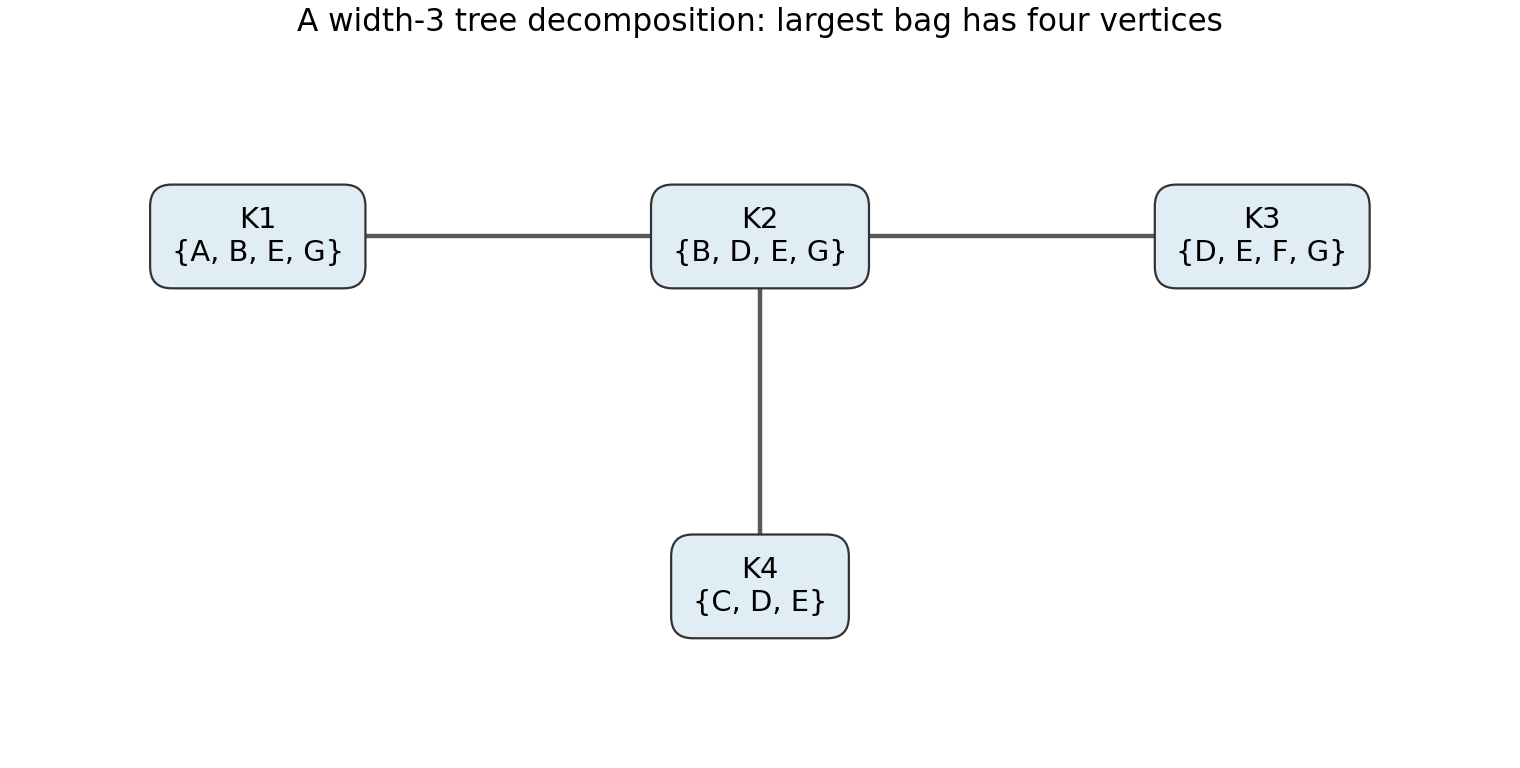
Every graph vertex occurs in a bag and every constraint edge has both endpoints in some bag. The bags containing any fixed vertex form a connected connected subgraph of a tree: occurs in , in , in , and in all four. The remaining vertices occur once. Hence the running-intersection condition holds. The maximum bag size is four, giving width .
Past exam of the computer science course of the University of Oxford 2021 Artificial intelligence 2 c Solution by Codex 0 2026-10-25
Codex 0 2026-10-25A solution is . Here is a backtracking search with forward checking, listing the chosen value order rather than assuming ascending values. No backtrack is needed on this branch.
Start with the constraint domains in (a). Assign ; remove from . Choose ; remove from each remaining neighbour. Now both have domain and each have . Choose . Its inequality removes from , forcing , and also removes from , leaving . Assigning removes from , leaving .
Choose . The edge reduces to ; makes no further deletion because is already absent from . Choose and then . All variables are assigned, and every constrained pair has different values.
| Slot | Talks in parallel |
|---|---|
Past exam of the computer science course of the University of Oxford 2021 Artificial intelligence 2 b Solution by Codex 0 2026-10-25
Codex 0 2026-10-25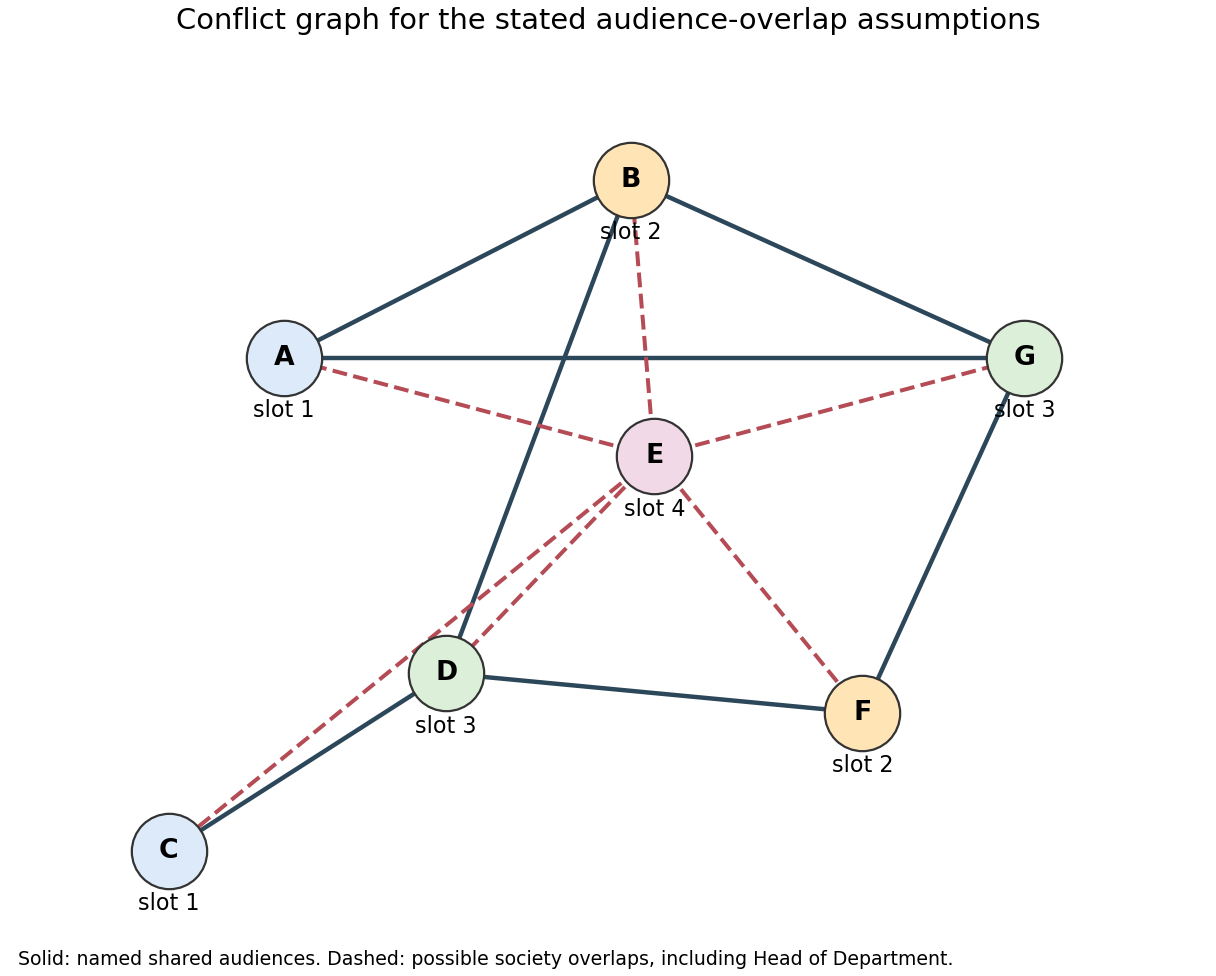


Past exam of the computer science course of the University of Oxford 2021 Artificial intelligence 2 a Solution by Codex 0 2026-10-25
Codex 0 2026-10-25Use seven variables , with and every other constraint domain . Each conflict is a binary constraint .
The audience assumptions are part of the constraint satisfaction problem. Talks occupy whole common-length slots, room capacity and travel times impose no additional restrictions, and different CS year cohorts do not overlap. Physics attendees are treated as separate from those cohorts and the Head of Department. To protect possible society overlaps, assume society members occur in each relevant student cohort and that the Head of Department may also need to attend . No additional overlap between otherwise distinct audience groups is assumed. These are declared modelling choices, rather than claims about the actual membership of any group.
The shared-audience restrictions give the edge pairsFor example, the Head of Department's three introductions produce all three pairwise inequalities on ; the Physics audience gives . The possible society overlaps addTogether these thirteen inequalities and give a binary formulation. There is no need for an all-different constraint on all seven variables: compatible talks may run in parallel. At least two rooms suffice for the solution below.
If the Head of Department is stipulated not to attend , remove just ; the exhibited schedule remains valid. If actual society membership excludes a specified cohort, remove its corresponding additional conflicts too. This separation makes clear which restrictions are direct requirements and which protect assumed overlapping attendance.
Past exam of the computer science course of the University of Oxford 2021 Artificial intelligence 1 j Solution by Codex 0 2026-10-25
Codex 0 2026-10-25Solve the finite state graph by winning-set fixed-point iteration, treating positions outside both winning regions as draws. A naive recursive minimax search over histories may run forever around a cycle. Store each ownership-sensitive state once, with a player-to-move flag and all legal successors.
Let and be terminal states where the propositional formula is true and false, respectively. Initialize . Repeatedly add nonterminal positions as follows:For , start at and exchange the players in the existential and universal conditions. Terminal states keep their original labels and are excluded from these predecessor rules, avoiding a vacuous all-successors test at a terminal loss. Each process stabilizes after at most strict growth steps; predecessor counters implement both regions via the winning-position attractor in an infinite game construction in graph time.
The admission round supplies a decreasing rank. At a state controlled by the winning player, choose a successor of smaller rank; at an opposing state, every successor already has smaller rank. Hence these strategies force a finite terminal win. The two winning regions are disjoint. Outside both, each player can keep the play outside the opponent's winning region, so neither can force a terminal win against best defence. Under the convention in (h), assign those remaining positions value ; the other regions have values and .
This is a finite reachability game calculation, with memoryless strategies read from successor choices. Merely calling the first back-edge encountered a draw is unsound: a cycle can have an exit through which one player can force a win.
Past exam of the computer science course of the University of Oxford 2021 Artificial intelligence 1 i Solution by Codex 0 2026-10-25
Codex 0 2026-10-25For , depth and history-tree size can be infinite, while a sufficient finite state bound is . The number of possible completed histories also becomes unbounded. With variables , first let assign and assign . Both can then keep flipping their own variable, leaving unassigned. After four such flips the same assignment, ownership and player-to-move recur. Arbitrarily many repetitions can precede assignment of , so there are infinitely many distinct finite complete histories as well as legal infinite plays.
A state must now record ownership: for each variable the possibilities are unassigned, -owned false, -owned true, -owned false, and -owned true. Include the player to move, since flips break the old link between turn parity and the number assigned. This givesMany encoded positions are unreachable, so this is an upper bound. Each nonterminal state has at most legal moves: two assignments per unassigned variable and one flip per variable owned by the acting player. Thus the finite directed graph has at most edges even though its unrolled game tree is infinite. The possible final Boolean valuations are unchanged, but they no longer count distinct plays or complete ownership states. For , no player gets a legal opportunity to flip before all variables are assigned, so the original finite bounds still apply.
Past exam of the computer science course of the University of Oxford 2021 Artificial intelligence 1 h Solution by Codex 0 2026-10-25
Codex 0 2026-10-25 Past exam of the computer science course of the University of Oxford 2021 Artificial intelligence 1 g Solution by Codex 0 2026-10-25
Codex 0 2026-10-25Depth ; at most complete plays; partial-assignment states; and tree nodes. Here “different games” means complete move histories for the fixed propositional formula, rather than different syntactic formulas or merely different terminal Boolean valuations.
At depth , the players have chosen an ordered list of distinct variables and a truth value for each, givingThus complete histories number : variable orders and assignments. Different variable orders can reach the same terminal Boolean valuation, of which there are only .
For a game state, each variable is unassigned, false or true, giving possibilities. Ownership and variable-assignment order are irrelevant in this version, and the next player is determined by the parity of the number already assigned. The full game tree, which keeps histories separate, hasThe depth counts edges; there are levels. These bounds explore the full tree even when a formula's truth might be inferable from a partial assignment, since the stated stopping rule waits for all variables.
Past exam of the computer science course of the University of Oxford 2021 Artificial intelligence 1 f Solution by Codex 0 2026-10-25
Codex 0 2026-10-25Minimax search applies because this is a finite, deterministic two-player zero-sum game with perfect information. Each move assigns a previously unassigned Boolean variable, so play terminates after exactly moves. Both players observe the whole partial Boolean valuation, and there are no chance moves. Give terminal positions payoff when the propositional formula is true and when it is false, measured for . At an -node take the maximum child value and at a -node the minimum. Backward induction then computes the winner and a corresponding winning strategy.
There are unlisted articles, also show them or only show them.