
For a compact flat Riemannian manifold , the translations in form a normal full-rank Euclidean lattice of finite index. The quotient is its finite linear holonomy. Affine conjugacy of the torsion-free crystallographic groups classifies these manifolds up to affine diffeomorphism. An abelian must consist entirely of translations: commuting with every lattice translation forces each linear part to fix a spanning set of .
On a compact flat Riemannian manifold, the integrated Bochner identity for Killing vector fields makes every Killing vector field parallel. Parallel vector fields are exactly the fixed vectors of the linear holonomy. Thus the six orientable closed flat three-manifold types have identity-component isometry dimensions three for the torus, one for each cyclic nontrivial holonomy, and zero for the Hantzsche-Wendt manifold.
Embed a sheaf of abelian groups into the sheaf by all its germs. Restrictions are projections, so is flasque. Repeat on the successive sheaf cokernels to obtain a canonical flasque resolution. Its complex of global sections computes sheaf cohomology. When is itself flasque, the flasque-kernel section-lifting lemma makes every successive quotient flasque and makes the global-section complex exact in positive degrees, proving for without assuming that vanishing in the construction.
For a steady forced Fourier mode with , coupled viscous and magnetic response gives and . Their mean-field electromotive force contains both forcing helicities and a possible weighted cross-forcing correlation. Jointly isotropic forcing removes the latter; its vanishing at zero mean field alone is insufficient for anisotropic forcing.
For background shear and uniform field , first-order smoothing gives the magnetic shearing-wave amplitude equationIf magnetic relaxation is fast compared with shear, after free transients decay. Thus the doubled Fourier-mode electromotive quantity is , where . The spatially averaged mean-field electromotive force of real waves has an extra factor . Using the helicity invariant of an inviscid shearing wave, and assuming the approximation holds uniformly in time with , givesIndeed , , and substitution uses .
For a locally uniform mean magnetic field, first-order smoothing solves . Inserting its causal diffusion propagator into the mean-field electromotive force and taking the trace of the isotropic response tensor gives the displayed relation to kinetic helicity. When diffusion during a correlation time is negligible, it reduces to . At small magnetic Reynolds number, a quasistatic monochromatic velocity instead gives . The effective correlation time and diffusion weighting should not be silently discarded.
Three equal-amplitude transverse waves along orthogonal axes, with the same circular polarization, each satisfy , . Distinct spatial phases have zero cross averages. The periodic first-order smoothing response to a uniform test field satisfies . Writing , the response is . Since , summing yields the displayed isotropic alpha effect. It includes the resistive and temporal weighting absent from an unqualified instantaneous helicity rule.
The symplectic canonical class is the negative First Chern class of the tangent bundle for a compatible almost complex structure. The contractibility of compatible almost complex structures makes it independent of that choice. It is the class appearing in the symplectic adjunction formula.
Introduce a variable for every nonempty and the homogeneous equations for . In their matrix , partition the columns by the displayed blocks. For each , the vector with coordinate exactly when lies in the kernel of a linear map of . Its nonzero coordinates occur in and earlier blocks only; every coordinate in is one. Hence the first block's column sum is zero and every subsequent block sum is in the linear span of earlier columns. The columns condition holds, so Rado's theorem forces a positive monochromatic solution, and all nonempty finite sums of its singleton coordinates have the same colour.
A finite deterministic Turing machine can be represented by a finite semigroup presentation whose generators are tape symbols, state symbols, a boundary marker , and an accept symbol . Defining equalities replace the local scanned symbol and state according to machine instructions, with separate boundary cases for implicit blanks. Only terminal-state equalities erase tape letters and then replace by . A derivation from an initial description to must encounter a terminal state before its first erasure. Simulation equalities preserve halting membership in either direction: for a deterministic transition , halts if and only if halts. Thus reverse use of defining equalities cannot create a false halting certificate. Boundary and erasure rules require explicit checking for every chosen encoding.
Suppose is an open normal subgroup of a pro-p group and has a finite pro-p presentation. Choose lifts of generators of the finite quotient . Add finitely many relators giving their conjugation and inverse conjugation on the generators of , and replace each quotient relator by its value in . The resulting finite finite pro-p presentation maps onto . Its closed subgroup generated by the kernel generators is isomorphic to , and its quotient by that subgroup is exactly , so the map is also injective.
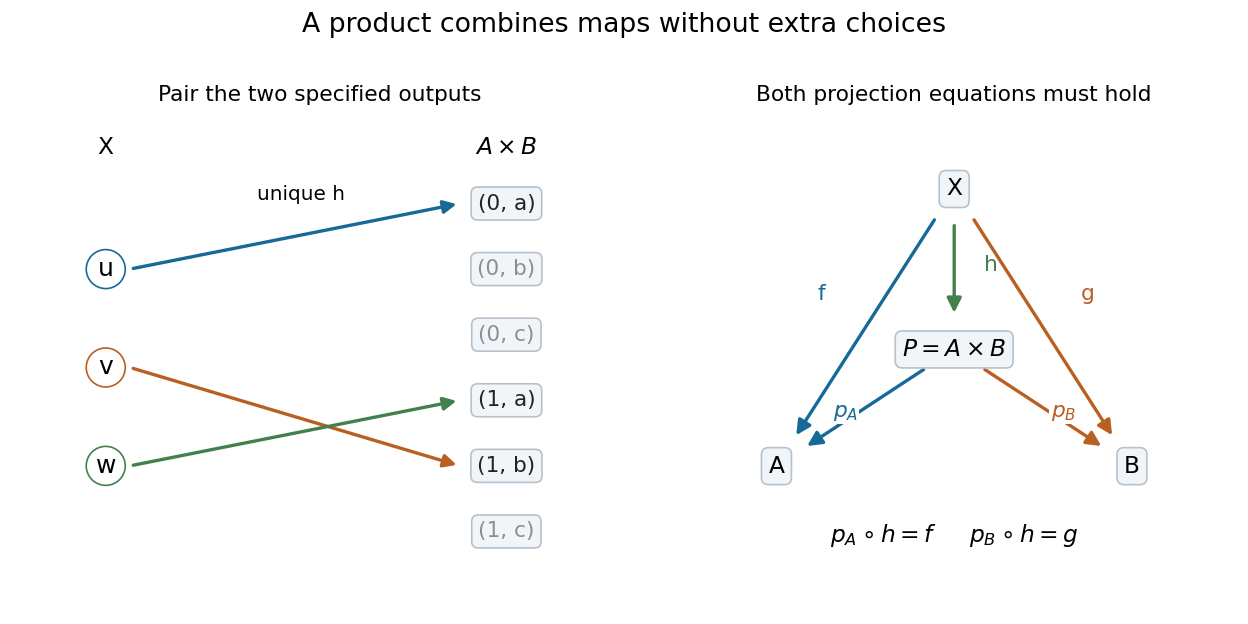
A binary categorical product of objects of a category is an object with categorical morphisms and . Its universal property is that, for every object and pair of arrows , , there is exactly one arrow satisfyingThe arrows are called the product projections. Existence lets us combine two maps; uniqueness means there is no extra unspecified information in the combined map.
In the Category of sets, take and . Their Cartesian product contains six ordered pairs, and the projection maps select the first and second coordinates. Let , , , , and , , . The unique required map is , , . Reading either coordinate recovers the corresponding input map.

In a partially ordered set viewed as a category, the projection arrows mean and . The universal property says that every common lower bound satisfies , so is the greatest lower bound. For subsets ordered by inclusion this is , the intersection; it is a different construction from the Cartesian product in the Category of sets because the allowed arrows have changed.
The universal property also compares any two proposed products: each supplies a unique map to the other compatible with the projections. The two composites have the same projections as the corresponding identity morphisms, so uniqueness makes them identities. Thus a categorical product is determined up to a unique projection-preserving isomorphism, which explains why we can use whichever concrete construction is convenient.
In the finite-limit convention, a Cartesian category is a category with all finite limits, equivalently a terminal object and all pullbacks in a category. Some authors use the term for finite products alone, so the convention matters in constructions requiring equalizers.
A terminal object and pullbacks in a category give binary products by pulling back the two terminal maps. The diagonal is the equalizer of the product projections; pulling it back along gives an equalizer of any parallel pair. A finite diagram then has a categorical limit as the equalizer of two maps from the product of its object values to the product of its arrow targets. The two maps encode source-image and target projections, so the equalizer enforces every cone equation.
For , , and , the joint distribution function is . The Brownian reflection principle gives killed endpoint density at zero drift. Multiplication by and completion of squares gives the formula.
In a complete finitary abelian category, the comparison with diagonal matrix entries the identity and off-diagonal entries zero is monic. Express its source as the directed colimit of finite biproducts. Their maps into the product have finite-coordinate retractions and are therefore split monomorphisms; the finitary axiom applies to this cocone. If the category is also cofinitary abelian category, duality makes epic and hence invertible. For countably many copies of any object, the shift-and-fold argument in countable biproducts in an additive category force triviality then forces the identity to be zero, so every object is a zero object.
A negative filtration of a ring has for nonnegative indices. It is complete and separated when the displayed map to the inverse limit is an isomorphism. Products make two-sided ideals. Series whose terms eventually belong to every converge. In particular, for and , the geometric series inverts , so the unit criterion for the Jacobson radical gives .
For two closed subschemes of a scheme , their intersection is their fiber product of schemes over . On an affine chart, ideals give the quotient by . This retains nonreduced structure and intersection multiplicities which a set-theoretic intersection would lose.
There are unlisted articles, also show them or only show them.