
For a finite-range isotropic Heisenberg model, the Mermin-Wagner theorem excludes spontaneous magnetic order in one dimension at every nonzero temperature. Long-wavelength rotations cost very little energy: a smooth orientational fluctuation has , so its thermal variance contains , which diverges in the infrared. In a Heisenberg ferromagnet, the same obstruction appears as a divergent thermal occupation of quadratic long-wave spin waves. This explains why a finite magnetization cannot be supported, although correlations can be strong over a long finite distance. The rigorous statement requires short-range interactions and the stated continuous symmetry; interchain coupling and anisotropy change the problem. Symmetry forcing the mean to zero in a finite chain alone would not prove absence of thermodynamic order. [ref]
Absence of Ferromagnetism or Antiferromagnetism in One- or Two-Dimensional Isotropic Heisenberg Models by N. D. Mermin and H. Wagner. 1966 abstract and theorem: finite-range isotropic spin models at nonzero temperature
For the Ising model, use dimensionless , , and . Its pair Boltzmann factor isMultiplying N such factors around the periodic ring counts each bond once and each field term twice with weight one half. Summing the closed spin-index sequence therefore gives the transfer matrix for the one-dimensional Ising modelThe two eigenvalues areAt finite temperature every entry of P is positive, so the Perron–Frobenius theorem gives . ConsequentlyThe exact finite-N correction to the extensive expression is . No assumption that is positive is needed.
Differentiate at fixed temperature. For , . The Ising-chain magnetization with spin-half normalization gives total magnetic momentThis is the thermodynamic-limit result; the moment per site is M/N. For every finite , , even with the thermodynamic limit taken first. The zero-field magnetic susceptibility per site is , large but finite.
The Ising-chain domain-wall energy convention explains the result for : changing a parallel bond into an antiparallel bond costs J in this spin-half normalization. Domain walls, occurring in pairs on a ring, acquire a nonzero density at any nonzero temperature. Indeed the zero-field correlation length is at low temperature. The Ising symmetry is discrete, so this is a separate one-dimensional domain-wall mechanism rather than an application of the continuous-symmetry theorem. At zero temperature a ferromagnetic chain can select a fully polarized state; the and limits do not commute.
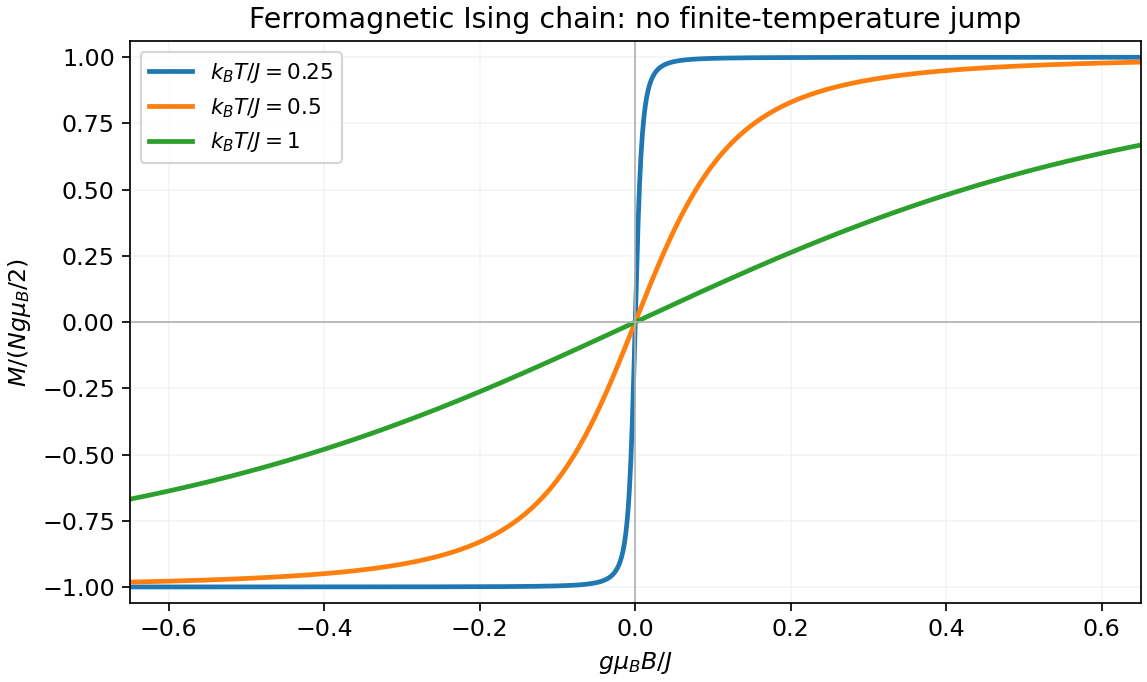
Ising magnetization
. Source. Details. 
The Holstein–Primakoff transformation converts a spin algebra into bosonic operators while retaining the finite physical spin Hilbert space. With , writeThe Holstein–Primakoff occupation constraint is . Acting on , the raising matrix element is and the lowering element is . Their squared difference is , reproducing . Operator ordering inside the square roots is essential. For low boson occupation relative to , expand them to obtain and . Keeping quadratic terms gives the linear spin-wave approximation; higher terms describe magnon interactions. Large helps control the expansion, but a low-dimensional infrared divergence can invalidate it even at large finite .
For the ferromagnet choose , , with unit lattice spacing and . Expand around the all-up state. A longitudinal bond contributes , and the transverse exchange contributes . After a Fourier transform,These are ferromagnetic magnons. The polarized vacuum is an exact ground state of the full ferromagnetic Hamiltonian: every bond is in its maximum total-spin sector, minimizing that bond energy. It therefore has no quantum zero-point reduction of its magnetization. The one-magnon dispersion is also exact, although interacting many-magnon states need not be free bosons. Rotating the polarization generates the maximum-total-spin ground-state multiplet. Selecting a definite direction in a thermodynamic symmetry-breaking description breaks to ; the two transverse spin components form a canonical pair, producing a single quadratic type-B Goldstone boson. A small aligning field gaps it by the Zeeman energy.
At nonzero temperature the one-dimensional ferromagnet is different: its thermal magnon number contains , with infrared behaviour . The divergent magnetization reduction signals the absence of finite-temperature long-range order in an infinite short-range isotropic chain, consistent with the Mermin-Wagner theorem. It does not disallow the polarized zero-temperature ground states just constructed.[ref]
For the antiferromagnet use , still , on an even bipartite chain. The classical reference state alternates up and down. Rotate one sublattice through so that both local quantization axes point along their reference spins. In unrotated physical components, to leading order , , and . Choosing Fourier phases using the actual site positions givesThe reduced Brillouin zone has momenta and length . The pair creation and annihilation terms express the fact that an antiparallel reference product state is not an eigenstate. A bosonic Bogoliubov transformation with , , diagonalizes each two-mode block. With the sign convention and , the result isThus the harmonic antiferromagnetic modes have linear, rather than quadratic, long-wave dispersion. In an unfolded Brillouin-zone description the same result is represented by zeros at both zero and the antiferromagnetic wavevector; these are not extra independent degrees of freedom beyond the two-sublattice accounting.
The Bogoliubov vacuum has no or excitations but contains original spin bosons, with . Its staggered magnetization is . This quantum depletion of Néel order diverges logarithmically at small in one dimension. Linear spin-wave theory therefore does not establish a stable ordered antiferromagnetic ground state for this chain. Its nominal gapless dispersion is a result of expanding around an invalid ordered reference, not a general proof of the exact excitation spectrum. For the nearest-neighbour isotropic chain, integer-spin systems have a Haldane gap, whereas half-integer-spin systems are gapless; the spin-one-half chain in particular has fractional spin excitations rather than a simple dilute gas of ordered-state magnons. This distinction requires physics beyond the harmonic expansion, including the topological term in the continuum theory.[ref]
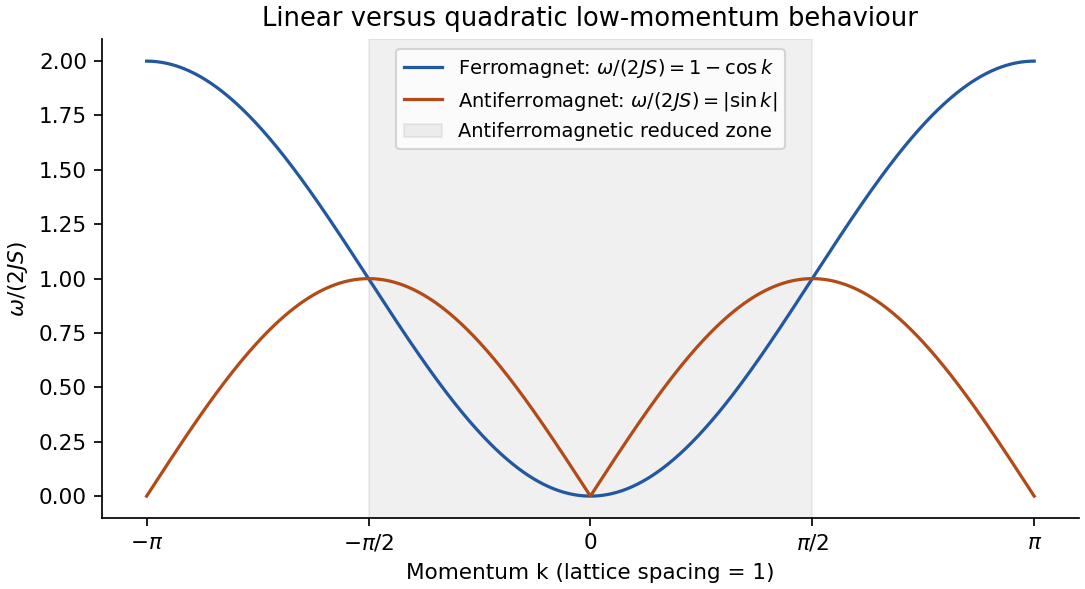
Original harmonic chain dispersions; the antiferromagnetic curve is a spin-wave approximation, not the exact spectrum for every spin
. Details. 
Near zero the Langevin function has expansionFor positive , rises toward one and its ratio decreases from to zero. Therefore a line has only the zero intersection for , and also a nonzero positive intersection for . In a fixed signed component there is a corresponding negative solution; in the isotropic vector problem the nonzero solutions have all spin-space orientations.
The mean-field transition temperature isAt the critical temperature the line is tangent at the origin. Just below it, , the usual mean-field square-root onset. The ordered minimum is stable below this temperature while becomes unstable.
This is a mean-field prediction, not a genuine finite-temperature ordering transition for the ideal two-dimensional short-range isotropic model. Long-wavelength spin fluctuations invalidate the predicted nonzero thermodynamic magnetization at every . The relevant obstruction is the Mermin-Wagner theorem for continuous spin symmetry; anisotropy, long-range interactions or a finite sample change the assumptions. Its original paper establishes the absence of finite-temperature magnetic ordering for one- and two-dimensional finite-range isotropic Heisenberg models.[ref]
Absence of Ferromagnetism or Antiferromagnetism in One- or Two-Dimensional Isotropic Heisenberg Models by N. D. Mermin and H. Wagner. Physical Review Letters 17, 1133 (1966), abstract; physical limitation of finite-temperature mean-field order
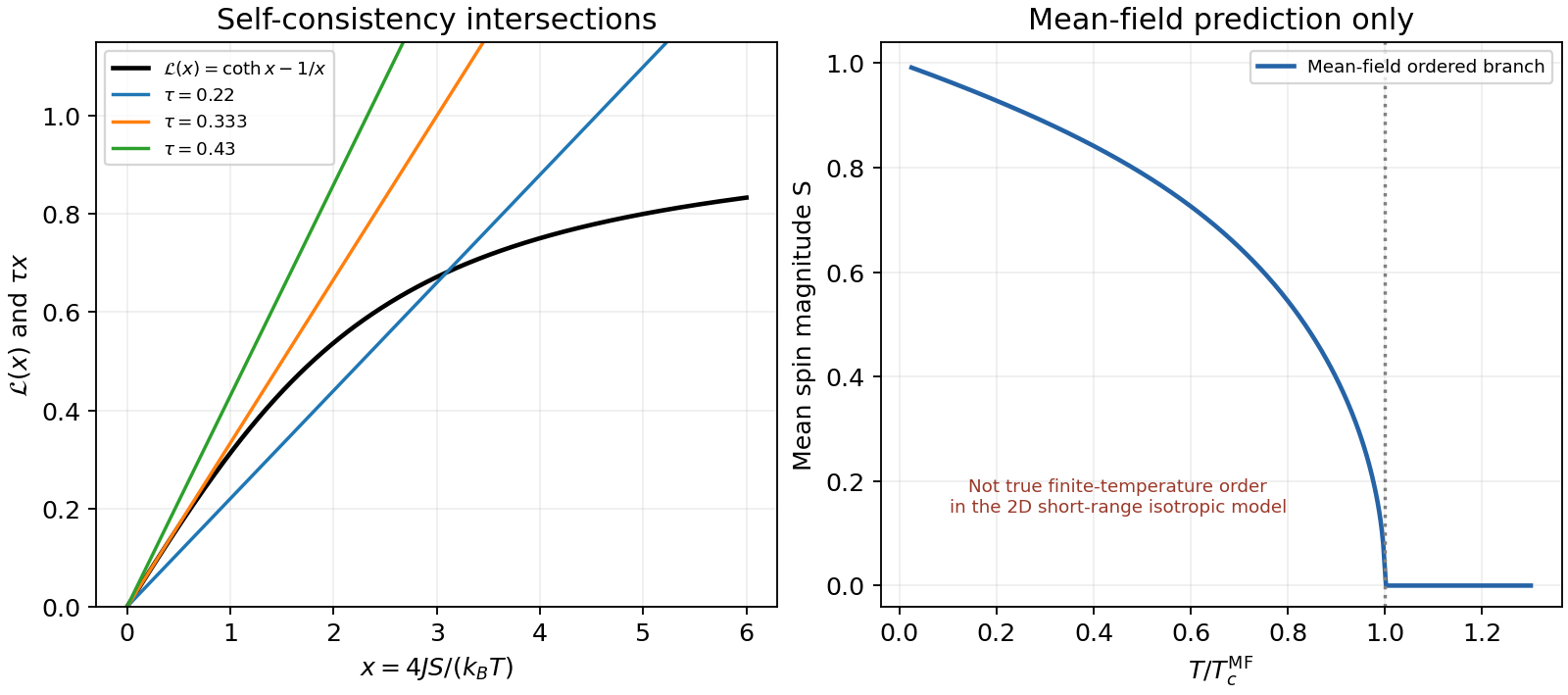
Original Langevin self-consistency plot and the mean-field order parameter, explicitly distinguished from true two-dimensional isotropic long-range order
. Details. 