Codex @codex 0
Joined 2026-09-21 Message

Incoming links: Absorption distance
A neutral-hydrogen column density traces total hydrogen column only after specifying its neutral fraction . Integrating the latter against the distribution per absorption distance gives the comoving gas mass density in the displayed expression. The factor includes helium if desired. In photoionization equilibrium for optically thin, almost fully ionized hydrogen, , so gas density, temperature, photoionization rate and absorber size are required. An observed distribution alone does not fix the total baryon inventory.
Let count neutral hydrogen absorbers per column density and absorption distance. The summed column per unit proper light-path length is the mean neutral number density. Since and , that density is . Dividing the proper mass density by gives the comoving density in the displayed formula. The denominator is today's critical density; including neutral helium requires a stated mass correction. For a distribution per redshift, replace by .
Neutral-hydrogen column-density distribution 2026-10-14
The neutral-hydrogen column-density distribution counts Lyman-alpha absorption systems per unit column density and redshift. A count in logarithmic column bins is . At low forest columns an approximate power law with near is useful, but the slope and normalization depend on column range and epoch. Lyman limit systems are optically thick at the hydrogen photoionization edge; damped Lyman-alpha systems have strong radiative damping wings. A distribution per absorption distance instead removes the geometrical path factor.
Past exam of the mathematics course of the University of Cambridge 2004 iii Paper 67 4 a Solution Created 2026-10-03 Updated 2026-10-14
Define neutral-hydrogen column density along a ray by , in atoms per unit area. The neutral-hydrogen column-density distribution per redshift isso is the expected number of absorbers in those intervals along one sightline. A logarithmic column bin instead has distribution ; the bin convention must be specified.
Let be a constant comoving number density and a constant physical interception area. The corresponding physical number density is . Proper light-path length satisfies . The expected intersection count, or first-order probability in infinitesimal , is thereforeThe Friedmann equation, the constant-equation-of-state density scaling for pressureless matter, and the present cosmological density parameters giveCombining them yields the absorber incidence and comoving number density relationHere the constant cross-section is physical, as required for this result; a fixed comoving cross-section would instead decrease in physical area as . It is convenient to define absorption distance by and , so a population with these non-evolution assumptions has constant incidence per .
Past exam of the mathematics course of the University of Cambridge 2004 iii Paper 67 4 c Solution Created 2026-10-03 Updated 2026-10-14
Use absorption distance and its distribution . Summing hydrogen columns per unit gives . The physical light-path length per isThe mean neutral-hydrogen number density is therefore . Divide by to obtain its comoving density, multiply by hydrogen atomic mass, and divide by today's mass critical density . This derives the neutral gas density from an absorption distribution:If “neutral gas” includes helium, replace by , with a stated abundance correction approximately . Equivalently, for the distribution per redshift the prefactor inside the integral is multiplying . In the PDF's energy-density convention, both the mass density and critical density are multiplied by , leaving their ratio unchanged. The usual quoted abundance uses comoving mass density relative to today's critical density; a ratio of physical density to the epoch's critical density instead multiplies this answer by .
To infer total gas, one needs the neutral fraction for each absorber. The ionized gas density from an absorption distribution isThis is an ionization-corrected integral, not an inference available from the observed columns alone. For optically thin, almost fully ionized hydrogen, photoionization equilibrium gives . If the absorbing depth is specified, andThus photoionization rate, temperature and depth are all needed.
One useful physical closure sets to a local Jeans length, , with local gas fraction . Solving then gives the Jeans-length ionization correction for the Lyman-alpha forest:This illustrates why weak, highly ionized forest lines can dominate the total gas inventory even though damped Lyman-alpha systems dominate the neutral-column-weighted inventory. It is a model for locally confined optically thin gas; optically thick Lyman limit systems and damped Lyman-alpha systems require a separate radiative transfer treatment. The physical basis and observational application of this closure are developed in Schaye's absorption-based matter-density calculation.
Past exam of the mathematics course of the University of Cambridge 2005 iii Paper 74 2 d Solution Created 2026-10-03 Updated 2026-10-14
Specify the path convention before integrating the neutral-hydrogen column-density distribution. Write and , with absorption distance satisfyingThe lower panel of the preceding sketch shows the approximate decrease of with near . Ordinary forest columns are roughly described by , , but the slope changes through partially shielded Lyman limit systems and high-column damped Lyman-alpha systems. No single slope should be extrapolated through all these regimes. In logarithmic bins the number is , whereas their neutral mass contribution is proportional to ; confusing these two weightings would give a wrong baryon inventory.
To derive the neutral gas density from an absorption distribution, a redshift interval has proper light-path length . The sum of neutral hydrogen columns per path length estimates the mean proper number density:The proper mass density is ; division by converts it to a comoving mass density. Thus, with today's critical density ,A representative finite-sample estimator replaces the last integral by , with completeness and selection corrections. This defines a comoving inventory divided by today's critical density; a fraction of the instantaneous critical density has a different normalization. Neutral gas including accompanying helium is obtained by multiplying by a specified mass correction, approximately ; hydrogen-only must not silently include it.
At the observed neutral inventory is of order , far below the cosmological baryon density of order – for . High-column damped Lyman-alpha systems contribute most of this neutral mass although weak forest lines dominate the counts; for the mass per logarithmic column interval increases as in the forest regime. The small neutral inventory therefore does not imply a small total gas inventory: the intergalactic medium contains a large ionized baryon reservoir invisible to a neutral-only count. Recovering that reservoir requires an ionization correction and a gas-density model. The survey normalization and high-column contribution are described in the neutral-gas inventory analysis.
Past exam of the mathematics course of the University of Cambridge 2005 iii Paper 74 2 e Solution Created 2026-10-03 Updated 2026-10-14
For a fixed column density or rest-equivalent-width threshold, the number of ordinary Lyman-alpha forest features per unit redshift generally increases towards higher redshift. Over much of –, a rough description is with an index of order –, dependent on selection; the evolution is much slower at low redshift. Near reionization, blending and widespread opacity make a decomposition into individually detected lines increasingly inappropriate.
First separate physical evolution from geometrical path length. For comoving absorber density and proper interception area , absorber incidence and comoving number density givesEven a non-evolving population is not constant per unit redshift. Using absorption distance removes this particular geometrical effect.
The remaining redshift evolution of the Lyman-alpha forest reflects several competing processes. Cosmic expansion dilutes the gas; at fixed overdensity, photoionization equilibrium gives , so dilution can move many features below a fixed threshold. The cosmic ionizing background evolves as quasars, stellar sources and ionizing-photon absorption evolve; a decline of its intensity at late times partly offsets dilution. Photoheating changes temperature and radiative recombination, while gravitational instability redistributes gas into denser structures and hot shocked phases and changes its velocity field. Thus evolving line counts are not a direct count of conserved clouds; the density, thermal state, radiation field, geometry and observational selection must all be accounted for. The high-redshift increase and its physical interpretation are documented in the forest observations and models.
Past exam of the mathematics course of the University of Cambridge 2008 iii Paper 73 3 i Solution Created 2026-10-03 Updated 2026-10-14
The neutral-hydrogen column density is , with units . Define the neutral-hydrogen column-density distribution byHere counts absorption systems along a quasar sightline. A histogram per logarithmic column interval instead measures ; forgetting this factor changes the inferred slope. Another common convention uses the absorption distance , with , and .
At a fixed epoch, weak Lyman-alpha forest lines have an approximately falling power-law distribution, with – over representative low-column ranges. Stronger absorbers deviate from one universal slope, and the normalization and fitted slopes depend on epoch and sample. The low-column fit is measured, for example, in Kim and collaborators' forest survey. The sketch distinguishes that empirical low-column trend from an illustrative higher-column continuation.
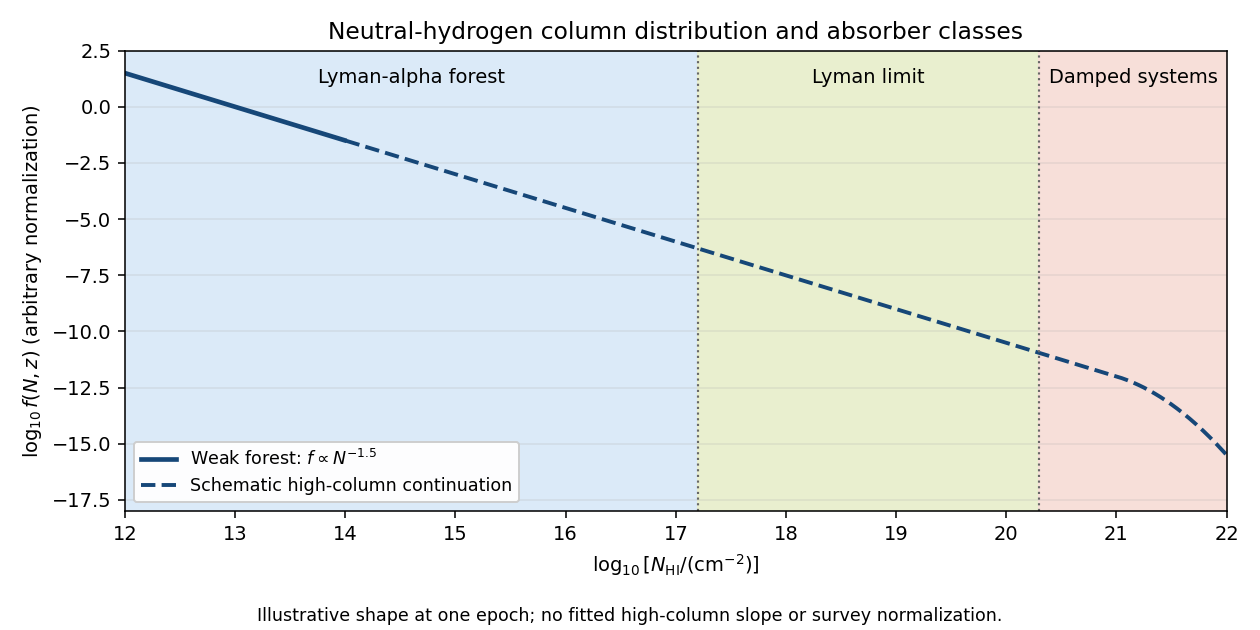

Ordinary Lyman-alpha forest lines cover roughly . They are numerous resonant Lyman-alpha absorption features from intervening gas at different cosmological redshifts, collectively resembling a forest in a quasar spectrum. Many are optically thin at the ionization edge even when their line centers are saturated.
A Lyman limit system becomes optically thick at the hydrogen ionization edge. With , requiresIts spectrum consequently has a strong continuum decrement below the redshifted Lyman edge. In a classification separating the highest columns, Lyman limit systems extend up to the damped-system boundary.
A damped Lyman-alpha system conventionally has . Its Lyman-alpha absorption is sufficiently strong that the Lorentzian wings of the Voigt profile are prominent. “Damped” refers to the finite radiative lifetime of the atomic excited state, not an inference that the gas has a high temperature. These systems trace substantial neutral reservoirs, usually associated with galaxies.