Single-electron superconducting tunneling transfers individual Electrons across a barrier into or out of quasiparticle states of a material with superconductivity. In a normal-metal–insulator–superconductor junction, abbreviated NIS, only one electrode has superconductivity. Such a junction can reveal a superconducting energy gap without supporting a DC Josephson effect between two superconducting reservoirs.
For an elementary interpretation, assume an opaque barrier, approximately constant normal-electrode density of states, and an energy-independent tunneling matrix element over the range probed. Write the superconducting density of states divided by its normal-state value as , with measured from its chemical potential. A signed voltage convention chosen for positive normal-electrode injection giveswhere is the Fermi-Dirac distribution at a common temperature and is the normal-state junction electrical resistance. This current convention is local to the NIS measurement. The expression counts occupied initial and empty final states; it is a quasiparticle transport model, not a current-phase relation of a superconducting weak link.
An original analytic illustration uses the ideal fully gapped BCS theory spectrum at zero temperature, with positive gap edge :For positive , the occupation difference restricts the integral to . Since , integration and odd extension giveThe threshold is for this NIS model. In the corresponding zero-temperature single-electron process between two fully gapped superconductors, creating excitations on both sides instead requires . That quasiparticle threshold does not forbid coherent pair electric current below it. At finite temperature, thermally populated quasiparticles soften the simple threshold argument.
At zero temperature in the NIS approximation, away from the singular gap edge. Thus a voltage sweep probes the excitation density of states. The ideal divergence is rounded in real measurements, and at nonzero temperature the derivative samples a thermally broadened range of energies. For , the model has : electrical work creates excitations and is dissipated on relaxation. This distinguishes its steady transport from the conservative Josephson coupling energy.
Ivar Giaever's gap experiment used a metal–insulator–metal sandwich. His lecture describes evaporating aluminium onto glass, briefly exposing it to air to form an oxide barrier, then evaporating lead cross-strips. Cooling in liquid helium made the lead superconducting while the aluminium stayed normal in the measurements compared. A voltmeter and ammeter supplied the junction electric potential difference and electric current readouts. Thick oxides initially gave unmeasurably small electric currents; the thinner barrier made the measurement practical. Temperature comparisons and a subsequent controlled magnetic field test changed the current-voltage characteristic with the superconducting state. [ref]
The 1960 letter compares measurements at and . An applied parallel magnetic field of kept the lead normal; removing the magnetic field strongly suppressed the small-voltage electric current. Figure 2 divides the superconducting by the normal-state slope. The letter calls its gap estimates preliminary and notes a temperature-dependent broadened peak. It also flags a limitation of interpreting tunneling directly through the density of states; the ideal NIS calculation above states additional assumptions explicitly. [ref]
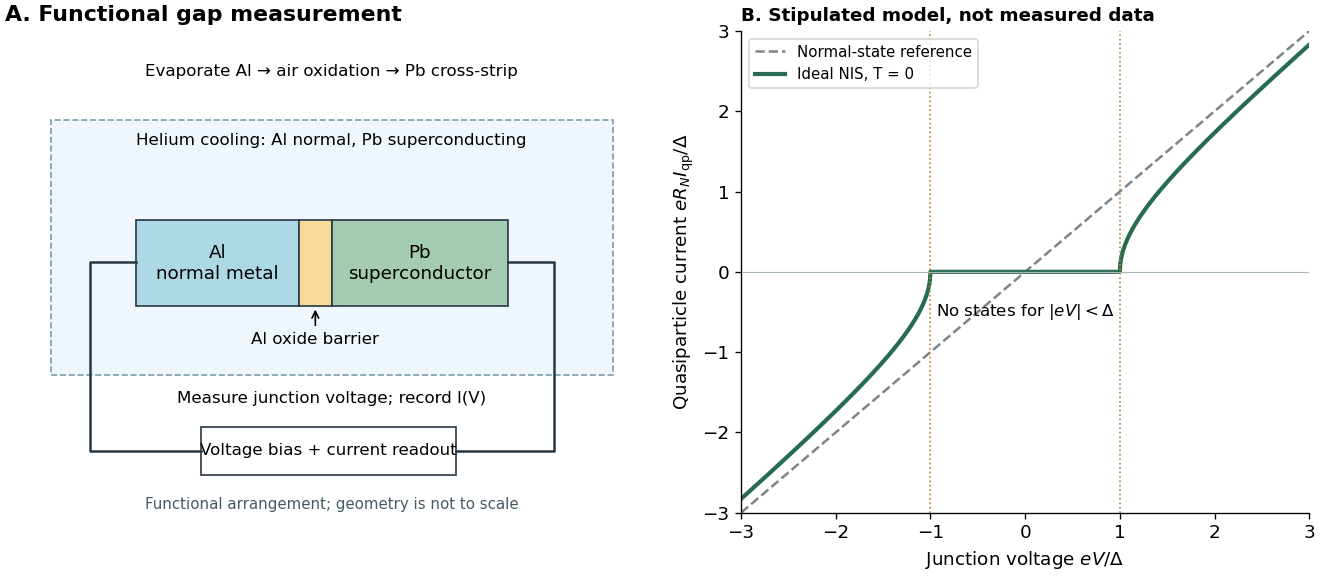

The central inference is that the barrier lets electric current interrogate available quasiparticle states. Suppression at small electric potential difference and the rise near the gap edge support a gapped spectrum; tracking the superconducting state helps distinguish that feature from an arbitrary nonlinear barrier. A leakage path through a metallic short, imperfect barrier, or an energy-dependent tunneling matrix element limits a literal density of states interpretation. The preparation and state controls therefore matter as much as seeing a nonlinear current-voltage characteristic.
Articles by others on the same topic
There are currently no matching articles.