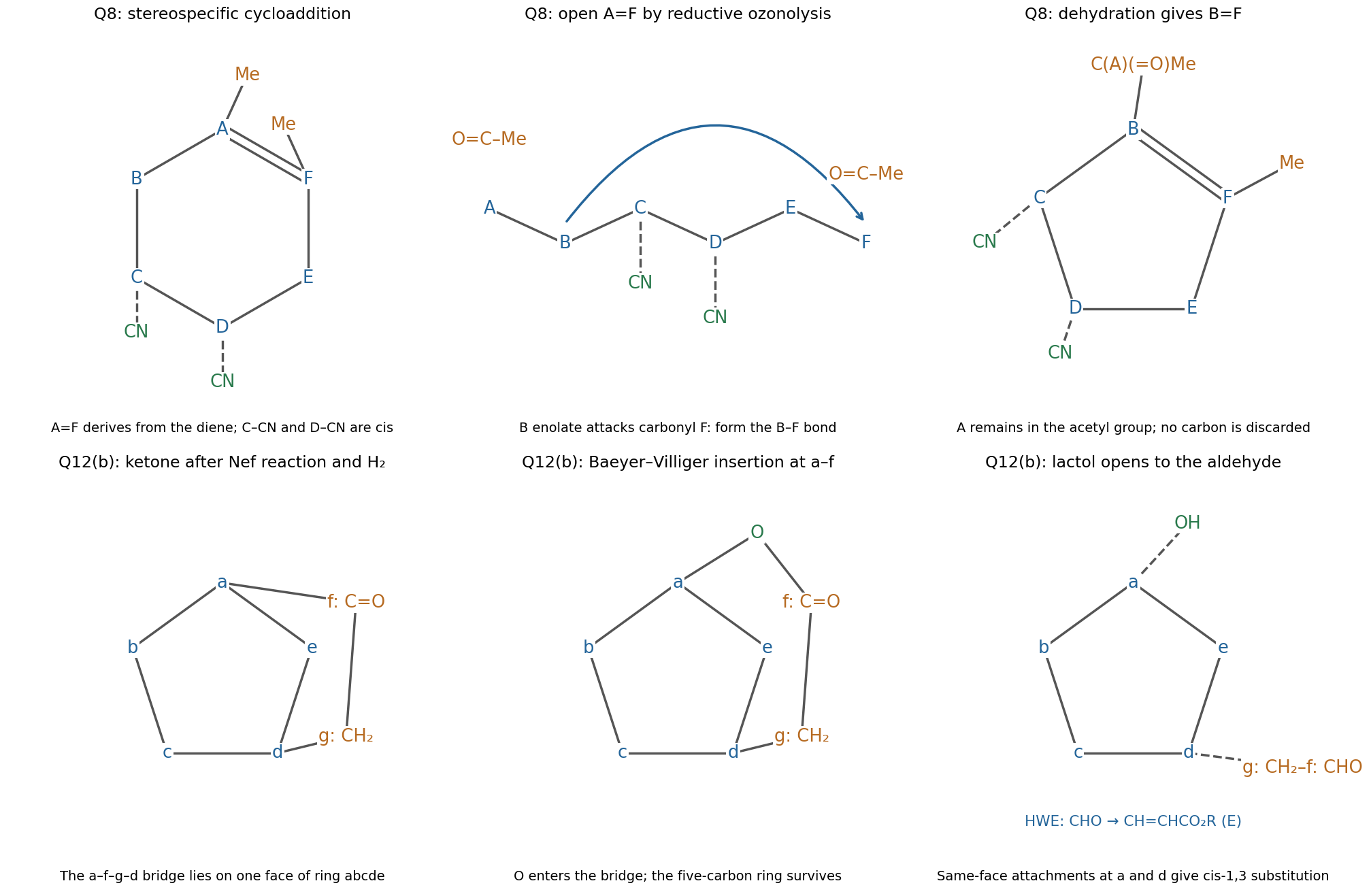
Here the organocopper formula is shorthand for a suitable cuprate preparation, not a claim that an isolated monomer is necessary. The acrylate contributes two methylenes and the estercarbonyl. Remove the THP group, replace the resulting terminal OH by Br, and react with PPh3 to form [Ph3PCH2(CH2)5CO2Me]+Br−. Deprotonate adjacent to phosphorus to generate the non-stabilized ylide. This proton is much more acidic than the ester alpha protons, but controlled base stoichiometry and low temperature remain important.
The four-carbon starting alcohol plus the three-carbon acrylate backbone supplies the seven-carbon acid-derived chain; the ester Me gives an eighth carbon. Pentanal plus allyl gives the other eight. The total is sixteen carbons, including the terminal alkene. A two-carbon extension would produce the wrong chain length.
Intramolecular aldol condensation gives 3-Me-5-R-cyclohex-2-en-1-one. The beta methyl derives from the carbonyl end attacked in the ring closure; the pendant aminoalkyl chain remains at C5. Hydrogenate the ringC=C selectively, retaining the ketone, then methylenate the ketone with preformed Ph3P=CH2. Do the hydrogenation before installing the exocyclic methylene so that it is not hydrogenated away.
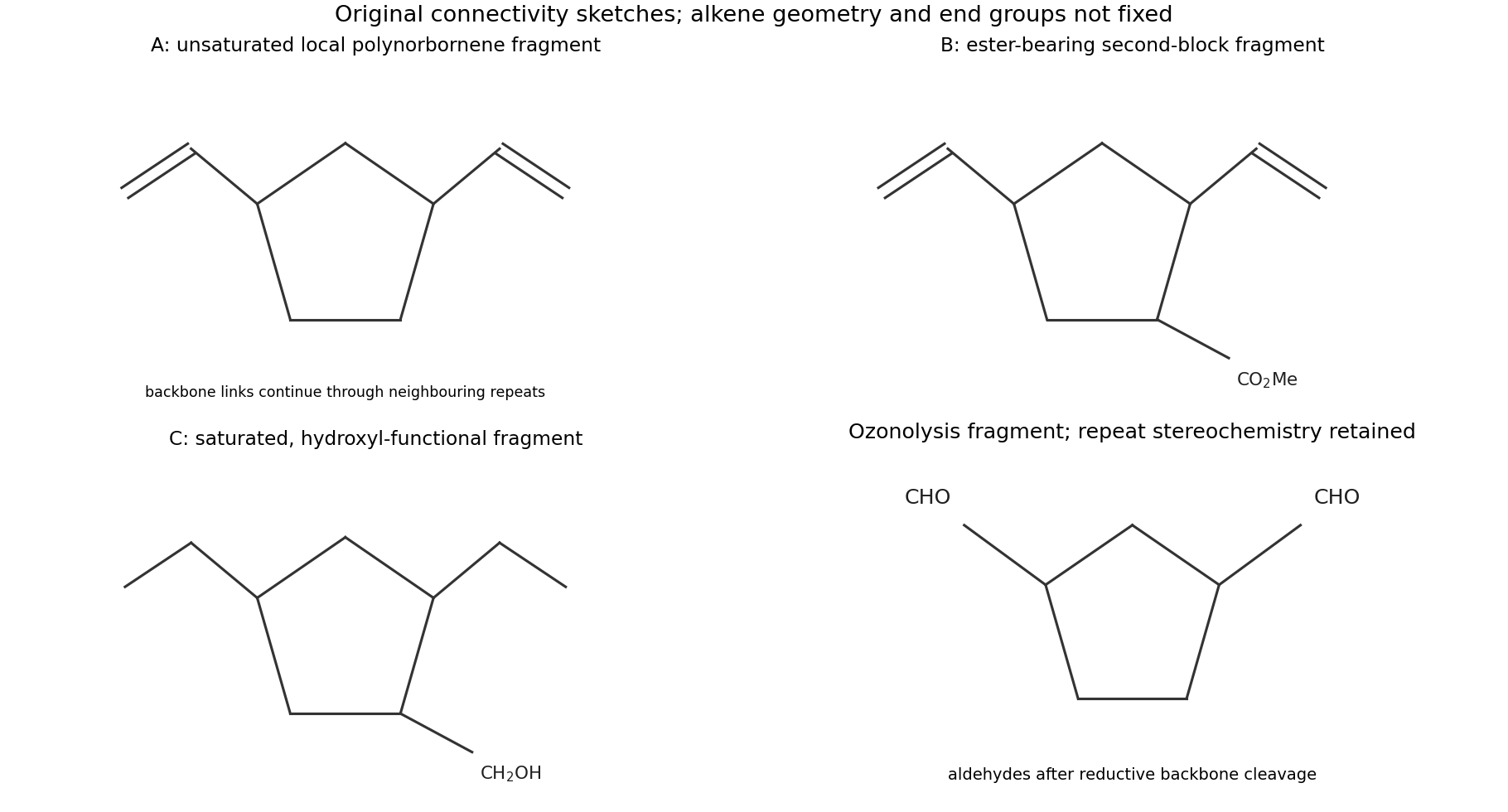
Use a Baeyer-Villiger oxidation to insert oxygen between the carbonylcarbon and its adjacent bridgehead carbon. Bridgehead migration is favoured over migration of the competing methylene; isolate the required lactone regioisomer if necessary. This opens the way to a hydroxy cyclopentyl side chain without breaking the original five-carbonring. In the resulting bridged lactone, one original cyclopentadiene terminus is bonded to O and the other bears the CH2CO segment.
Reduce the lactone selectively with DIBAL to its lactol. Ring opening of that lactol gives the aldehyde equivalent cis-3-hydroxycyclopentyl-CH2CHO. The ring OH and the two-carbon aldehydeside chain are cis because their original attachments were the two ends of the Diels–Alder bridge; neither the migration nor lactol opening inverts those cyclopentane carbons.
Perform a Horner-Wadsworth-Emmons reaction on the lactol/aldehyde equilibrium using (EtO)2P(O)CH2CO2R, where R=CH(Me)CH2CH(Me)2. Preform the phosphonate anion and allow for consumption of base by the lactol OH. Standard stabilized-phosphonate conditions favour the required E-CH=CHCO2R unit. No further hydrogenation should follow it.
Bridge-derived cis ring stereochemistry plus E-selective phosphonate olefination gives both specified relationships. Achiral cycloaddition and subsequent reagents give a racemic pair with this relative configuration; isolation of one absolute enantiomer would require resolution or an asymmetric variant. The acid fragment contains nine carbons: five from cyclopentadiene, two from nitroethylene and two from the phosphonoacetate. The ester alkyl group adds six, giving fifteen overall. The atom tracing in the original schematic in question 8 shows why oxygen insertion retains the five-membered ring rather than producing a six-membered carbocycle.
Disconnect the tertiary alcohol at its bond to the alkenyl group. The required carbonyl partner is MeCOCH(Me)Et; the other partner is an E-configured PhCH2CH=CH organometallic reagent. This disconnection fixes the alkenegeometry before the alcohol is made.
First form the ethyl-side enolate of butan-2-one under equilibrating conditions, then trap it with ethyl iodide and isolate the required monoalkylated ketone:
The incoming group is Et: methylation would give a carbon skeleton one carbon too short. Because an unsymmetrical ketone can form two enolates and undergo repeated alkylation, regioisomer separation and controlled conversion are part of this step.
The E alkene and the complete fifteen-carbon skeleton are obtained. No absolute configuration is specified at the newly formed alcohol centre, so an unselected stereoisomeric mixture there is acceptable. An alternative carbon–carbon disconnection is acetylideaddition to the same ketone followed by a controlled trans-selective alkyne reduction; the vinyl-reagent route avoids relying on reduction of a tertiary propargylic alcohol.
Thus the forward plan is Diels–Alder addition, reductive ozonolysis, then five-membered aldol ring closure and dehydration. Use a reductive ozonework-up that stops at the diketone. During the final step, avoid prolonged strongly basic heating because the carbons bearing CN can be deprotonated and epimerized. Achiral reagents give the racemic pair with the required cis relationship; resolution would be necessary if only the depicted enantiomer were required. The diene supplies six carbons and maleonitrile supplies four, accounting for all ten carbons without an unexplained carbon deletion.
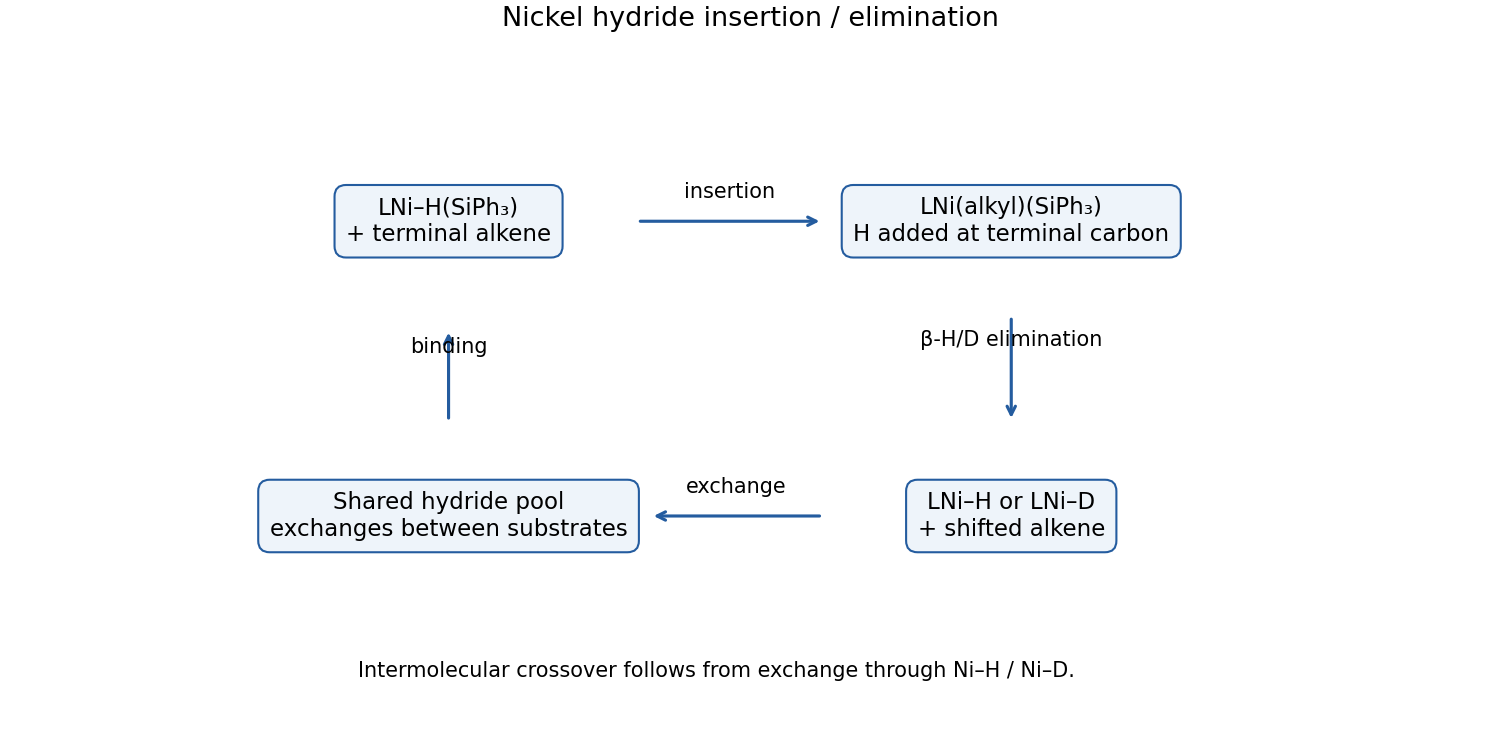
Write L for the imidazolylidene N-heterocyclic carbene bearing the two mesityl groups shown. The proposed active unit is LNi(H)(SiPh3), with H and SiPh3 both bonded to nickel, rather than anickel-free hydrosilane or a bare NHC-Ni fragment.
The strongly donating NHC stabilizes a reactive low-coordinate metal and assists Si-Hactivation. Its steric bulk discourages unproductive saturated bis-alkenespecies and promotes product departure, but excessive crowding can hinder substrate binding/insertion. The silyl ligand also tunes the metal electronically: changing its aryl substituents changes donation and the barriers for hydride transfer/elimination. Product release and reversible insertion determine whether further double-bond migration occurs. Bulky ligands can suppress competing alkyl-silyl reductive elimination, which would instead consume substrate by hydrosilylation.
The hydride-silyl formulation and insertion/elimination interpretation are the experimentally proposed mechanism; the individual catalyst resting states need not all be uniquely fixed by the activation recipe.[ref]
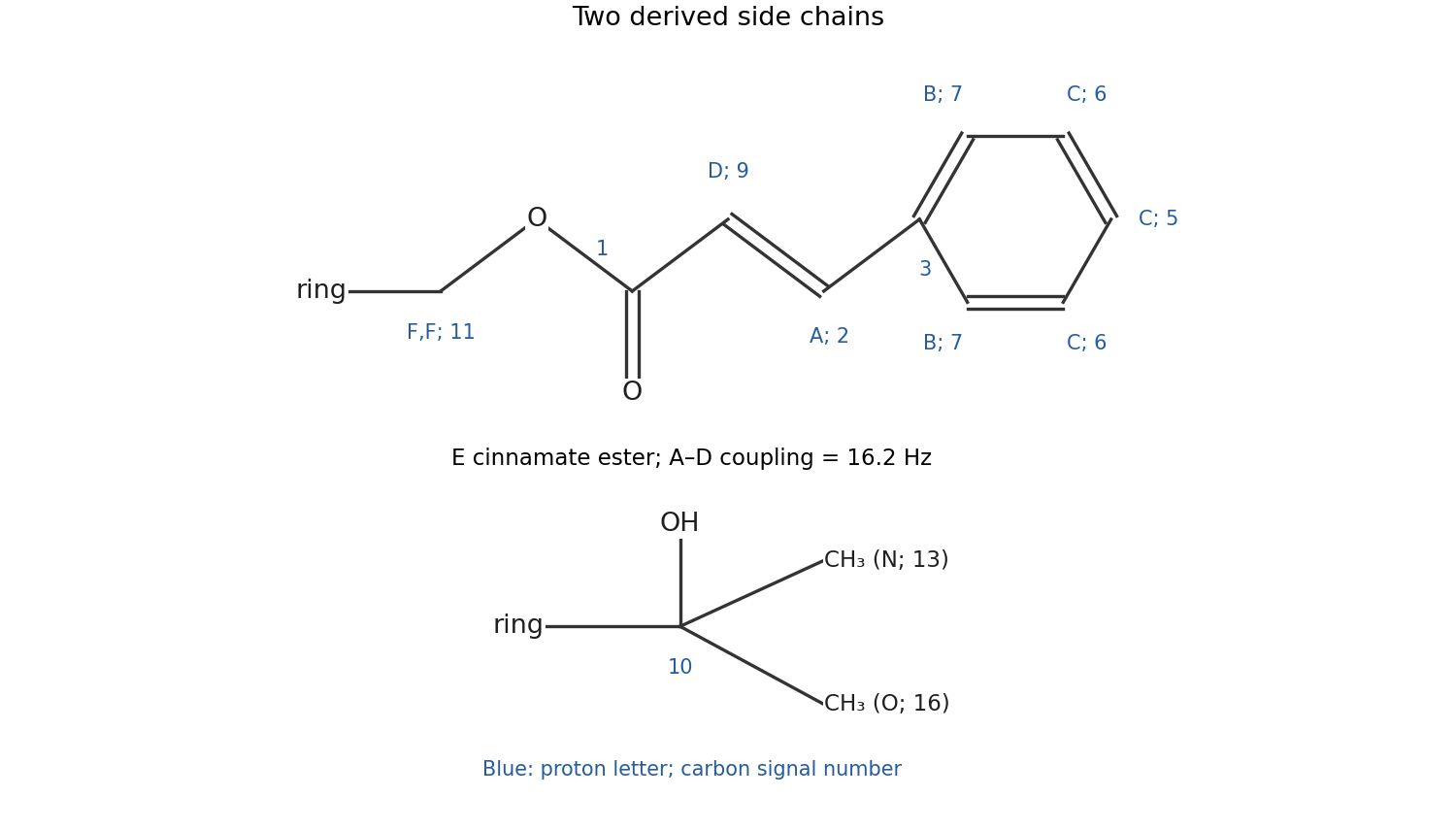
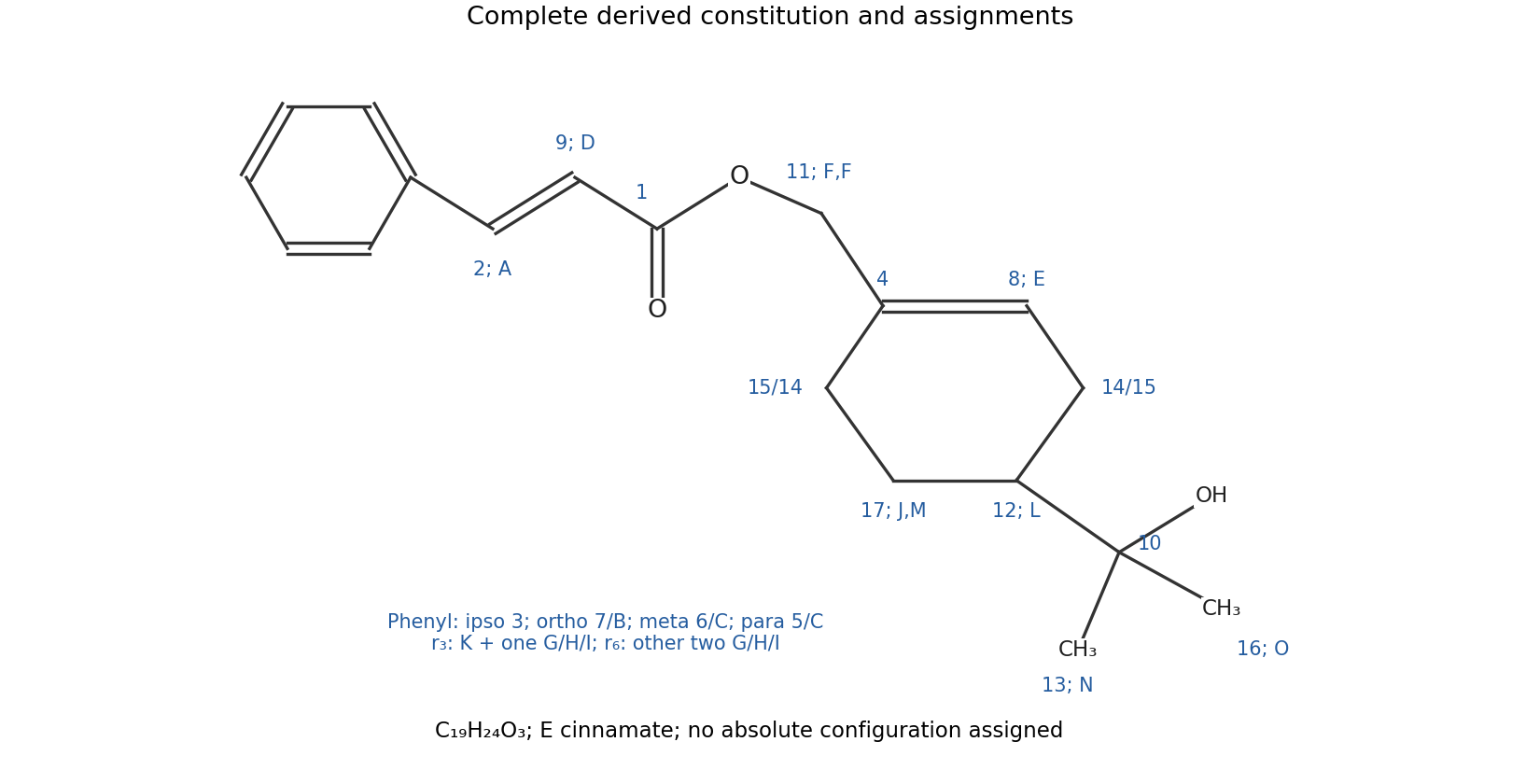
The two substituents are −CH2−O−C(O)−CH=CH−Ph, with the alkene E, and −C(OH)(CH3)2. The free bond at the left of each drawing attaches to the cyclohexene.
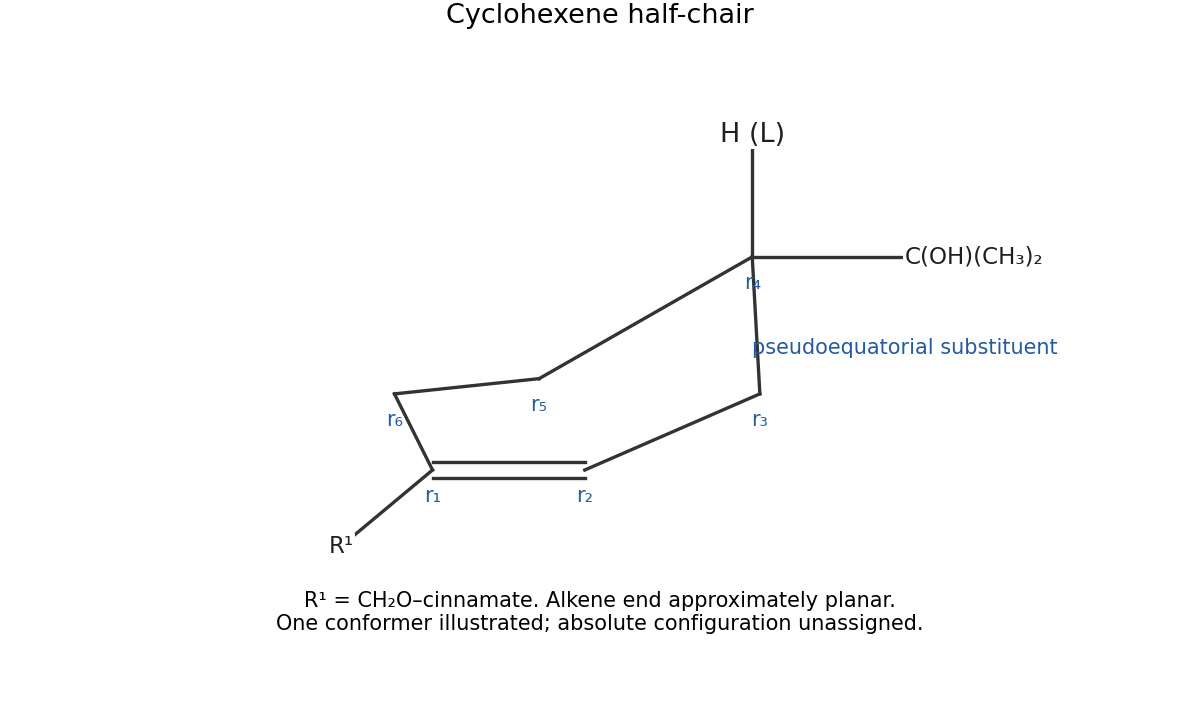
Use a cyclohexene half-chair, not a fully puckered saturated-cyclohexane chair. The alkenecarbons and their directly attached bonds form the approximately planar end; the saturated part puckers. Put the C(OH)(CH3)2substituent pseudoequatorial at the opposite saturated methine to avoid a crowded pseudoaxial arrangement. Its methine proton is correspondingly pseudoaxial. This is a preferred conformation; the achiral spectra do not assign an absolute configuration.
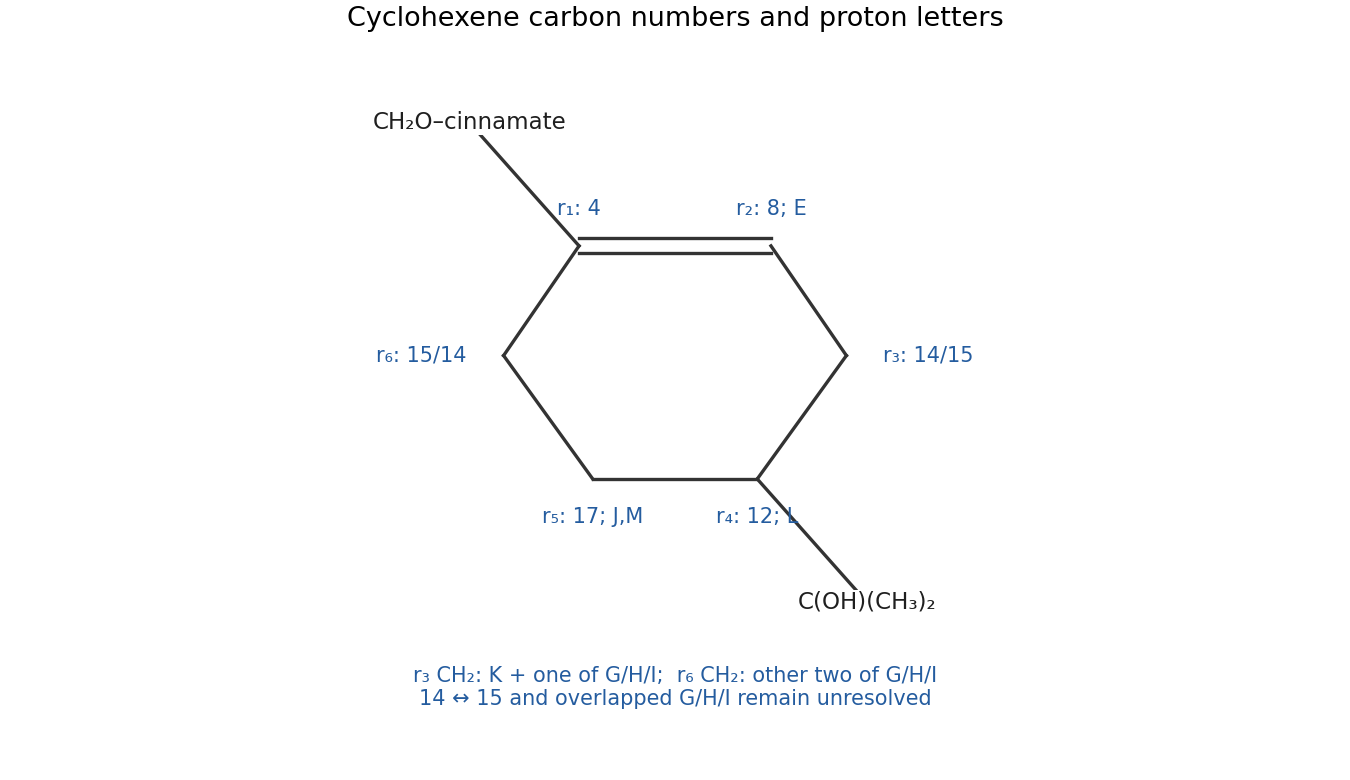
r6: the other allylic CH215/14, carrying the remaining two of G/H/I.
The HSQCpairsJ and M with 17 and placesL on 12. It also placesK and one unresolved member of G/H/I on one of the closely spaced allylic carbons, with the other two G/H/Iprotons on the other. COSY connects the vinylic E to the adjacent allylic part and connects the methine L to its neighboring methylenes; HMBClinksF to the substituted alkene end and the gem-dimethyl group to the methine end.
The printed overlap does not justify a unique assignment of every G/H/I letter or a forced 14-versus-15 assignment to those two ringpositions. The drawing retains those alternatives explicitly. In the half-chair, L is pseudoaxial; the resolved large/small couplings are consistent with pseudoaxial/pseudoequatorial methylene partners, but exact axial letter labels within the overlapped group remain uncertain.
The constitution is [4-(2-hydroxypropan-2-yl)cyclohex-1-en-1-yl]methyl (E)-3-phenylprop-2-enoate, with absolute configuration at the saturated substituted ring carbon unspecified.
The two alkene faces are diastereotopic because the molecule already contains stereocentres. A plausible substrate-controlled conformation minimizes allylic strain and presents the face opposite the bulky OTBS-bearing part of the chain to the oxidant. Predict epoxideoxygen on the face opposite OTBS, retaining the pre-existing methyl and OTBS configurations. Hydrogen-bond direction, steric approach and conformational population compete; one cannot deduce an exact diastereomeric ratio from the flat drawing alone. The same facial preference has been discussed for this synthetic series.[ref]
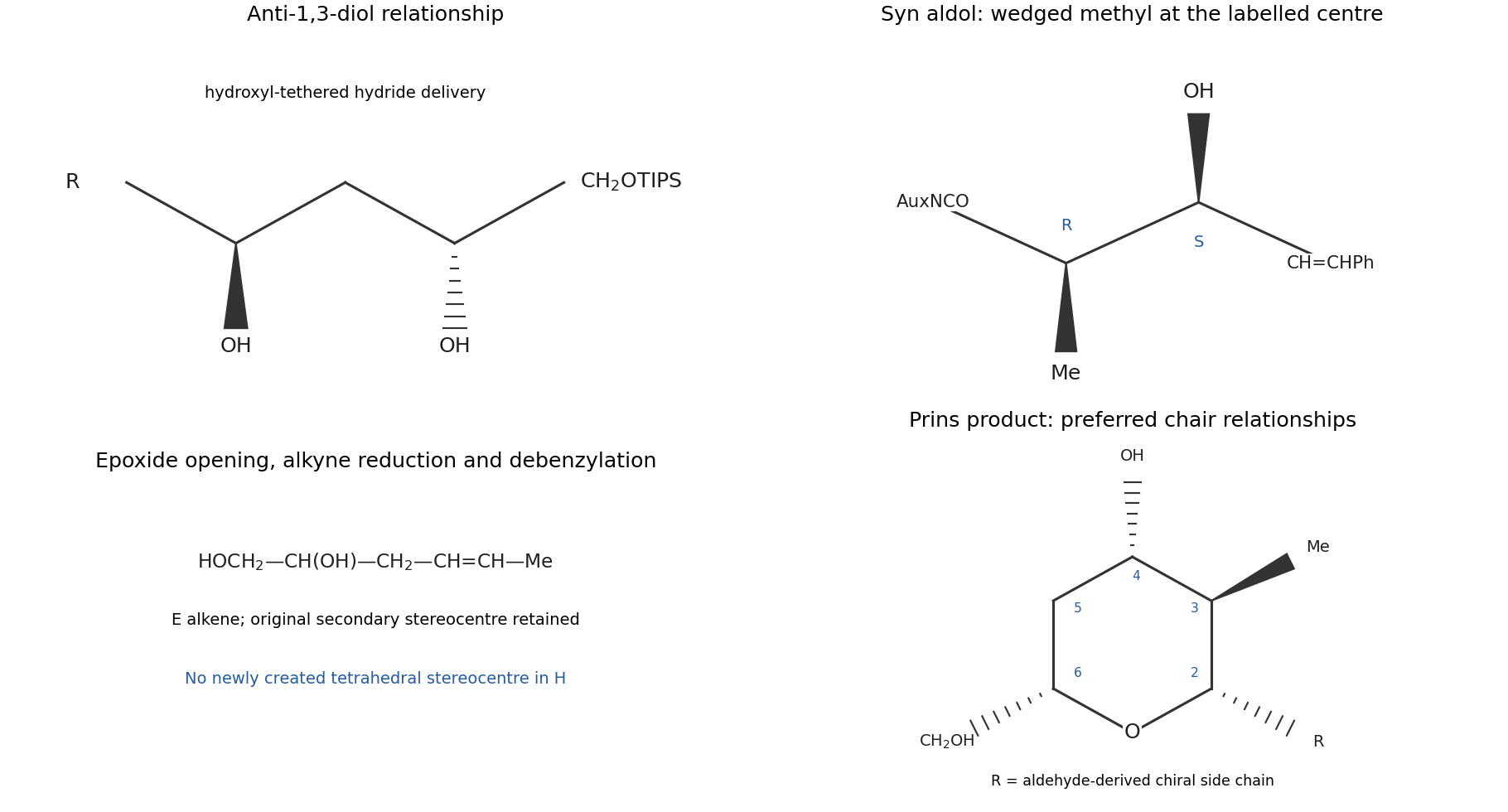
Number the product ring from oxygen through the aldehyde-derived carbonas C2, then the alkene-derived methyl-bearing carbon C3, the hydroxyl-bearing carbon C4, the intervening methylene C5 and the original alcoholcarbon C6. A chair keeping the bulky C2 side chain and C6 hydroxymethyl group equatorial predicts 2,6-cis substitution. Suprafacial alkene capture preserves the E-alkene-derived relationship, giving 2,3-trans between the C2 side chain and C3 methyl. Preferred equatorial trapping of the C4 cation gives 3,4-trans, hence the 2,4,6-cis arrangement of the substituent-bearing bonds in the favoured chair. In the printed flat-ring orientation, draw the C2 side chain, C4 hydroxyl and C6 hydroxymethyl behind the plane, and C3 methyl in front. Existing stereocentres in the aldehydeside chain and at C6 are retained; they anchor the absolute face of this assignment.
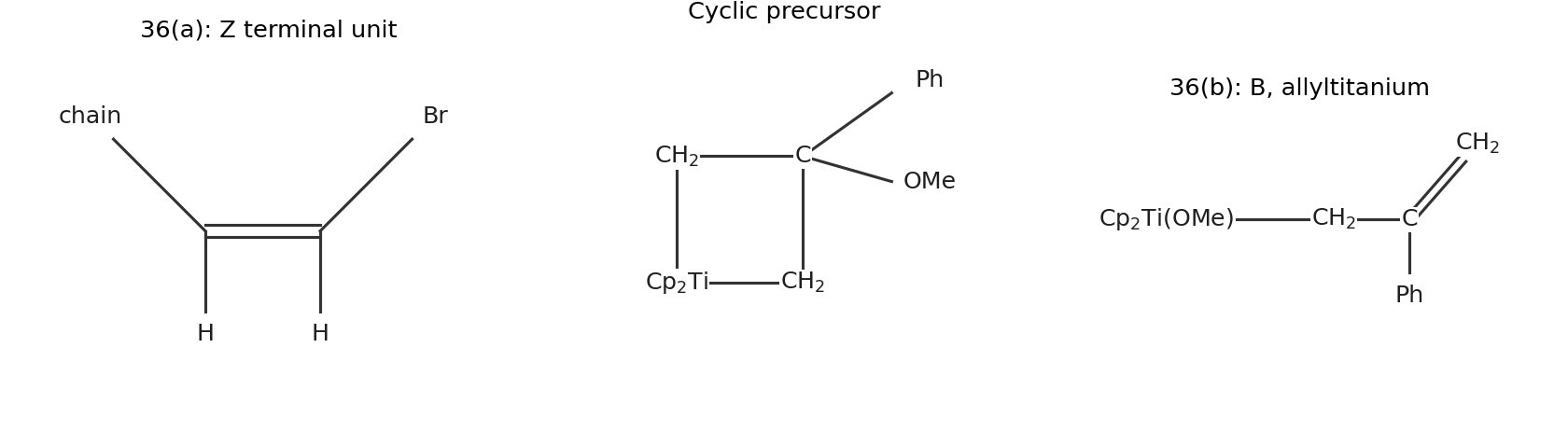
Only one bromine is replaced by hydrogen. Writing the unchanged protected chain as R=THPOCH2CH(Me), the product is RCH=C(Me)CH=CHBr, retaining the original internal alkenegeometry and forming predominantly the Z terminal bromoalkene: bromine and the carbon chain lie on the same side of that new stereodefined double bond. The formula is consequently C13H21BrO2.
Schwartz reagent adds syn across the terminal alkene, placing zirconium at its terminal carbon and hydrogen at the substituted carbon. The organozirconium intermediate is PhCH(OMe)CH(Me)CH2ZrCp2Cl. The two faces of the achiral starting alkene give enantiomeric organometallic intermediates.
Boron trifluoride coordinates the etheroxygen, making the benzylic C–OMe bond susceptible to cleavage. The C–Zr bond then transfers its carbon terminus intramolecularly to the benzylic carbonas the activated methoxy group departs, closing a cyclopropane. This can be represented asa concerted, strongly assisted displacement rather than requiring a freely equilibrating long-lived benzylic carbocation. hydrozirconation fixes the relative disposition of the new C–H and C–Zr bonds, and the preferred closure conformationplaces the bulky phenyl and methyl groups on opposite faces. The result is racemic trans-1-methyl-2-phenylcyclopropane, with much less steric crowding than the cis alternative. The ring contains the original two alkenecarbons and the original benzylic carbon; no carbene carbon is added.
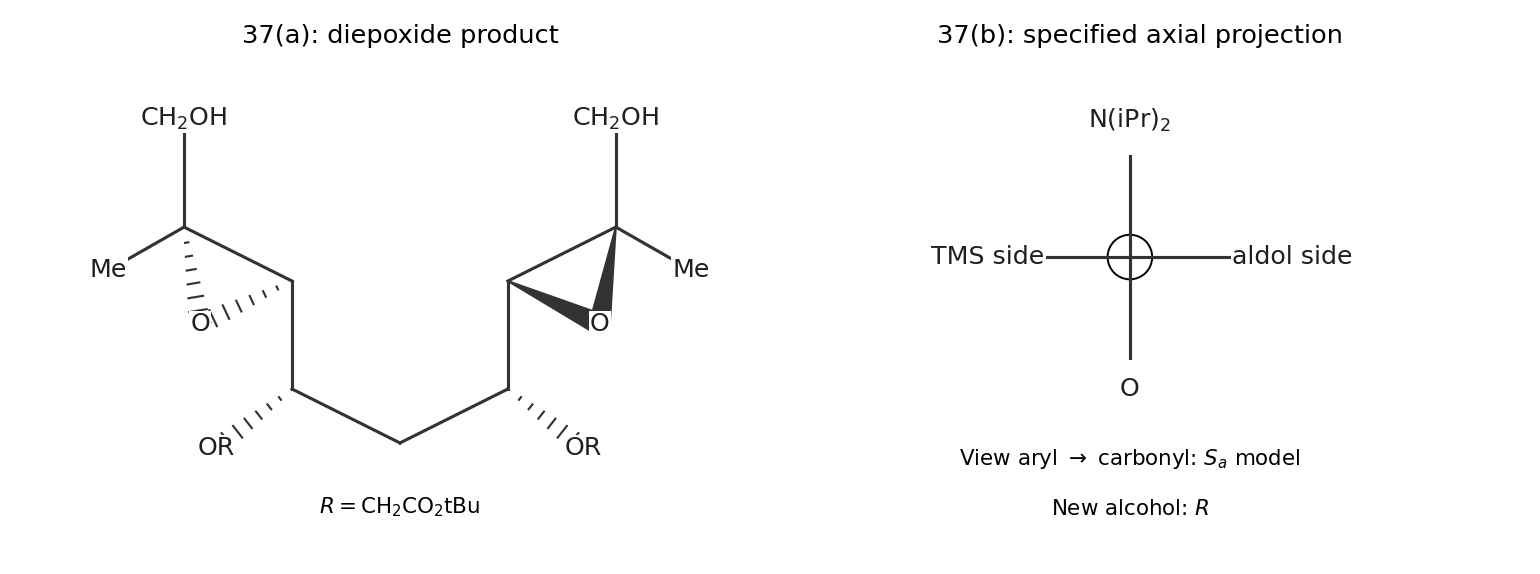
The stereochemical construction is unambiguous by applying the L-(+)-tartrate mnemonic separately at each end: orient that alkene horizontally with its CH2OH group at lower right, and deliver oxygen from the back face. In the source's original in-plane orientation this gives the left epoxideoxygen behind the plane and the right epoxideoxygen in front. The methyl and hydroxymethyl groups retain their original relative arrangement about each former double bond. One cannot simply draw both oxygens on the same face of the original extended chain: the two allylic-alcohol ends have opposite drawing orientations. titanium binding to each free hydroxyl directs oxygen transfer; the pre-existing stereocentres can create matched/mismatched rate differences, but the stated reagent control predicts the stereochemistry of both epoxidations. Molecular sieves maintain a dry active titanium–tartrate system.[ref]