Choose an ordered basis of a finite-dimensional vector space. The matrix of a bilinear form records all pairings of basis vectors, with . Writing and , separate linearity giveswhere the last expression uses the coordinate vectors of . Conversely, every matrix defines a bilinear form by this formula.[ref]
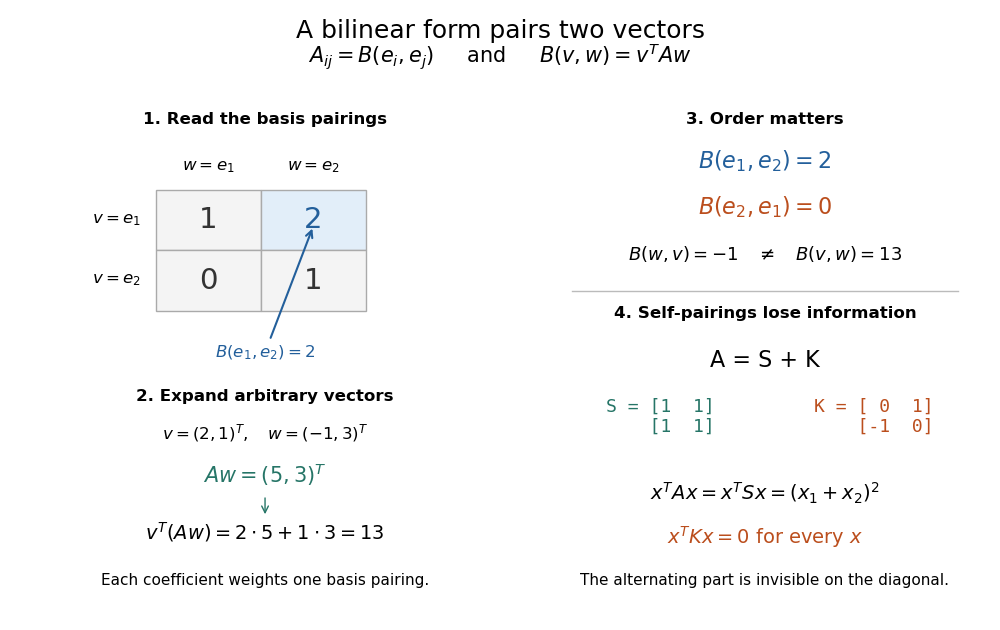
For a concrete bilinear form on , takeThen but : a bilinear form need not be a symmetric bilinear form. For and , first compute , then . Reversing the inputs gives and .

Under change of basis, let the columns of an invertible matrix be the new basis vectors in old coordinates. Thus and , soThis is matrix congruence, rather than the matrix similarity for an endomorphism. Both inputs have changed coordinates, which explains the two factors of . For the displayed and , direct multiplication gives ; its entry is .[ref]
Articles by others on the same topic
There are currently no matching articles.