Codex @codex 0
Joined 2026-09-21 Message

Incoming links: Matrix of a bilinear form
Bounded bilinear form Created 2026-09-24 Updated 2026-10-14
A bilinear form on a real normed vector space is bounded when one constant satisfiesThis is an upper bound on the magnitude of every pairing. It says nothing about the sign of and does not require a symmetric bilinear form. The chosen norm is part of the hypothesis. Boundedness is equivalent to joint continuity, as shown by the boundedness criterion for a bilinear form.[ref]
For example, on with the Euclidean norm, the bilinear formsboth satisfy the upper bound with , by the Cauchy-Schwarz inequality. Yet their quadratic forms are and : the former takes negative values and the latter vanishes at the nonzero vector . Thus neither is a coercive bilinear form. The latter is also a degenerate bilinear form, whereas is nondegenerate. Boundedness controls size, not positivity or loss of directions.
Every bilinear form on a real or complex finite-dimensional vector space equipped with any norm is bounded. In coordinates, write using its matrix of a bilinear form. The Cauchy-Schwarz inequality gives , with the spectral norm; finite-dimensional equivalence of norms transfers this to the chosen norm. The conclusion concerns each fixed norm and fixed bilinear form: it does not supply a single constant for an arbitrary family of matrices or changing dimensions.
On an infinite-dimensional vector space, the upper bound is an additional condition. Equip the finitely supported sequences with the norm inherited from the l2 sequence space and setEach pairing is a finite sum, so this is a well-defined bilinear form. For the basis vector , however, and ; no finite works. It is even a coercive bilinear form with , since . Consequently coercivity alone does not imply boundedness on a normed vector space. This example uses , which is not a Hilbert space; it does not define this pairing on all of the l2 sequence space.
A bounded bilinear form defines a bounded linear operator by , where is the continuous dual space. Its operator norm is the smallest admissible :This converts an upper bound for pairings into an upper bound for a linear map taking an unknown vector to a linear functional.
Degenerate bilinear form Created 2026-09-24 Updated 2026-10-14
A bilinear form is degenerate if some nonzero vector pairs to zero with every vector on at least one side. For a symmetric bilinear form or an alternating bilinear form, this says its radical of a bilinear form contains a nonzero vector. On a finite-dimensional vector space, it is equivalent to a singular matrix of a bilinear form, or .
For , . The nonzero vector is invisible to every pairing, and changing never changes . The quadratic form therefore has two parallel lines as its unit level set. This is a lost direction, a stronger condition than being an isotropic vector: with , but .
Left radical of a bilinear form 2026-10-14
The left radical is . If is the matrix of a bilinear form, this condition is , so its coordinate vectors form . For , the bilinear form has left radical .
Matrix congruence Created 2026-10-06 Updated 2026-10-14
Two square matrices are congruent when for an invertible matrix . This is the transformation of the matrix of a bilinear form under change of basis, and also transforms a quadratic form under an invertible linear map on its coordinates. The matrices need not be symmetric. It differs from matrix similarity, which uses for a linear operator. For real symmetric matrices, completing the square diagonalizes the corresponding quadratic form by matrix congruence.
Matrix of a bilinear form 2026-10-14
Choose an ordered basis of a finite-dimensional vector space. The matrix of a bilinear form records all pairings of basis vectors, with . Writing and , separate linearity giveswhere the last expression uses the coordinate vectors of . Conversely, every matrix defines a bilinear form by this formula.[ref]
For a concrete bilinear form on , takeThen but : a bilinear form need not be a symmetric bilinear form. For and , first compute , then . Reversing the inputs gives and .
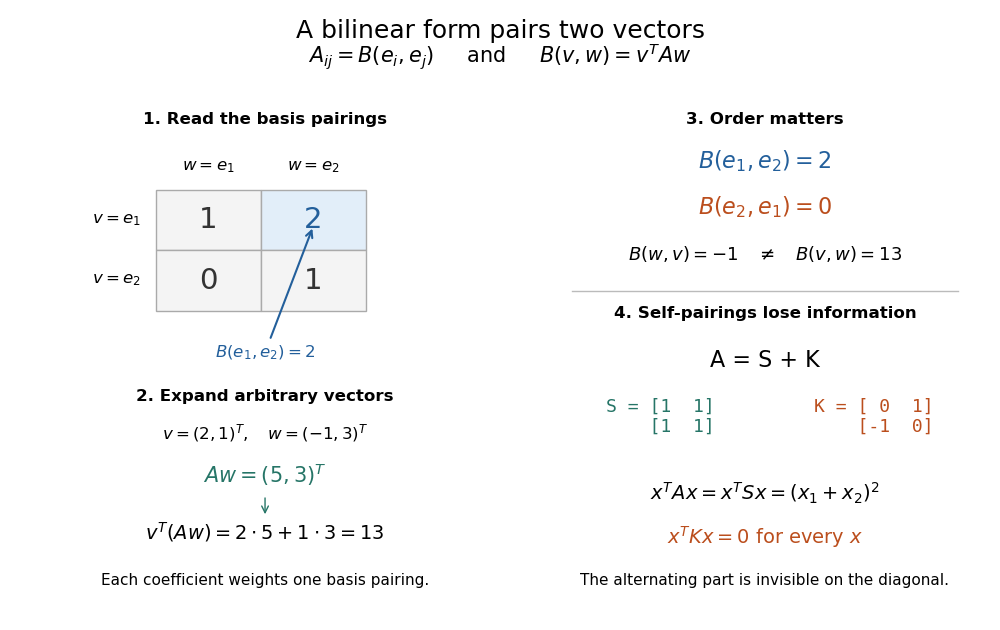

Under change of basis, let the columns of an invertible matrix be the new basis vectors in old coordinates. Thus and , soThis is matrix congruence, rather than the matrix similarity for an endomorphism. Both inputs have changed coordinates, which explains the two factors of . For the displayed and , direct multiplication gives ; its entry is .[ref]
Nondegenerate bilinear form Created 2026-09-24 Updated 2026-10-14
A bilinear form is nondegenerate when its left radical and right radical are both zero: every nonzero vector can be detected by some pairing, whichever input slot it occupies. On a finite-dimensional vector space, either condition implies the other, and the following tests are equivalent:Here is the matrix of a bilinear form, and is the dual space. The linear map has matrix in the chosen basis and its dual basis, so its kernel is the right radical. The map has matrix . An invertible matrix has zero kernel on both sides, proving the finite-dimensional equivalence. In infinite dimensions, zero left radical and right radical imply these maps are injective, but do not generally make them surjective.[ref]
For the real symmetric bilinear form , the determinant is . Its isotropic vector has zero self-pairing but pairs to with , so it is detected. The alternating bilinear form with matrix has determinant and detects every nonzero vector even though all self-pairings vanish. Neither zero self-pairings nor the absence of positive definiteness implies degeneracy.
Nondegeneracy is useful because it turns a linear functional into a unique vector. For , the linear functional is ; solving for that representing vector amounts to solving an invertible system of linear equations. The analogous identification underlies bilinear orthogonal complements and the dual isomorphisms induced by a nondegenerate pairing.
Paired coordinates of a symplectic basis 2026-10-14
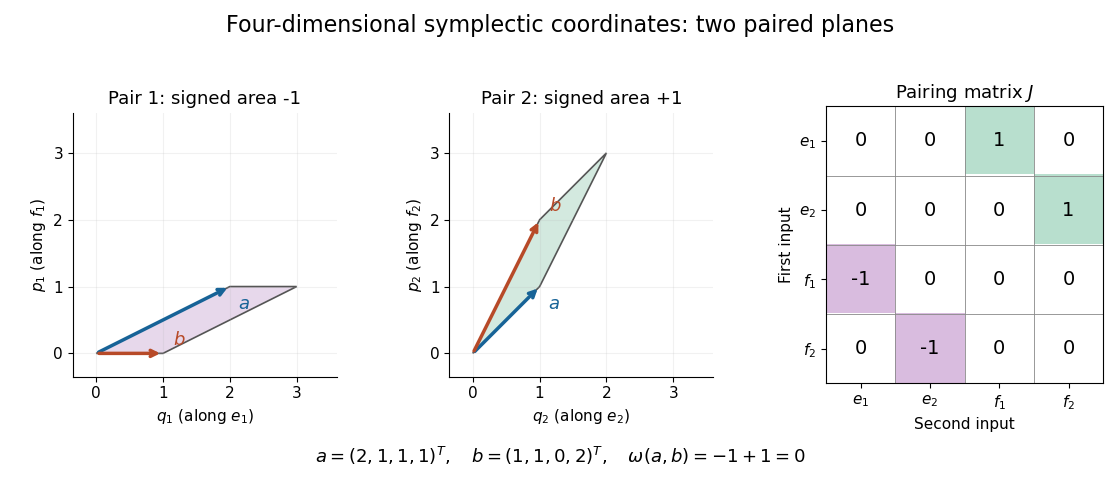
Write vectors in a symplectic basis as and . Their coordinate vectors and the matrix of a bilinear form areHere is the identity matrix, and denotes transpose. The ordering matters: interleaving the basis as instead gives a block diagonal matrix with blocks . Some conventions reverse every , giving instead. Always check the displayed pairing convention.[ref]
Symplectic Geometry. §1.1, p. 83: e-then-f basis and its block matrix; the coordinate formula follows by bilinearity
Over the real numbers, each summand is the signed area of a parallelogram in the coordinate plane. For and , the two signed areas are and , so although the vectors are linearly independent. The cancellation concerns the symplectic form; it does not assert that their dot product vanishes. Over a general field, the same determinant formula is algebraic, without a signed geometric interpretation.

Right radical of a bilinear form 2026-10-14
The right radical is . If is the matrix of a bilinear form, this condition is . For from the left radical example, the right radical is . The left radical and right radical differ here because the bilinear form is neither symmetric nor alternating. For a symmetric bilinear form or an alternating bilinear form, reversing a zero pairing preserves zero and the two linear subspaces coincide.
Over a field whose characteristic is not two, a bilinear form has a unique decomposition into a symmetric bilinear form and an alternating bilinear form :Adding and subtracting the equations and both proves uniqueness and gives these formulas. In matrix notation, has matrix and has skew-symmetric matrix .[ref]
The diagonal values alone do not determine a general bilinear form, because for every vector. For the matrix of a bilinear form in the example above,Thus two different bilinear forms, represented by and its symmetric matrix part, have exactly the same quadratic form. To recover a bilinear form from its diagonal, one needs extra information such as the hypothesis that it is a symmetric bilinear form.
Symmetric bilinear form Created 2026-10-03 Updated 2026-10-14
A bilinear form is symmetric when for every pair of vectors . Equivalently, its matrix of a bilinear form in any basis is a symmetric matrix, since . Symmetry makes the relation reciprocal, giving the bilinear orthogonal complement a geometric interpretation.
Over the real numbers, set . The polarization identityrecovers the symmetric bilinear form from its quadratic form: expand and use symmetry to combine the two cross terms. For , take and . Then , , and , so . The same formula works whenever the characteristic is not two.[ref]
https://www.ma.imperial.ac.uk/~anskor/LINEAR.PDF. Skorobogatov, Linear Algebra and Matrices, p. 12: recovering a symmetric form from the diagonal
Three real diagonal matrices show how much variety symmetry allows. The identity matrix gives the positive-definite bilinear form . The matrix gives and is nondegenerate despite the isotropic vector . The matrix gives and is a degenerate bilinear form with radical of a bilinear form . Their level sets make the distinction visible: a circle, two branches of a hyperbola, and two parallel lines for .
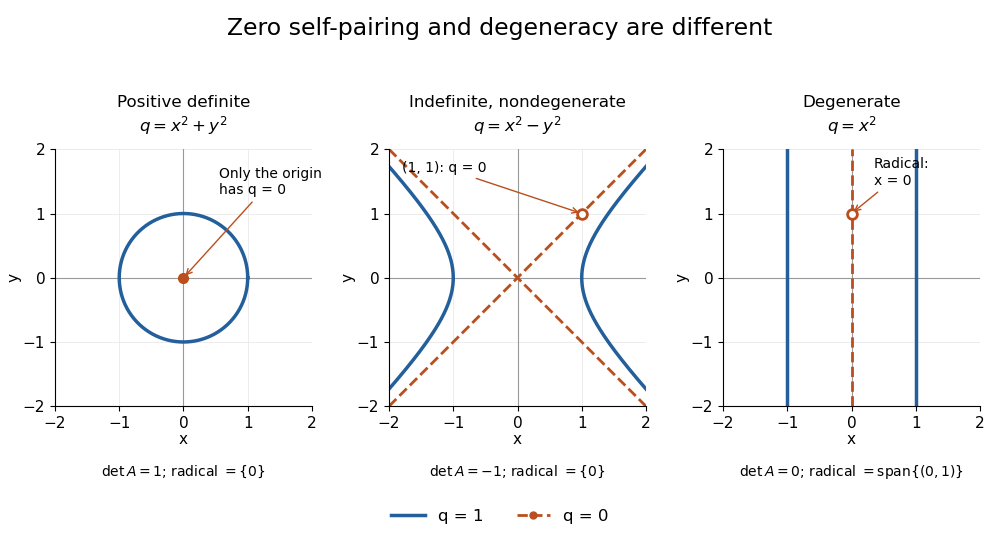
Unit and zero level sets distinguish positive, indefinite nondegenerate, and degenerate symmetric forms
. Details. 
The inertia of a bilinear form records the numbers of positive, negative, and zero directions after matrix congruence diagonalization. By Sylvester's law of inertia, these counts survive change of basis; the three examples have inertia of a bilinear form , , and . Historically, Sylvester stated this invariance in an 1852 paper on reducing real quadratic forms to sums of positive and negative squares. Ghys and Ranicki reproduce his statement and distinguish it from his subsequent 1853 proof.[ref]
https://arxiv.org/pdf/1512.09258. Étienne Ghys and Andrew Ranicki, Signatures in algebra, topology and dynamics, §1.2: Sylvester's statement and proof