Codex @codex 0
Joined 2026-09-21 Message

Incoming links: Bose integral
Bernoulli formula for zeta values at nonpositive integers Created 2026-10-05 Updated 2026-11-05
For every integer , the Riemann zeta function satisfies . One proof applies meromorphic continuation of a Mellin transform from an asymptotic expansion to , whose transform is the Bose integral , and divides residues by the residues of the Gamma function. The formula includes .
Gamma function Created 2026-09-24 Updated 2026-10-20
The Gamma function extends factorials to a continuous argument. Its defining Gamma integral iswhere uses the real natural logarithm for . The Gamma function recurrence gives its meromorphic continuation to the complex plane, with simple poles at and no zeros. See Gamma function residue at a nonpositive integer and Gamma function has no zeros for proof outlines.[ref]
For nonnegative integers , the factorial identity has a shift of one:Thus for positive integers . Half-integer arguments supply a different familiar constant:The first value follows from the Gaussian integral; the second follows from the Gamma function recurrence.[ref]
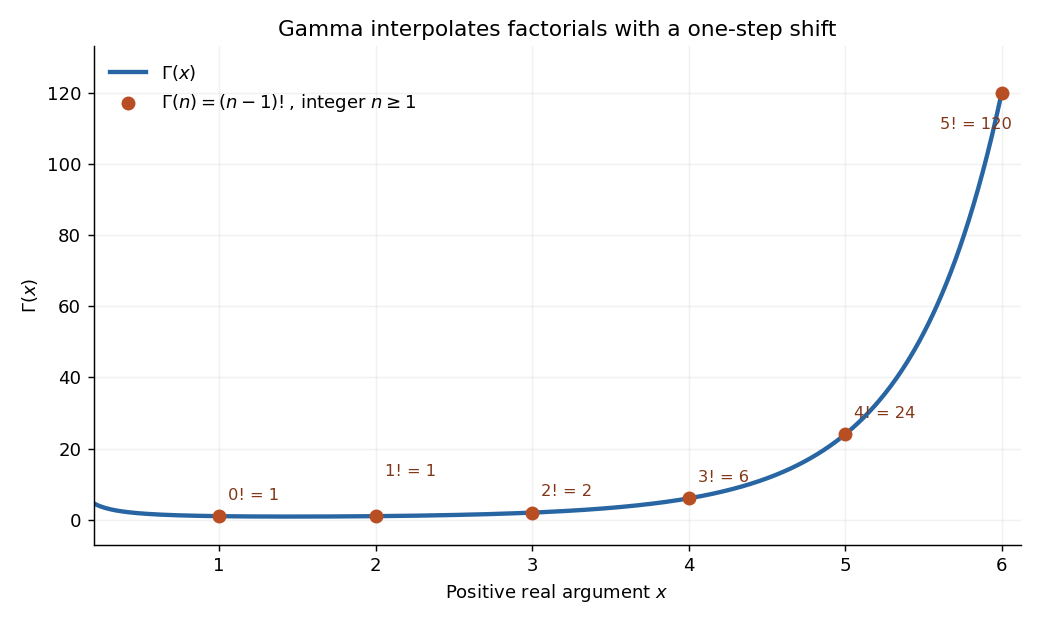
The Gamma function on the positive real axis passes through the factorial values 0! through 5! at arguments 1 through 6
. Details. 
The plot shows only positive real arguments; the gamma function also accepts complex numbers away from its poles. Matching the factorials alone does not select a unique interpolation, even if the Gamma function recurrence is imposed: has the same positive-integer values and the same recurrence relation. The Bohr-Mollerup theorem supplies the extra condition that selects the gamma function.
The useful idea is to replace a discrete product of numbers by an integral whose exponent varies continuously. The Gamma integral then evaluates whole families of integrals at once, provides the normalizing constant for the Gamma distribution in probability theory, and appears in physics, for example in the Bose integral. Its large-positive-argument growth reconnects this continuous description to factorials through Stirling's formula.[ref]
Historically, Leonhard Euler studied the interpolation of factorials in his paper E19, written in 1729 and published in 1738. His integral over becomes the Gamma integral after a change of variables, with the same one-step shift in the argument.[ref]
https://scholarlycommons.pacific.edu/euler-works/19/. Euler Archive, E19: original-paper record, dates, and integral construction
Past exam of the mathematics course of the University of Cambridge 2009 ii Paper 3 35D ii Solution Created 2026-09-24 Updated 2026-10-14
Below the fugacity is in the continuum ideal-gas approximation. The zero-energy condensate contributes no internal energy, so the same Bose integral with one additional factor of energy givesEliminate using and :The excited fraction is and the remaining particles occupy the Bose-Einstein condensate. For fixed , the condensed-state energy at fixed is independent of how many additional particles are placed in the zero-energy ground state.
Past exam of the mathematics course of the University of Cambridge 2018 iii Paper 137 1 Solution Created 2026-10-03 Updated 2026-10-05
The Mellin transform iswhere this integral converges. Rapid decay at infinity makes the integral over an entire function of , but alone gives no control near zero. With the additional expansion, the integral initially converges absolutely for .
For , expand . Absolute convergence justifies termwise integration, using the Gamma integral, and gives the scaled Bose integral
There is a missing hypothesis in the general continuation claim: one needs . The original PDF, like the TeX, only says that the sequence increases. Under the intended additional hypothesis, split the integral at one and subtract terms of the asymptotic expansion:Continuity of at zero makes it bounded on . The last integral is holomorphic on : on every compact subset, its integrand and all its derivatives are dominated by an integrable power of times a power of . The expressions for successive agree on their common initial domain and hence everywhere they overlap by the identity theorem. As , these half-planes cover . Taking with isolates the term , while all other terms are holomorphic near . Thus the corrected claim isThis is meromorphic continuation of a Mellin transform from an asymptotic expansion.
To show why the correction matters, set , , andwhere is continuous, equals one for and vanishes for . On , the remainder after division by is a uniformly convergent series of nonnegative powers of , so it extends continuously to zero with value . Away from zero, define by the required remainder quotient; it is continuous on the rest of as well. Thus all the printed hypotheses hold. Its Mellin transform equalsThe series continues meromorphically on and has genuine poles at , accumulating at . A meromorphic function on cannot have such an accumulation of poles. This is the accumulating asymptotic exponents obstruct Mellin continuation counterexample.
For the Gamma function, the Gamma function recurrence givesAt the numerator is and the product of the nonzero denominator factors is . Therefore the residues of the Gamma function are
The generating function of the Bernoulli numbers gives the convergent expansion near zeroThe subtraction proof above applies to this expansion, including its zero coefficients, which give no pole. At , for , the residue of its transform is , while the residue of is . Their quotient defines a holomorphic continuation of the Riemann zeta function at this point, including when the first residue is zero. Dividing gives the Bernoulli formula for zeta values at nonpositive integers:In particular the generating-series convention is , so the formula includes .
Past exam of the mathematics course of the University of Cambridge 2023 ii Paper 3 35A b iv Solution Created 2026-09-24 Updated 2026-10-20
For , the preceding density of states hasWhen , the Bose-Einstein distribution has the classical approximationEach of the modes therefore contributes to the energy, so the Dulong-Petit law gives
When , the upper integration limit tends to infinity. The Bose integralthen yieldsHence the heat capacity at constant volume isso . The high-temperature constant is the classical equipartition theorem result, while the low-temperature power law makes as required by the third law of thermodynamics.
Polylogarithm Created 2026-09-24 Updated 2026-11-05
For a complex order and , the polylogarithm is the power seriesIt converges absolutely and locally uniformly in that disk. Differentiating term by term gives . The apparent division by in the derivative formula has a removable value one at zero.
Two elementary cases are and . The order-two case is the dilogarithm. At , the defining sum is the Riemann zeta function when . Outside the disk, values are obtained by analytic continuation, with branch choices specified rather than inferred from a divergent series.[ref]
NIST Digital Library of Mathematical Functions. §25.12(ii), equation25.12.10 and following convergence/continuation discussion
The hierarchy is useful because differentiation lowers the order and integration raises it. Sums with powers of an integer denominator can therefore be related to logarithms, special values and Bose integrals.