The Bernoulli numbers are a sequence of rational numbers that turns integer power sums into exact polynomials. The same numbers describe corrections when a discrete summation is compared with an integral. For example, the sum of squares is : the leading term is an integral, while the last two terms repair the difference between area and sampled values.
We use throughout. The defining exponential generating function isHere is the exponential function and is a factorial; in particular, the coefficient of is , rather than . At the quotient has limiting value one. The identity can be read algebraically as a formal power series, or as a convergent series for .[ref]
NIST Digital Library of Mathematical Functions. Karl Dilcher, Chapter 24, §24.2(i), equation 24.2.1: defining generating function and convergence domain
To compute the numbers, multiply by and compare coefficients. The resulting recurrence relation, with binomial coefficients, isThus , , and give , , and . Continuing givesThe recurrence relation agrees with equation 24.5.3 after replacing its index by .[ref]
NIST Digital Library of Mathematical Functions. Karl Dilcher, Chapter 24, §24.5(i), equation 24.5.3; first values also in Table 24.2.1
Why do so many values vanish? Put . Direct substitution gives , so is an even function. Its odd power series coefficients vanish: for every positive integer . The exception matters. The alternative convention obtained from has and exactly the same other values. A formula copied between conventions must also retain its summation endpoints.
Historically, integer power sums were studied before the modern Bernoulli number notation. A historical study examines formulas published in 1631 and distinguishes those separate formulas from encoding all exponents using one sequence of constants. This is a useful motivation for the generating function, without assigning all discovery to a single moment. [ref]
Johann Faulhaber and sums of powers by Donald E. Knuth. Donald E. Knuth, Johann Faulhaber and sums of powers, 1992 preprint, pp. 2 and 14: the 1631 power-sum formulas and the uniform Bernoulli-number formula
The Bernoulli polynomials extend the Bernoulli numbers by inserting the exponential function into their exponential generating function:For example, , , , and .[ref]
NIST Digital Library of Mathematical Functions. Karl Dilcher, Chapter 24, equations 24.2.3–24.2.5 and Table 24.2.2
Their crucial property is a finite difference identity:Indeed, subtracting the two exponential generating functions cancels and leaves . Thus plays for discrete summation the role that plays for integration: taking a unit finite difference recovers .[ref]
An integer power sum adds a fixed nonnegative integer power of consecutive integers. Let be a nonnegative integer and a nonnegative integer. For , use the constant polynomial , including at zero, so . Summing the Bernoulli polynomial finite difference identity makes the intermediate terms cancel and givesThe sum is empty when . For the endpoints , the formula valid also at is insteadFor , , and this becomes the standard positive-endpoint formula. The exception at is essential: .[ref]
NIST Digital Library of Mathematical Functions. Karl Dilcher, Chapter 24, equations 24.4.1 and 24.4.7; the displayed equation 24.4.7 needs the endpoint adjustment at exponent zero
For , adding to changes the contribution from to . Equivalently,where only differs from our Bernoulli numbers. A quick endpoint check is : the sums over and are and , respectively. The latter is a triangular number.
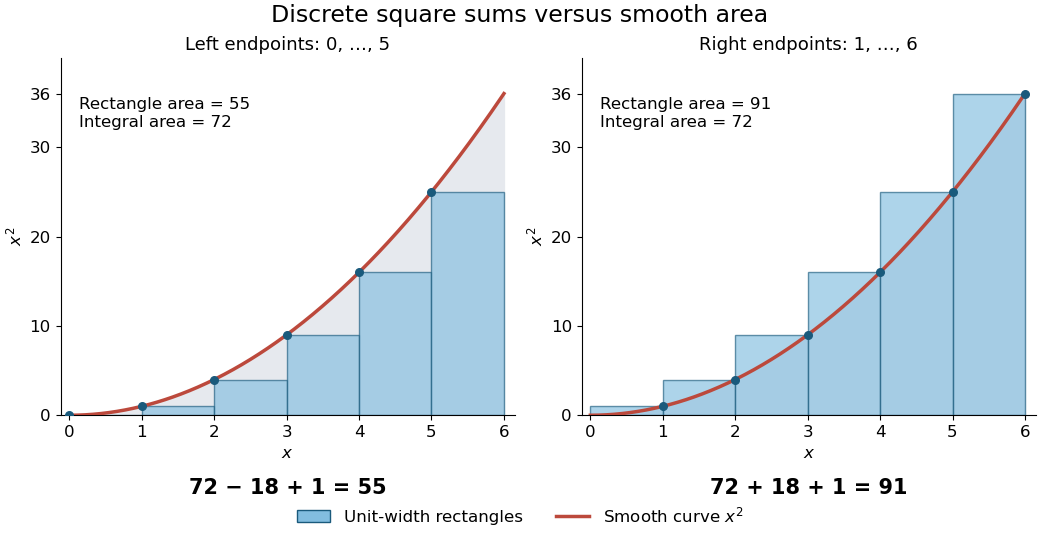
For a concrete comparison, take on . The integral is , whereas the unit-width left and right Riemann sums are and . The exact integer power sum formula givesThe endpoint choice explains the opposite signs of the correction. The remaining correction is one in both cases.
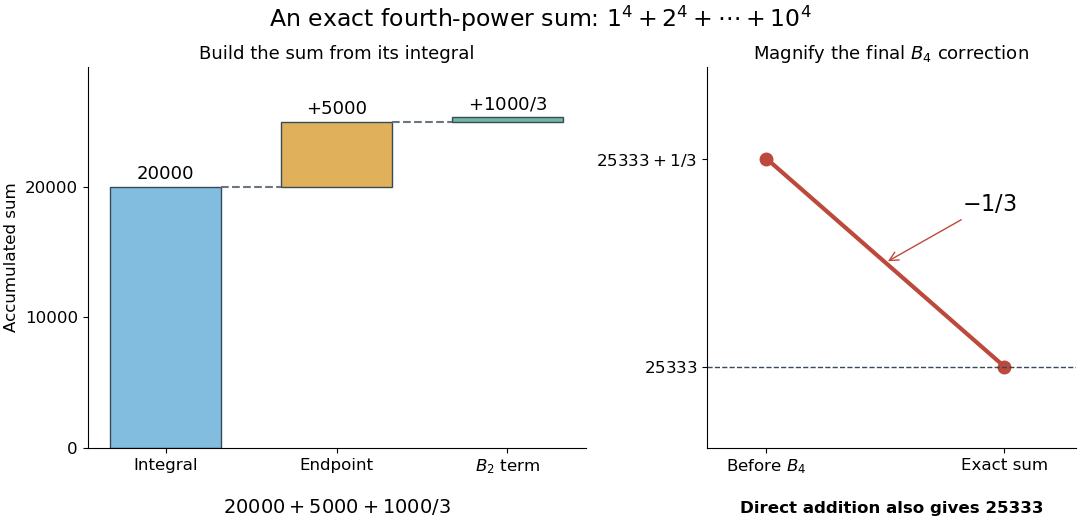
The same method is useful far beyond squares of numbers. Substituting , , and into the integer power sum formula gives the exact fourth-power resultAt , this isThus a finite polynomial calculation replaces ten additions, or a million additions if is a million. Although the individual corrections can be rational numbers, the result is the exact integer sum.
There is also a useful numerical integration interpretation. The average of the left and right Riemann sums is the composite trapezoidal rule. For , the endpoint corrections cancel but its value is , one above the true integral. Subtracting the correction makes this particular polynomial example exact. For , the two interior corrections above can be written and . These are exact identities for these polynomials; extending such corrections to general functions requires a separate error analysis.
The defining generating function of the Bernoulli numbers, with , gives this identity of formal Laurent series by . Therefore is regular and odd. Integrating it gives the even formal logarithm of . Its even derivatives of order at zero are , while the odd derivatives vanish. This computes the cyclotomic higher logarithmic derivatives of symmetric cyclotomic units without introducing a spurious linear term.
The Euler evaluation of even zeta values turns a family of series into exact expressions using Bernoulli numbers, factorials and powers of . For every positive integer ,Here is the Riemann zeta function, defined by its convergent series at these arguments, and the Bernoulli number convention is . The alternating sign combines with the sign of to give a positive sum.[ref]
Substituting , and givesThe first identity answers the Basel problem. It is surprising because the original series only mentions reciprocal squares of integers, while its exact sum involves the circle constant . The cotangent partial-fraction expansion supplies a connection between the two: trigonometric functions encode equally spaced integer poles, whose expansion brings the reciprocal powers into view.
For an original numerical comparison, the first ten terms give , while . The omitted positive terms still contribute approximately . For fourth powers, the ten-term partial sum is approximately , only below . Both are convergent series, but the second approaches its limit much faster.
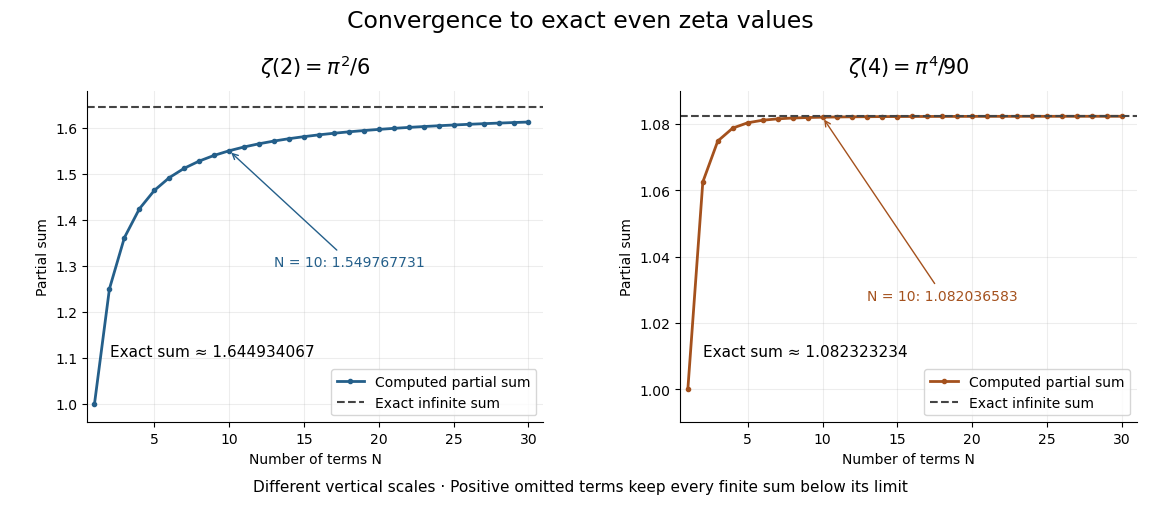
Exact evaluation is useful beyond obtaining more digits. It supplies an independent check on a numerical summation, exposes how Bernoulli numbers organize infinitely many identities, and makes the remaining series truncation error measurable without knowing any omitted terms individually. The even integer condition is essential to this formula: putting into it is not a way to evaluate , since the required Bernoulli number index and factorial expression here are indexed by positive integers.
Historically, Leonhard Euler announced reciprocal-square and reciprocal-fourth-power evaluations in §2 of On the sums of series of reciprocals by Leonhard Euler. That paper was presented on 5 December 1735 and published in 1740, as the English translation's first-page note records. His §§3–8 develop a route through the sine power series and relationships between roots and coefficients. The cotangent calculation below is a concise modern presentation of the connection.[ref]
On the sums of series of reciprocals by Leonhard Euler. English translation, p. 1, §2 and publication note; pp. 3–4, §§3–8: sine series, roots and coefficients
For a real exponent and a positive integer , the series truncation error in the defining Riemann zeta function series isThe integral comparison for the positive decreasing function gives the explicit boundsOn each unit interval, the area under lies between its endpoint heights. Summing from the first omitted term gives the lower integral from to infinity and the upper integral from to infinity. This uses positivity and monotonicity, not an assumption that the last computed term equals the remaining error.
At , the bounds are , whereas . The errors above fit both intervals. Merely looking at the eleventh term would give for squares, far smaller than the actual remaining .
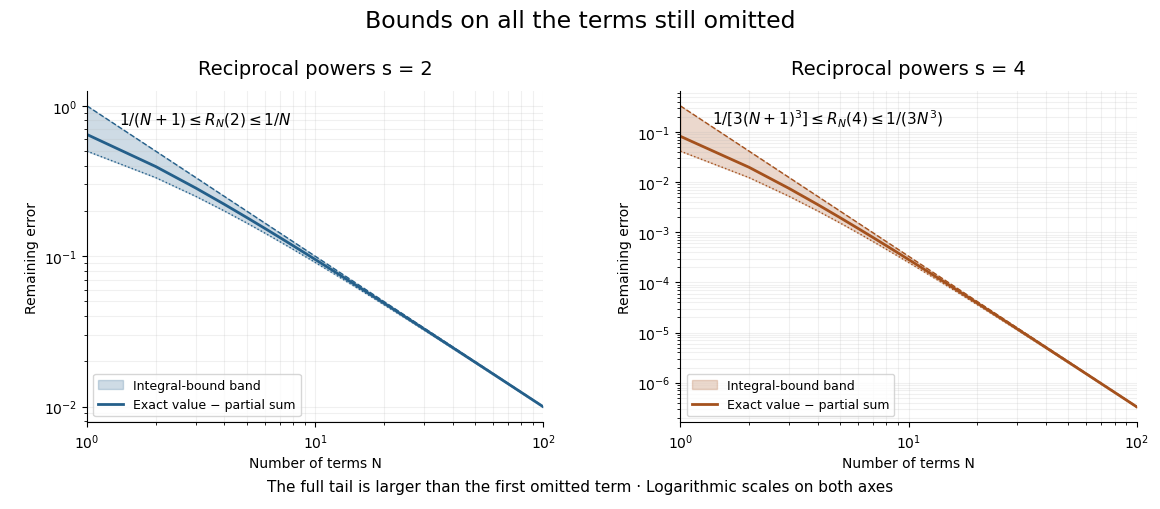
For a chosen absolute error target , the sufficient condition is , rounded upward to an integer. Thus requires by this bound for squares but only for fourth powers. This is a guarantee from an upper bound, not a claim that those are the smallest successful term counts.
The cotangent partial-fraction expansion gives, on ,The Bernoulli number generating function gives the same Laurent series in another form:The term cancels the separate ; the higher odd Bernoulli numbers vanish. Comparing Laurent coefficients therefore gives , which is the stated real formula because . The cotangent partial-fraction expansion justifies the convergent expansion before the coefficient comparison; a finite plot of partial sums alone would not prove the infinite identity.
For a Dirichlet character of conductor , define the generalized Bernoulli numbers byThey express special values of Dirichlet L-functions at nonpositive integers and occur in the interpolation formula for Kubota-Leopoldt p-adic L-functions.
Articles by others on the same topic



Bernoulli numbers are a sequence of rational numbers that have important applications in number theory and mathematical analysis, particularly in the computation of sums of powers of integers and in the theory of Fourier series. They are named after the Swiss mathematician Jacob Bernoulli.