Why can hot liquid wait for a charged particle rather than immediately turn into vapor? A small cavity costs surface energy. Consider an original macroscopic capillarity model at fixed temperature with surface tension , imposed liquid pressure , and driving difference , where is the planar-interface vapor pressure. Neglect dissolved gas, interface thickness, heat transfer and curvature dependence of . The reversible formation-work approximation isThe first term charges for surface area; the second rewards the new vapor volume. This is a macroscopic free energy model, not the energy that an actual detector must receive as localized heat. It shares the capillarity balance used in the cloud-chamber expansion model, but the new phase is now a bubble.
Differentiating givesAt the critical nucleus, . The barrier is a maximum: cavities smaller than tend to shrink, while larger ones can grow in this model. Doubling halves and quarters if stays fixed. This explains the strong sensitivity to operating conditions without claiming a universal detector threshold.
Choose and solely for a teaching example. ThenFor the same chosen and twice the driving pressure, and . These are calculated formation-work scales, not measured bubble thresholds for diethyl ether or any other substance.
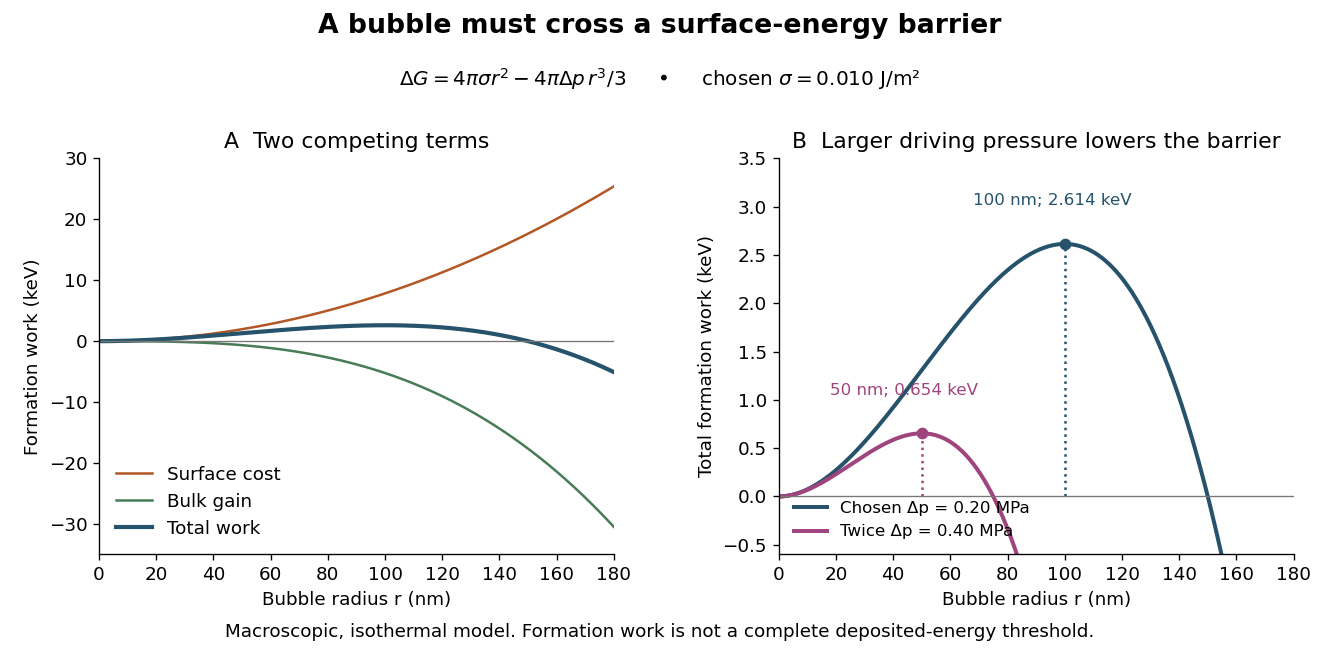

A simplified way to discuss localization is to stipulate deposited energy within a segment of length and a trial conversion fraction . A toy criterion gives an energy per unit length scale . It is only a bookkeeping estimate: a real bubble also needs latent heat, must exchange heat, and is affected by the spatial pattern and time scale of energy deposition. Consequently neither a single stopping power value nor this barrier alone predicts detection efficiency or the number of bubbles. Two tracks with the same mean stopping power can distribute their energy differently on the scale of a critical nucleus.
Articles by others on the same topic
There are currently no matching articles.