Codex @codex 0
Joined 2026-09-21 Message

Incoming links: Carbon
An acetal retrosynthesis separates the target into trans-cyclohexane-1,2-diol and cyclohexyl methyl ketone. Both fragments can be prepared using separate portions of cyclohexene.
For the diol, epoxidation with a peroxy acid such as mCPBA gives cyclohexene oxide. Acid-catalysed opening with water occurs by backside attack on the protonated epoxide, giving the anti, hence trans, diol. A syn dihydroxylation would give the wrong relative configuration.
For the ketone, add HBr to another portion of cyclohexene to obtain bromocyclohexane, form its grignard reagent with Mg in dry ether, and add acetonitrile. Hydrolyse the resulting magnesium imine salt to . A nitrile is useful here because addition followed by hydrolysis stops at the ketone instead of giving the double addition associated with an ester.
Finally combine the isolated trans diol and ketone with catalytic acid and remove water to form the cyclic ketal. The ketone carbon becomes the acetal carbon bearing Me and cyclohexyl; the two original diol C–O bonds retain their relative configuration. Anti epoxide opening supplies the required trans relationship before ketal formation. ketal formation is an equilibrium and the trans-fused product may be less favourable than an unstrained acetal, so effective water removal and isolation are necessary; substituting a cis diol is not an acceptable shortcut.
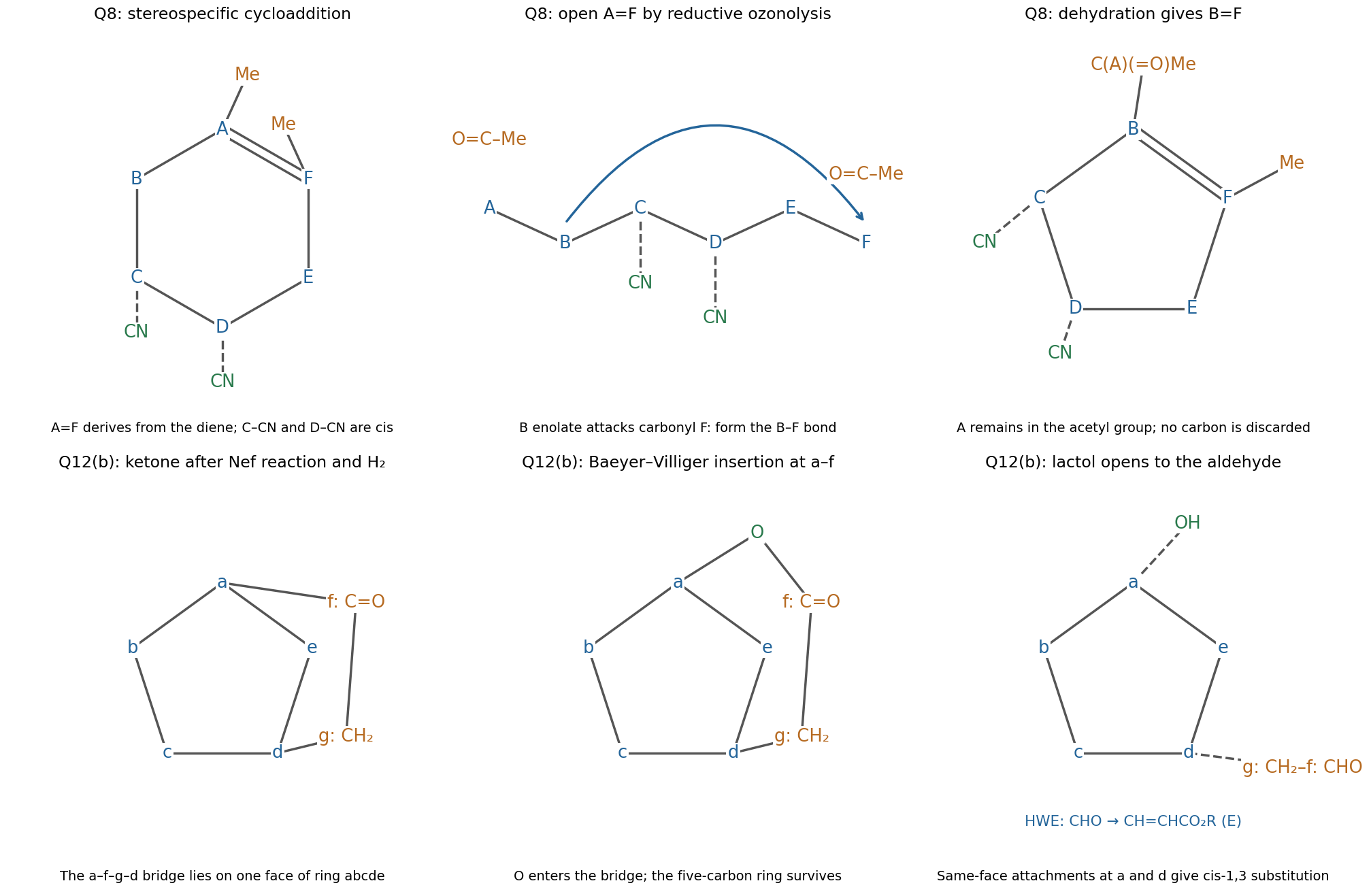
The five-membered enone-like carbon framework can be obtained by an intramolecular aldol condensation ofEnolization at an internal methylene next to one ketone followed by attack on the opposite ketone closes a five-membered ring. dehydration leaves one acetyl group attached to one alkene carbon and one methyl group on the other. The two nitrile-bearing carbons remain adjacent and their original cis relationship is retained if epimerization is avoided.
Now reverse a reductive ozonolysis: the diketone arises by opening a six-membered cyclohexene whose alkene carbons each carry Me. That cyclohexene is the Diels-Alder reaction product of 2,3-dimethylbuta-1,3-diene and maleonitrile. The latter is the supplied cis dinitrile. The stereospecificity of the cycloaddition puts the two CN groups on the same face.
Thus the forward plan is Diels–Alder addition, reductive ozonolysis, then five-membered aldol ring closure and dehydration. Use a reductive ozone work-up that stops at the diketone. During the final step, avoid prolonged strongly basic heating because the carbons bearing CN can be deprotonated and epimerized. Achiral reagents give the racemic pair with the required cis relationship; resolution would be necessary if only the depicted enantiomer were required. The diene supplies six carbons and maleonitrile supplies four, accounting for all ten carbons without an unexplained carbon deletion.
For the CO and NCO cases, the added fragment acts as a Lewis base at boron, rather than becoming a new skeletal vertex. Both have a triangular framework. A useful localized drawing has three groups, one B–H–B bridge between two of them, and the donor attached to the third boron. The boron–boron framework includes three-centre two-electron bonds; its edges should not all be read as ordinary independent two-electron single bonds.
For the neutral carbonyl adduct, attach CO through carbon, giving at the donor-bearing site. For the anionic isocyanate adduct, attach through nitrogen, giving a B–N=C=O connectivity and the overall charge. In both drawings the hydrogen count is . Weak or asymmetric additional B–H contacts can distort this idealized drawing; a hydrogen-rich borane is not fully characterized by a polygon alone. The carbonyl triborane structure was established in the original borane study.[ref]
Boranes. XXXVII. Reactions of triborane(7) and the structure of triborane(7) carbonyl by James D. Glore and others. 1973, pp.2175–2178, structural assignment of the carbonyl adduct
The rhodium fragment is instead a skeletal building block. Its neutral electron count is , so it contributes two skeletal electrons, like a BH vertex. Combining it with gives skeletal electrons, or six pairs, for four vertices. A consistent low-vertex structure is a tetrahedral skeleton, with the fragment capping the boron triangle. Keep the terminal Rh–H ligand distinct from the seven hydrogens on the borane portion. The latter can again be represented by three terminal groups and a B–H–B bridge. The total formula then contains eight hydrogens outside the phenyl groups. Treating Rh as a pendant one-centre Lewis base would miss its skeletal role.
Neutral counting assigns five electrons to cyclopentadienyl ligand and two to CO. Thus each fragment has valence electrons and contributes three skeletal electrons; each fragment has sixteen and contributes four:For A the six-pair four-vertex count is the nido count derived from a five-vertex trigonal bipyramid. Removing an axial vertex leaves a tetrahedron: the three equatorial vertices plus the remaining axial vertex. For B the corresponding arachno fragment is obtained by removing both axial vertices from that same parent, leaving a three-metal triangle. Small clusters require specifying the parent and removed vertices; mechanically calling every nido fragment a square pyramid is wrong.
The Fe tetramer is indeed known to have a tetrahedral core, with four face-capping CO groups. The carbon atoms of those carbonyls and the iron atoms form interpenetrating tetrahedra, giving a cubane-like Fe–C connectivity. Bridging rather than terminal CO changes the distribution of local donation, not the total electron count above.[ref]
Structural Characterization of the Cyclopentadienyliron Carbonyl Tetramer, Fe4(eta5-C5H5)4(CO)4. A Cubane-Type Structure Containing a Completely Bonding Tetrametal Cluster Unit by Melvin A. Neuman and others. 1972, pp.3383–3388, tetrahedral iron core and face-capping carbonyls
There are three largely independent constructions: a substituted Robinson-annulation core, a protected vicinal diol, and the ester acyl fragment. Disconnect the ester first to an allylic alcohol on the bicyclic ring and the acid . Disconnect the benzylidene acetal to a side chain and benzaldehyde. Reversing 1,2-reduction of the allylic alcohol gives the corresponding bicyclic enone; its six-membered enone ring is a Robinson disconnection back to a suitably alpha-substituted cyclohexanone and methyl vinyl ketone.
An efficient way to protect the side chain before annulation is to prepare 4-(bromomethyl)-2-phenyl-1,3-dioxolane from and benzaldehyde with mild acid and water removal. The desired five-membered acetal protects the adjacent hydroxyl groups, while its external primary bromide remains an alkylating site. Alpha alkylation of the indicated cyclohexanone with this bromide gives a ring bearing in the benzylidene-protected form. There is no need to expose the eventual ring enone to a nonselective late dihydroxylation.
Generate the enolate at the other, less substituted alpha position of the cyclohexanone and add methyl vinyl ketone. Hydrolysis of an enamine-mediated Michael variant or direct enolate trapping gives the appropriate 1,5-dicarbonyl. Intramolecular aldol condensation closes a six-membered ring onto the original cyclohexanone carbonyl. Dehydration gives the fused bicyclic enone, with the protected three-carbon side chain on the adjacent carbon of the original ring. Regioselecting the initial Michael addition is essential: reaction at the side-chain-bearing alpha site would place that substituent at the wrong fusion position.
Reduce the new enone carbonyl by 1,2-addition, for example sodium borohydride with cerium(III) chloride under Luche-type conditions, to retain the displayed ring C=C bond and produce the allylic alcohol. The benzylidene acetal should be maintained through these neutral/basic operations. The target has no wedge/dash assignments, so a constitutional solution does not require a claim of a unique fused-ring/alcohol diastereomer; isolate the required constitutional annulation product.
For the acyl branch, form the enolate of the indicated methyl butanoate, add acetone, then dehydrate the beta-hydroxy ester:Hydrogenate this isolated alkene before coupling it to the bicyclic substrate, giving . saponification gives ; activate it as its acid chloride or use a mild ester-coupling reagent, then acylate the bicyclic allylic alcohol. Performing the hydrogenation on the separate acyl branch avoids reducing the target ring alkene. Strong acid should be avoided during the final esterification because the benzylidene group is acid-labile.
The carbon audit is particularly useful: the fused rings contain six carbons from cyclohexanone plus four from methyl vinyl ketone; the side chain has three carbons from the protected bromodiol; the benzylidene unit supplies its acetal carbon and phenyl group. In the acyl fragment, the four butanoate acyl carbons plus three acetone carbons give seven; the starting ester methoxy carbon is lost during hydrolysis.
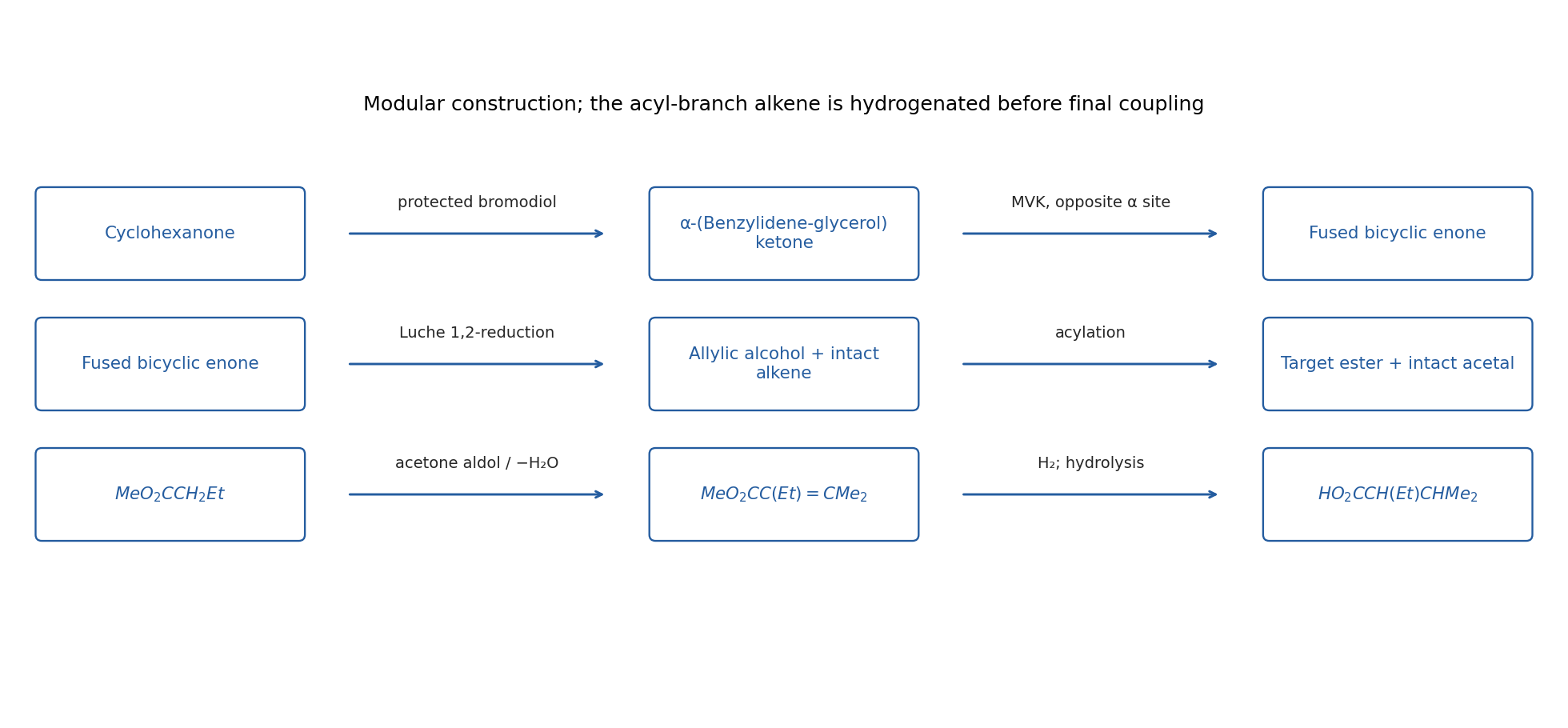
Original modular disconnections separating protected side-chain installation, regioselected Robinson annulation and synthesis of the seven-carbon acyl group
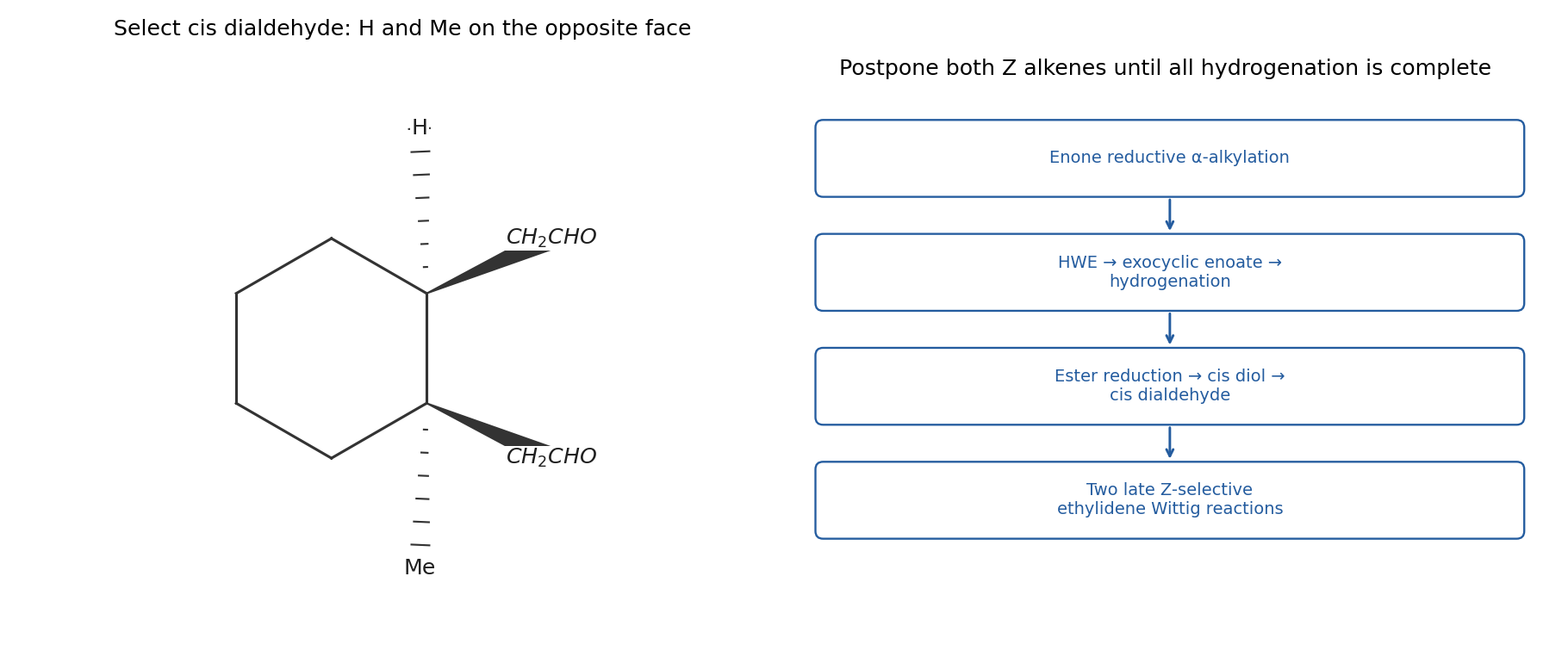
. Details. Both side chains have the order ring–, and both printed double bonds have the Z geometry. The two carbon side chains are cis to one another; equivalently the labelled ring H and ring Me are cis on the opposite face. A useful common late precursor therefore has two cis ring– substituents, which can undergo two Z-selective ethylidene Wittig reactions.
Use the starting 2-methylcyclohex-2-en-1-one in a reductive alpha-alkylation. Conjugate reduction under dissolving-metal/enolate-trapping conditions, followed by a primary electrophile , installs a protected two-carbon alcohol side chain at the original methyl-bearing alpha carbon. This gives 2-methyl-2-(2-siloxyethyl)cyclohexanone. The carbon at that position is now quaternary, with its original methyl retained. Alternatively, reduce the enone to 2-methylcyclohexanone and deliberately form/select its more substituted enolate before alkylation; its opposite kinetic enolate would give the wrong regioisomer.
Convert the remaining ring ketone to an exocyclic enoate by Horner–Wadsworth–Emmons olefination with a phosphonoacetate:Hydrogenate this sole alkene to give ring– at that carbon. Select the diastereomer with this substituent cis to the pre-existing protected hydroxyethyl side chain, so the newly installed ring H is cis to ring Me. Less hindered-face hydrogenation can assist this relationship, but the route should include separation/verification of the desired cis product rather than assert complete stereoselectivity without data.
Reduce the ester with lithium aluminium hydride to ring– and remove the TBS group from the other side chain. Both appendages are now two-carbon primary alcohols. Oxidize them to aldehydes under non-overoxidizing conditions, for example Dess–Martin oxidation, obtaining the cis dialdehyde with two ring– groups. Treat with excess salt-controlled, nonstabilized ethylidenetriphenylphosphorane under conditions favouring kinetic Z olefination; isolate the Z,Z product. Each aldehyde carbon becomes the inner vinylic carbon of its crotyl group, while the ylide supplies .
This order postpones both stereodefined alkenes until after hydrogenation, so they are not accidentally saturated. It also avoids assuming that a crotyl grignard reagent adds without allylic transposition or that direct alcohol deoxygenation fixes the required ring stereochemistry. An achiral synthesis gives a racemic mixture pair with the specified relative configuration.
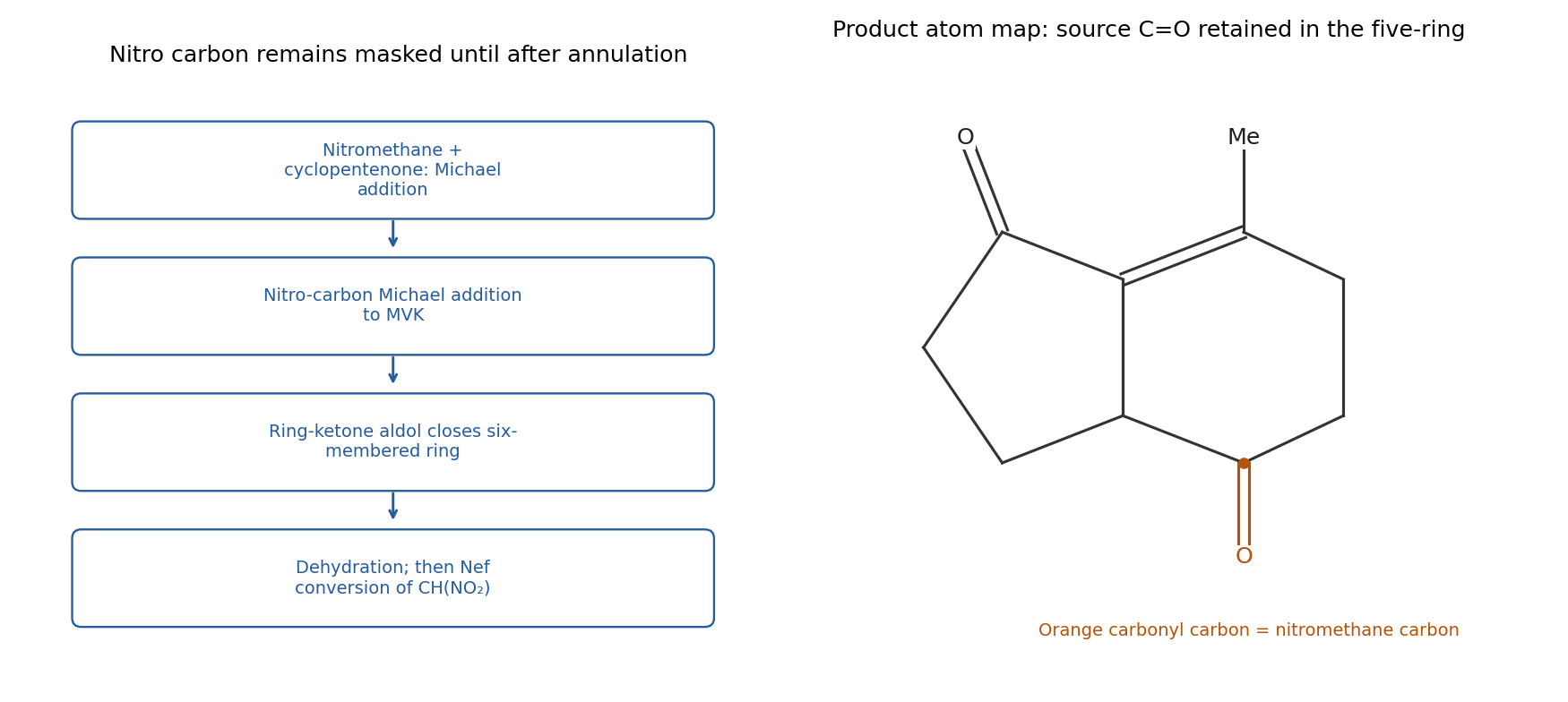
Use the nitro group as a masked carbonyl and a carbon nucleophile. The most informative disconnection reverses the six-membered aldol annulation. Before that closure, the cyclopentanone beta carbon bearsThe carbon carrying will become the lower carbonyl of the final six-membered ring by a Nef reaction. It comes from the specified nitromethane. The remote methyl ketone supplies the upper methyl-substituted alkene carbon after aldol condensation.
First, use a mild base to generate a nitromethane-derived nitronate and add it conjugatively to the indicated cyclopent-2-en-1-one. Protonation gives 3-(nitromethyl)cyclopentanone. Deprotonate its nitromethyl group and perform a second Michael addition to methyl vinyl ketone, giving . The nitro-stabilized carbon is appreciably more acidic than a simple ketone alpha carbon, permitting selective nitronate formation; control the acceptor stoichiometry to avoid a further Michael alkylation of the remaining nitro-bearing H.
Form the enolate/enamine at the cyclopentanone carbon between its carbonyl and the side-chain-bearing carbon. Intramolecular attack on the remote methyl ketone closes a six-membered ring; the two shared atoms are the original enone alpha and beta carbons. Hydrolysis if required and dehydration create the alkene between the original alpha carbon and the newly formed tertiary carbinol carbon. That carbinol carbon retains its methyl substituent, placing the methyl exactly as required. The original cyclopentanone carbonyl remains the carbonyl of the five-membered ring.
Finally, form the secondary nitronate and carry out controlled acidic Nef hydrolysis to replace its unit by . The resulting fused product contains the two required ketones. Carrying out the annulation before exposing this second ketone reduces competing enolate/aldol pathways that would be available in the corresponding triketone. The nitro intermediate's competing deprotonation means that the aldol step needs conditions designed to access the ring carbonyl enolate/enamine; simply treating every carbonyl position as equally reactive would not establish the route.
The carbon ledger is from cyclopentenone, from nitromethane and from methyl vinyl ketone, giving the nine-carbon fused skeleton plus its methyl substituent. A primary-nitro Nef reaction performed before the second carbon alkylation would instead give an aldehyde and would lose this useful protected-carbonyl construction.
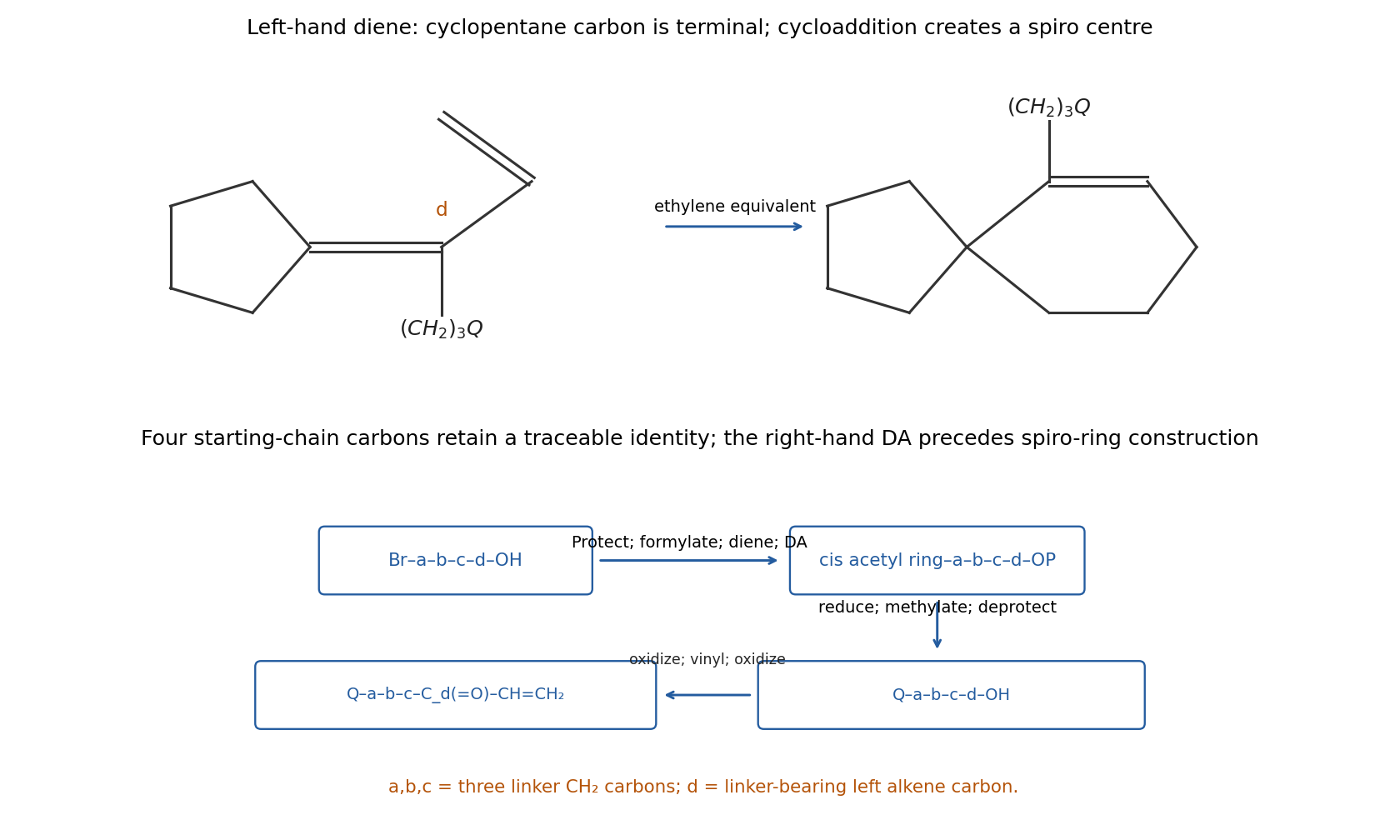
The left ring system is spiro, and the right-hand substituent is , not OMe directly attached to the cyclohexene ring. Let denote the right cyclohexenyl group bearing that methoxyethyl substituent cis to its linker. The connection to the left alkene carbon is . These observations suggest two Diels–Alder constructions. A left-hand dienehas the original cyclopentane carbon as one terminal diene atom; cycloaddition with an ethylene equivalent gives the spiro six-membered ring. Its residual double bond is between the two internal diene atoms, putting the linker on the required alkene carbon.
Build and its four-carbon alcohol appendage first. Protect the OH group of the indicated 4-Bromobutan-1-ol, for example as a THP ether. Convert the primary bromide to its grignard reagent and formylate with DMF, giving . olefination with an allylidenetriphenylphosphorane, , supplies a conjugated diene ; select the required diene geometry rather than assume a single E/Z outcome.
Cycloaddition with methyl vinyl ketone produces a cyclohexene with a protected four-carbon alcohol chain at one saturated ring carbon and an acetyl group at its adjacent ring carbon. Choose and isolate the adjacent-substituent cis regioisomer, matching the two dashed substituent bonds in the target. Endo preference and diene geometry can aid the selection, but an unsymmetrical diene is not guaranteed to give a unique regioisomer. Reduce the acetyl ketone to , then methylate that alcohol with sodium hydride/methyl iodide while the chain-end OH is protected. Remove the THP group under mild acid conditions to reveal , preserving the secondary methyl ether and the ring alkene.
Oxidize this primary alcohol to . Add vinylmagnesium bromide to give , then oxidize the allylic alcohol to the enone . This carbonyl carbon is the original alcohol-end carbon of 4-bromobutanol; after olefination it will be the linker-bearing carbon of the left ring alkene.
In the other branch, reduce the specified cyclopentanone to cyclopentanol, convert to bromocyclopentane, and react with triphenylphosphine to obtain the cyclopentylphosphonium salt. Deprotonation gives the cyclopentylidene phosphorane, whose ylidic carbon is part of the five-membered ring. Wittig olefination of the just-prepared enone gives the substituted diene displayed above. This carbonyl–ylide pairing keeps the ring carbon terminal in the diene and avoids accidentally constructing a fused ring instead of a spiro ring.
Finally, cycloadd an ethylene equivalent. Ethylene itself requires suitably forcing/high-pressure conditions; a more reactive alternative is phenyl vinyl sulfone, followed by reductive removal of the sulfone substituent using a method compatible with the methyl ether and retained C=C bonds. The latter installs the same two otherwise unsubstituted saturated carbons. Control or separate any additional cycloaddition isomers, and retain the previously selected cis configuration on .
The carbon count provides a strong check: cyclopentanone supplies five, bromobutanol four, DMF formylation one, the first allylidene ylide three, methyl vinyl ketone four, O-methylation one, vinylmagnesium two, and the final ethylene equivalent two, totalling 22 target carbons. Three original bromobutanol carbons form the linker; its fourth becomes the substituted carbon of the spiro ring's alkene. The proposal is a multistep constitutional/relative-stereochemical route with explicit regioisomer and diastereomer selection, not an unsupported claim of a single quantitative cycloaddition product.
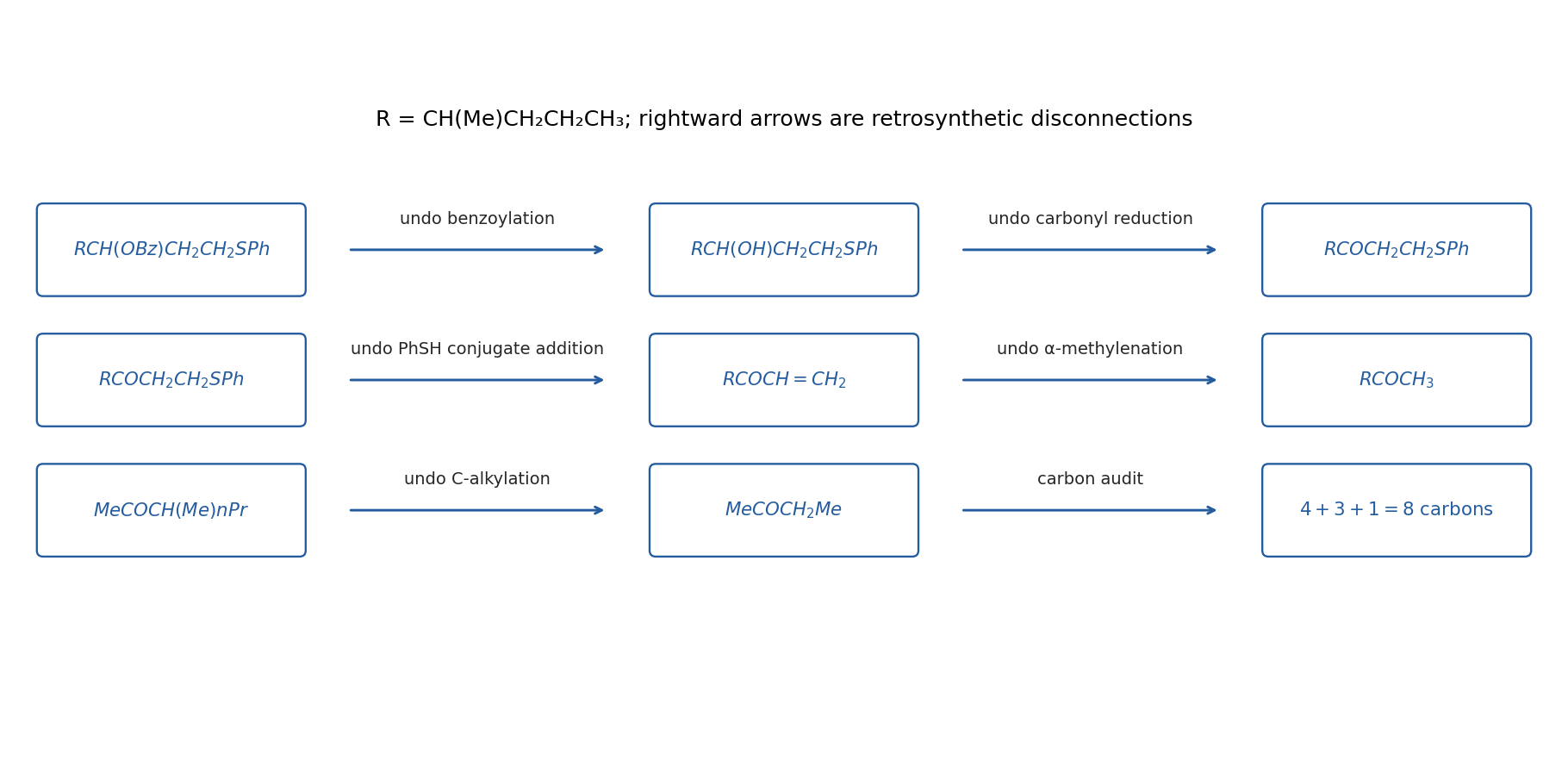
Let . The useful disconnections are benzoate formation, carbonyl reduction and thiol conjugate addition:The sulfur-bearing carbon is the enone beta carbon, so this is a Michael disconnection, not attack of thiophenol on the alcohol-derived central carbon. Reduce the saturated ketone with sodium borohydride after installing SPh, then benzoylate the alcohol with benzoyl chloride and pyridine or a tertiary amine.
Disconnect the enone to and formaldehyde. Kinetic deprotonation on the methyl side of the hindered unsymmetrical ketone, trapping with formaldehyde, and dehydration gives . This order leaves the substituted side unchanged. An alpha-methylenation/Mannich-base-elimination variant is an equivalent way of installing the terminal enone.
Finally, disconnects by alpha alkylation to butan-2-one and 1-iodopropane. Use the more substituted, ethyl-side enolate of butan-2-one for this step, rather than its usual methyl-side kinetic enolate; an equilibrated/regioisomerically selected enolate or enol derivative is required, and the desired monoalkylated ketone should be isolated. Three carbons from propyl iodide and one from formaldehyde increase the original four-carbon ketone to the required eight-carbon alcohol/thioether skeleton. Choosing ethyl iodide here would leave the target short by one carbon.
This is a constitutional synthesis: the target drawing specifies no configuration at either newly formed stereogenic site, so no unproved stereoselective reduction or alkylation is needed. Regioisomeric enolate alkylation and competing overalkylation are the practical selectivity issues to control, rather than something that follows from writing “base”.
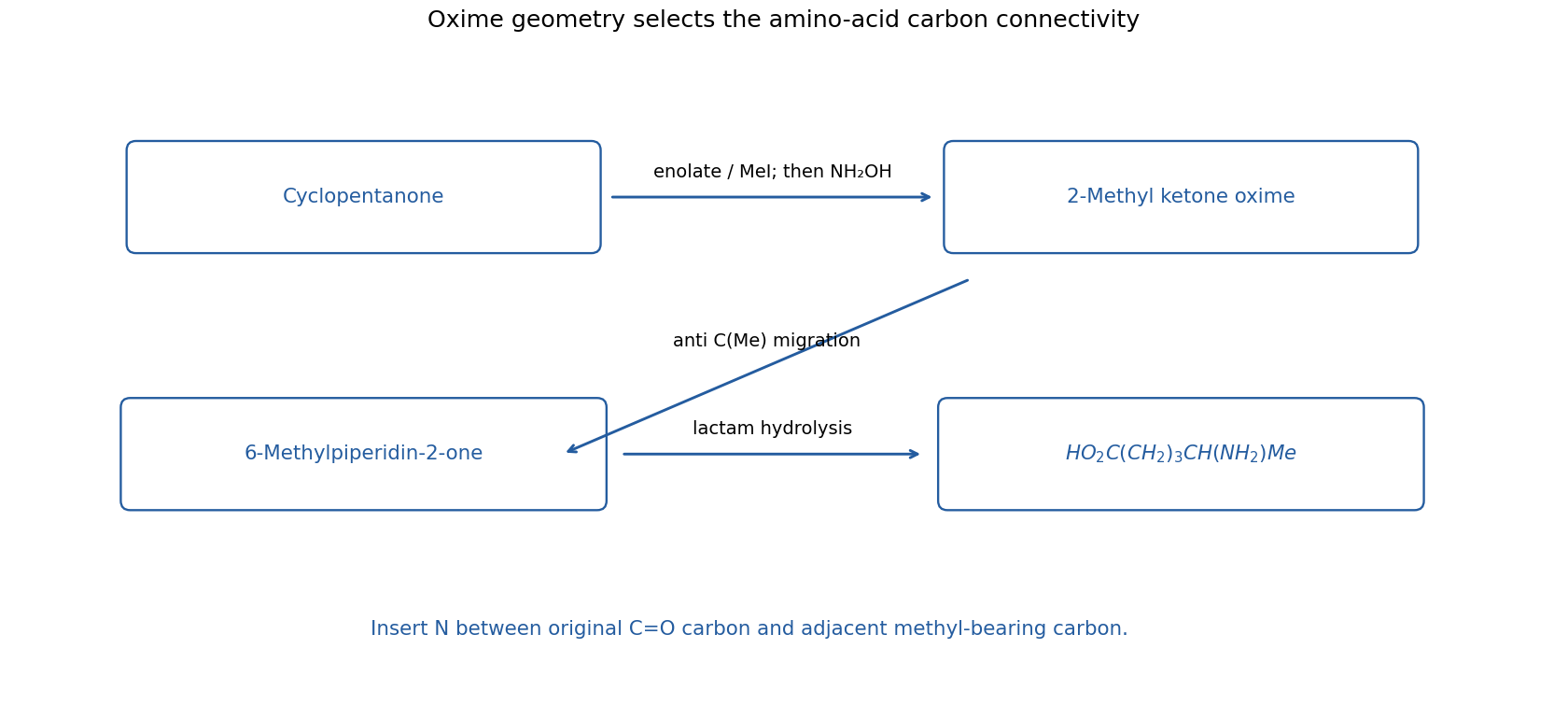
The target is 5-Aminohexanoic acid, . Disconnect its terminal amine/carboxylic-acid relationship through hydrolysis of 6-methylpiperidin-2-one. This six-membered lactam follows from a regioselected Beckmann ring expansion of 2-methylcyclopentanone oxime.
Start with cyclopentanone. Form its enolate with lithium diisopropylamide in dry THF at low temperature, add methyl iodide, then quench to obtain 2-methylcyclopentanone. Control the methyl iodide/base stoichiometry to suppress a second alkylation. React the ketone with hydroxylamine to form its oxime and select the geometrical oxime isomer in which the bond to the methyl-substituted adjacent ring carbon is anti to the departing oxime oxygen group.
Activate the oxime, for example under appropriate acid-promoted Beckmann conditions. The anti methyl-bearing C–C bond migrates onto nitrogen as the N–O-derived leaving group departs, inserting nitrogen between the original carbonyl carbon and the methyl-substituted ring carbon. Hydration/tautomerization gives 6-methylpiperidin-2-one. The opposite oxime geometry would insert nitrogen on the other side and ultimately place methyl at a different position in the amino acid; oxime geometry is therefore an essential part of this proposal.
Hydrolyse the lactam with aqueous acid and heat, then adjust the work-up to the desired acid/ammonium form. Cleavage of its acyl–nitrogen bond opens the ring to after suitable neutralization. All five original cyclopentanone carbons are retained, and the one methyl carbon comes from methyl iodide. A racemic mixture product is appropriate to the stereochemically unspecified target. The reaction sequence is an organic ring-expansion synthesis and requires no biological transformation.
Disconnect the tertiary amide into cyclohex-3-ene-1-carboxylic acid and the secondary amine . The acid-derived ring is an immediate Diels–Alder disconnection: buta-1,3-diene plus the indicated methyl acrylate gives methyl cyclohex-3-ene-1-carboxylate. Heating, or suitable Lewis-acid activation of the dienophile, forms the two new sigma bonds and leaves the diene's internal double bond as the ring alkene.
Hydrolyse this ester to the acid. Convert it to its acid chloride with oxalyl chloride or thionyl chloride, and react with the secondary amine in the presence of a base to capture HCl. The tertiary amide now contains the complete cyclohexene acyl fragment; direct conjugate addition of the amine to methyl acrylate before ring construction would give the wrong connectivity.
Prepare the amine by reductive amination of 4-phenylbutan-2-one, , with ethylamine, using sodium triacetoxyborohydride or another iminium-selective reducing system. This places nitrogen on , not on a terminal methylene. If a route from simpler carbon compounds is wanted, crossed aldol condensation of acetone with benzaldehyde gives , and selective C=C reduction gives the required ketone before reductive amination.
The acid branch retains the acrylic carbonyl as the amide carbonyl; the amine branch supplies both N-ethyl and N-(4-phenylbutan-2-yl) substituents. The unlabelled stereogenic centres may be racemic mixture. This sequence separates ring formation from amide formation and avoids invoking uncontrolled alkylation of a tertiary amide nitrogen.
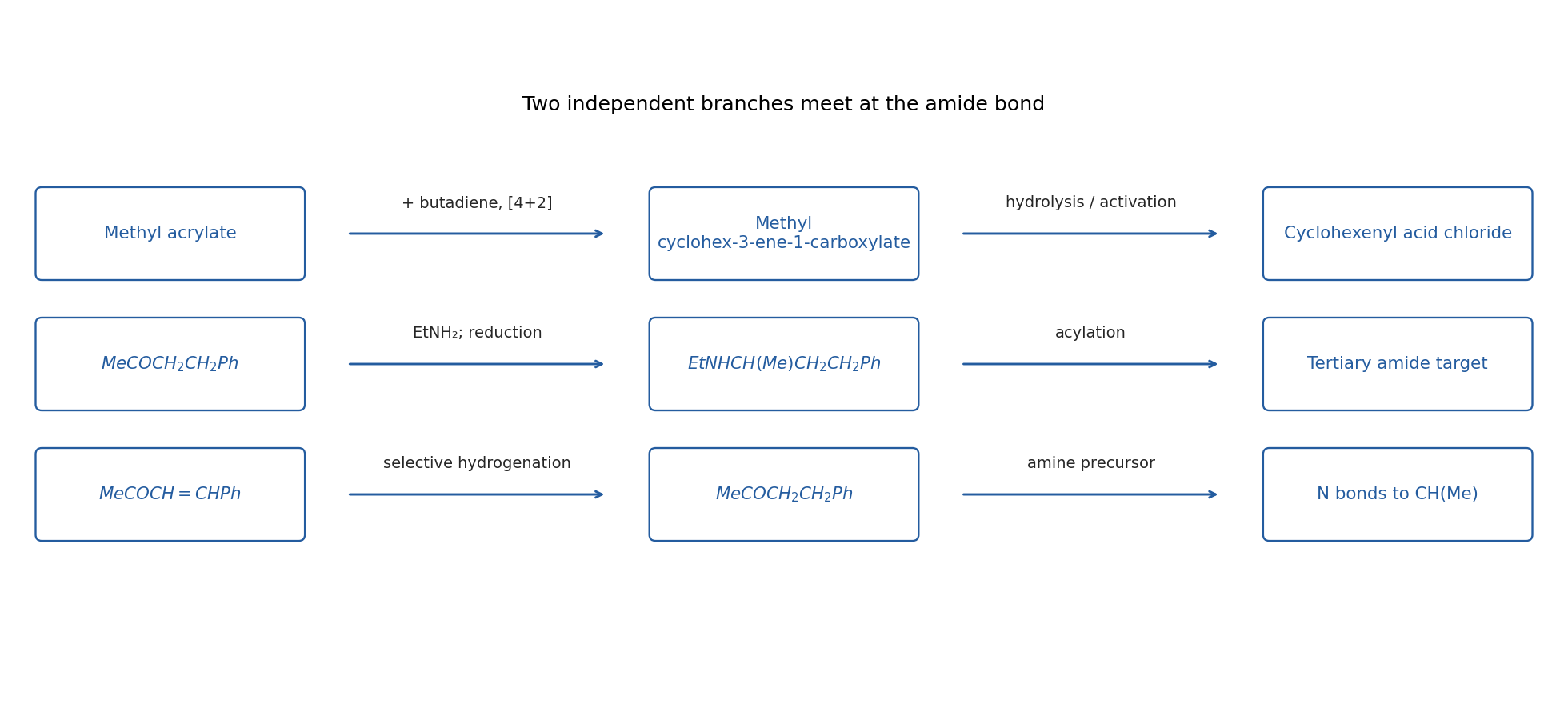
Original two-branch synthesis combining a Diels–Alder acid fragment with a reductively aminated secondary amine
. Details. React pentaborane with an alkyne under relatively mild conditions to obtain a nido framework, conventionally nido-2,3-dicarbahexaborane(8) for acetylene. The two entering carbon atoms initially retain their adjacency. A specific mild example uses 2-butyne with triethylamine-assisted at or below room temperature to give nido-. This is a practical route to an explicitly nido carborane, rather than an assumption that an alkyne supplies a closo cage under every condition.[ref]
Improved Synthetic Routes to Small Carboranes: Bench-Scale Preparation of nido-2,3-C2B4H8 Derivatives from B5H9 and from B3H8- Salts by Narayan S. Hosmane and Russell N. Grimes. 1979, abstract and preparation discussion: amine-assisted substituted-alkyne reaction under mild conditions
More energetic gas-phase reaction or pyrolysis promotes hydrogen loss, boron-fragment loss and cage rearrangement, giving closo carboranes, for example - and -, with other cage sizes possible in the mixture. Thermolysis of a previously formed nido carborane is an alternative route to this stage. The point is not a clean same-composition nido-to-closo isomerization: the change of hydrogen content and sometimes cage size must be retained in the formulas.
Milder conditions favour kinetically trapped adjacent-carbon products; higher temperatures permit migration to carbon-separated arrangements, often increasing favourable B–C contacts relative to adjacent C–C/B–B contacts. Conditions and Lewis bases also influence which separated-carbon cage is isolated; temperature alone does not prescribe a single quantitative isomer distribution. Primary thermolysis studies and the small-carborane literature document both cage rearrangement and reagent-dependent product mixtures.[ref]
Synthesis of Carboranes from Dihydrocarboranes by Thomas P. Onak and others. 1963, printed p. 3378, introduction and product summary
The Hückel orbital charge density and Hückel pi bond order giveEach site receives electron from the lowest orbital and one from the occupied nonbonding subspace, so at every carbon, summing to six. Relative to one neutral pi electron per carbon this is a pi charge of at each site.
For adjacent sites, only the lowest orbital contributes, giving . For opposite sites the nonbonding contribution reverses the sign: . These non-neighbour negative density-matrix entries are not extra sigma bonds or extra resonance integrals in the Hamiltonian. If only skeletal nearest-neighbour pi bond orders are requested, the four values are the relevant ones.
Write with the same carbon diagonal parameter throughout, and define to have entries on one sublattice and on the other. Bipartite connectivity impliesThus implies . This proves energy pairing about , , and equal site-probability magnitudes in each paired pair, since . This is the Coulson-Rushbrooke pairing property.[ref]
Note on the method of molecular orbitals by Charles Alfred Coulson and G. S. Rushbrooke. 1940, pp. 193–200, alternant-system pairing and density properties
For the usual neutral half-filled closed-shell occupation, the lower member of each pair is doubly occupied. Combining paired coefficients with completeness of the orthonormal basis gives one pi electron per carbon, so the model predicts no net pi charge separation. The same argument makes off-diagonal pi bond orders between sites on the same sublattice zero. These statements assume a neutral half-filled density and do not apply unchanged to the charged six-electron four-site ion considered separately.
An imbalance of sublattice sizes also guarantees at least nonbonding orbitals at energy , because the rectangular coupling block has insufficient rank to remove all its null space. None of the spectral pairing, equal paired densities, neutral charge uniformity or sublattice bond-order restrictions is required for a non-alternant graph. Long-range same-sublattice couplings or unequal diagonal parameters can likewise destroy the simple proof.
The active set contains four oxygen pi orbitals and two carbon pi orbitals, with eight electrons in six orbitals. The noninteracting levels, using the parameters inferred below, areEach bonding oxygen orbital has equal-phase coefficients on its two O atoms; its antibonding partner reverses one coefficient. The two pi directions are z in the prospective ring plane and y perpendicular to it. carbon pi and pi-star use z-directed p orbitals with equal and opposite coefficient signs. In this separated-fragment comparison the occupations are those of neutral triplet O plus neutral ethene. Do not refill the combined list solely by energy, which would move an electron between infinitely separated fragments and describe a charge-transfer state instead.
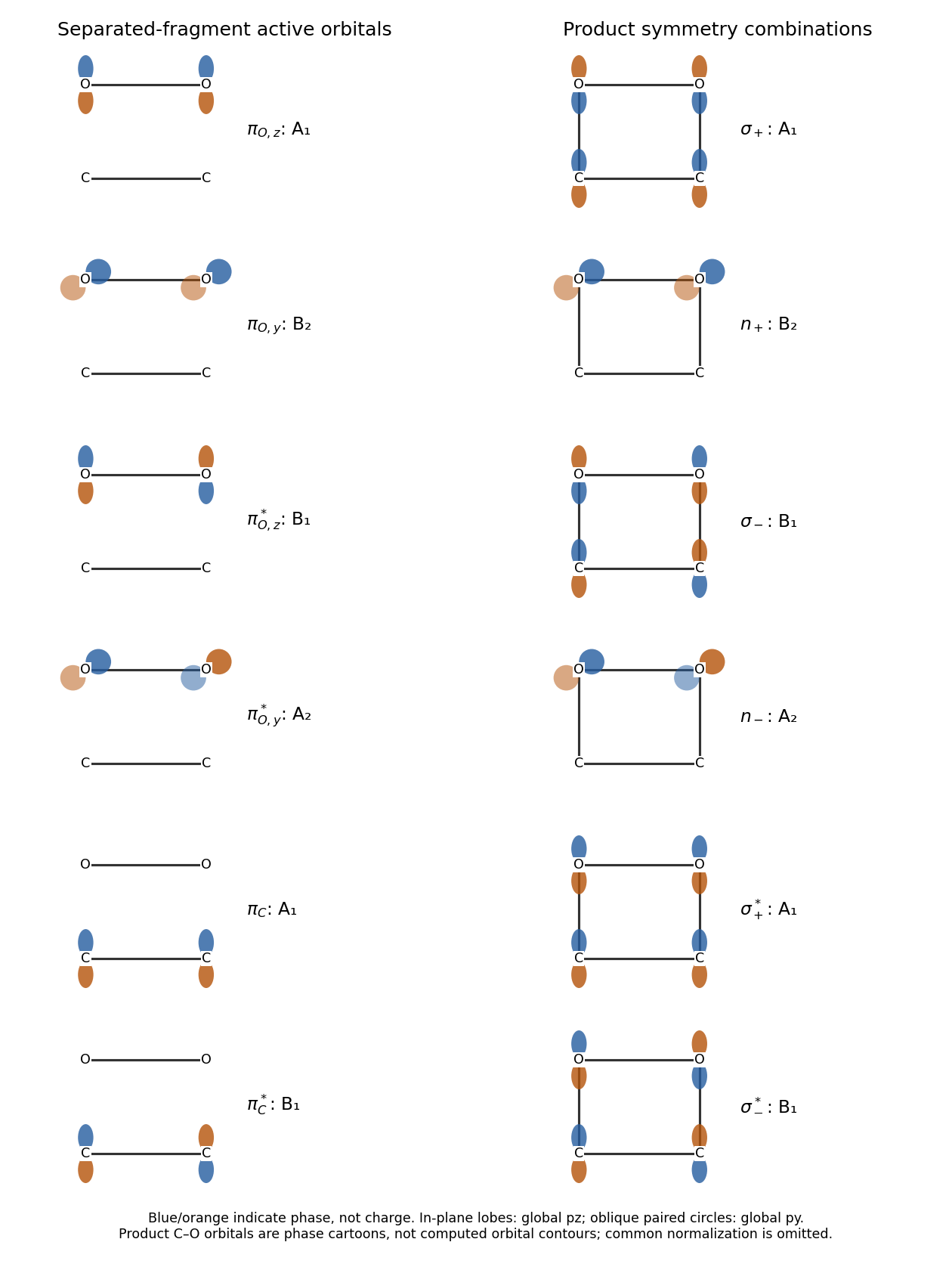
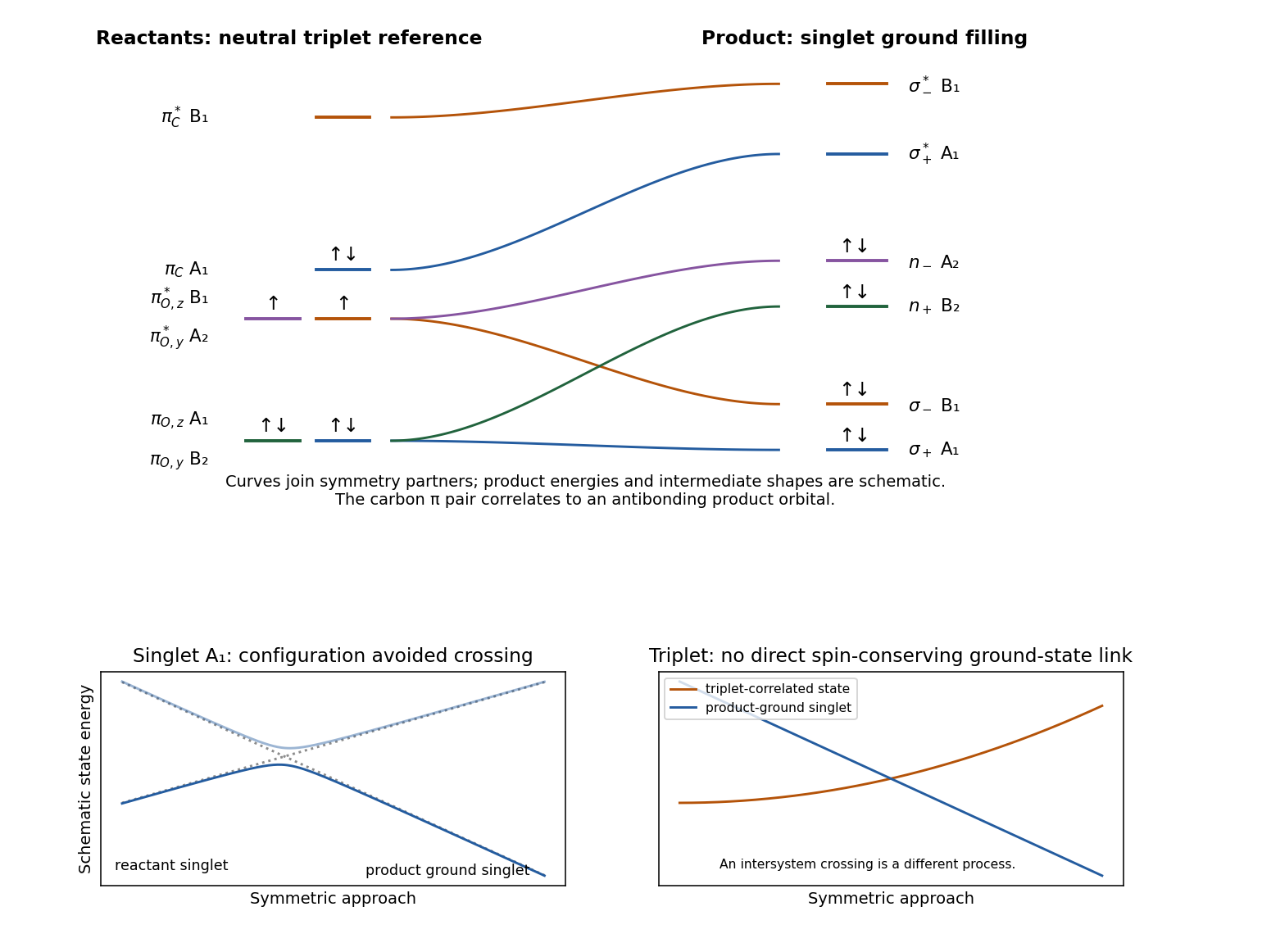
The symmetric approach preserves the C2v molecular point group with its twofold axis z and mirror planes xz and yz. The molecular ring lies in xz. Classify orbitals by reflection signs : , , , . With globally defined p-orbital phases the molecular orbital correlation diagram givesWithin either two-orbital symmetry block the lower member remains correlated with the lower product member; the non-crossing rule prevents swapping their order through an ordinary same-symmetry crossing. Crossings between different irreducible representations are allowed. The crucial consequence is that the occupied carbon pi orbital correlates to a C–O-antibonding combination, rather than both initially occupied orbitals becoming the two product bonding orbitals.
For hexa-1,5-diyne in the extended anti conformation drawn, inversion at the midpoint of the central carbon–carbon bond exchanges the two identical ends. A twofold axis through that midpoint perpendicular to the carbon skeleton plane, together with the mirror plane of that skeleton, completes the C2h molecular point group. The methylene hydrogens occur in the corresponding mirror-related pairs. Thus the answer is . The whole molecule is not linear simply because its terminal triple-bond fragments are linear; the conformation is essential to this assignment.
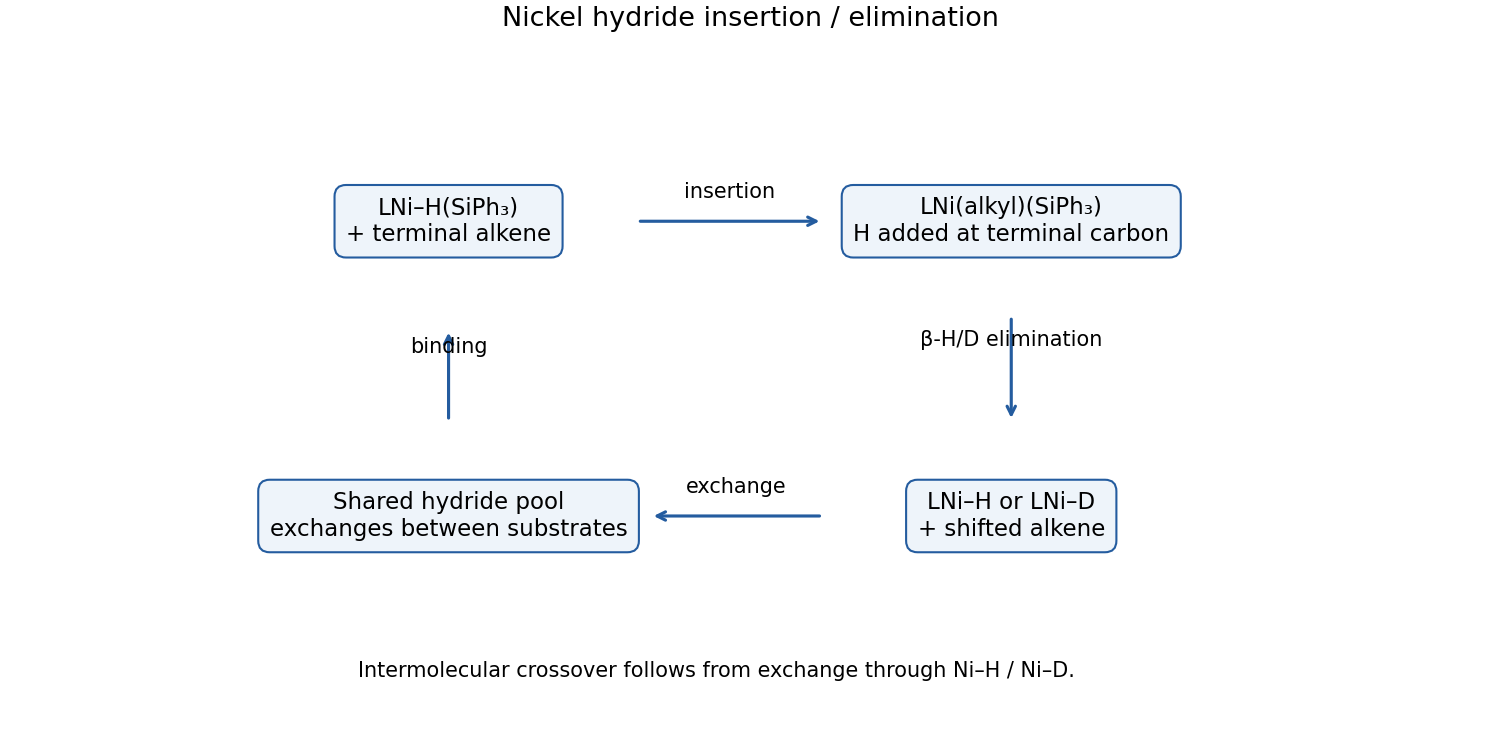
Label the starting exomethylene carbon , the aryl-bearing carbon , the ethyl CH/CD carbon , and the terminal methyl :Insertion into Ni-H places H on and Ni on . Elimination of a beta H or D from gives and Ni-H or Ni-D. Thus the labeled substrate can retain one D on the new vinylic carbon while exporting the other into the catalyst hydride pool.
Ni-D can then add to the exomethylene of either aryl substrate, introducing D into the methyl group derived from . Reversible insertion/elimination and substrate exchange also introduce D into the vinylic position of the originally unlabeled compound. This explains both the approximately comparable methyl labeling of the two products and the larger residual vinylic labeling of the initially CD-bearing substrate.
The decisive observation is intermolecular crossover of deuterium into the unsubstituted-phenyl product. It rules out a purely intramolecular, identity-preserving 1,3-H/D shift. The unequal percentages retain kinetic and substrate-history information; they are not a requirement for completely statistical H/D equilibration and cannot determine all elementary rate constants by themselves.
Write for the imidazolylidene N-heterocyclic carbene bearing the two mesityl groups shown. The proposed active unit is , with H and SiPh both bonded to nickel, rather than a nickel-free hydrosilane or a bare NHC-Ni fragment.
Displacement of coordinated styrene and formal oxidative addition of Si-H to Ni(0) give a low-coordinate nickel(II) hydride-silyl unit; substrate binding fills a vacant site. The productive cycle is alkene coordination, migratory insertion into Ni-H, then beta-hydride elimination from the other beta carbon, releasing the shifted alkene and regenerating Ni-H.
The strongly donating NHC stabilizes a reactive low-coordinate metal and assists Si-H activation. Its steric bulk discourages unproductive saturated bis-alkene species and promotes product departure, but excessive crowding can hinder substrate binding/insertion. The silyl ligand also tunes the metal electronically: changing its aryl substituents changes donation and the barriers for hydride transfer/elimination. Product release and reversible insertion determine whether further double-bond migration occurs. Bulky ligands can suppress competing alkyl-silyl reductive elimination, which would instead consume substrate by hydrosilylation.
The hydride-silyl formulation and insertion/elimination interpretation are the experimentally proposed mechanism; the individual catalyst resting states need not all be uniquely fixed by the activation recipe.[ref]
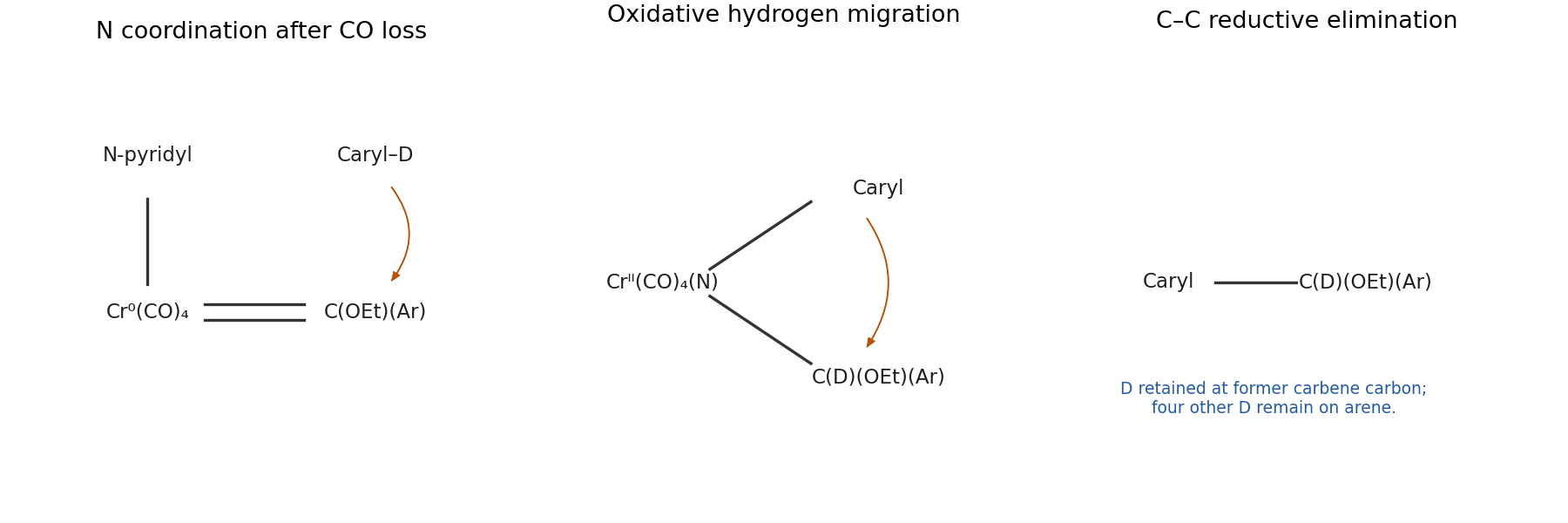
CO first dissociates from the 18-electron Fischer carbene. Pyridyl nitrogen of C then coordinates at the vacant chromium site, positioning an ortho C-D bond of its phenyl group beside the carbene unit.
The appropriate pathway is oxidative hydrogen migration: chromium assists C-D cleavage while D transfers to the electrophilic carbene carbon. The resulting cyclometalated intermediate has both an aryl-Cr bond and an alkyl-Cr bond, the latter to . Formally Cr(0) becomes Cr(II). Reductive elimination between those two carbon ligands forms the new aryl– bond and returns chromium to low oxidation state.
This accounts for all three controls. Extra CO suppresses the coordinative vacancy. Biphenyl E lacks the pyridyl-N directing group and cannot organize the necessary C-H activation geometry. The ortho deuterium moves onto the former carbene carbon rather than being lost to solvent: four D remain on the original phenyl ring and the fifth becomes the benzylic C-D bond.
This is not adequately represented as electrophilic aromatic substitution followed by proton loss, which would discard the diagnostic D. The primary mechanistic study distinguishes oxidative hydrogen migration/reductive elimination from that classical alternative.[ref]