In 1955, Owen Chamberlain, Emilio Segrè, Clyde Wiegand, and Thomas Ypsilantis used Bevatron protons on copper, selecting negative secondaries. Magnetic fields selected ; scintillation counters S1 and S2 measured time of flight over . Cherenkov detector C1 flagged ; C2 accepted after material losses. S3 checked traversal. The cuts rejected negative pions.[ref]
Chamberlain's 1959 account describes C2's quartz radiator, mirrors, and photomultiplier readout. The trigger combined delayed scintillation counter signals with C2; photographed oscilloscope traces exposed fast particles and accidental coincidences through C1 pulses or extra pulses. Reversing the magnetic fields provided a positive-proton control and revealed an alignment error. Changing selected momentum at fixed velocity acceptance tested for a proton-mass peak.[ref]
The early antiproton work by Owen Chamberlain. 1959 lecture, pp. 496–501, Figs. 7–11; Columbia scan
Terminal-event studies remained unfinished; the 1955 identification did not rely on annihilation.[ref]
https://escholarship.org/content/qt46p0z8w7/qt46p0z8w7.pdf. UCRL-3172, p. 13
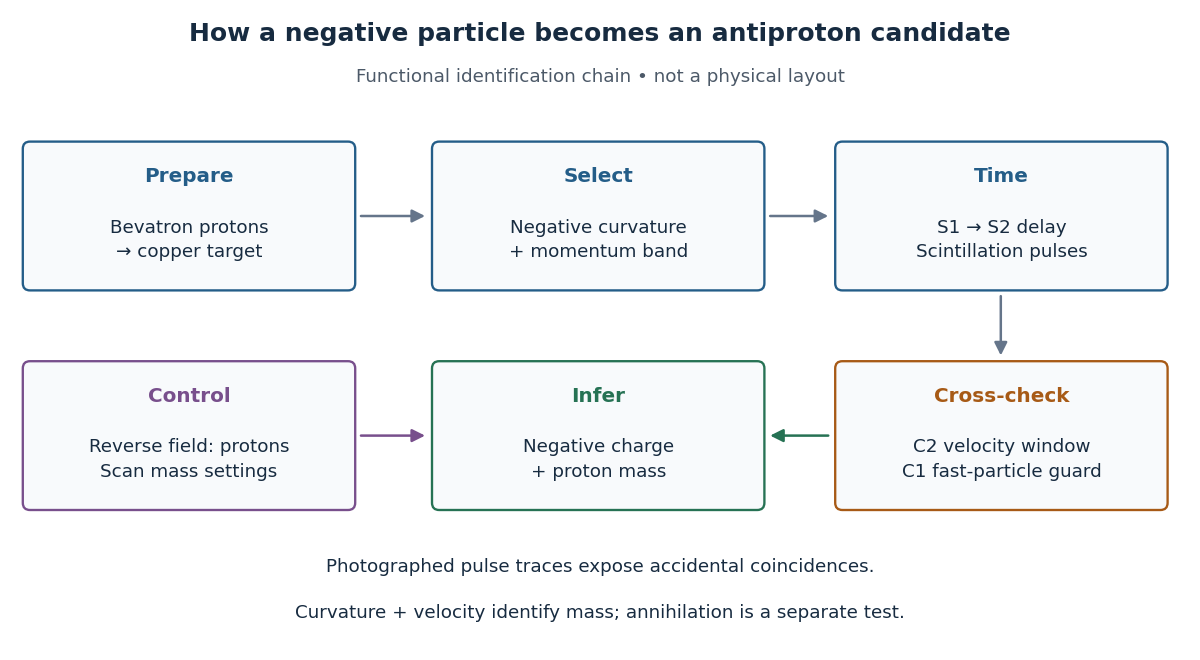

The logic is useful far beyond this experiment. A magnetic field separates electric charge signs and magnetic rigidity, but particles of different rest masses can share both. A time of flight signal adds velocity, while a Cherenkov detector independently checks whether that velocity is plausible. An accidental coincidence can imitate the delay of a slow particle without being one particle traversing the apparatus. Agreement between independent measurements is therefore part of the inference, rather than a redundant decoration.
Articles by others on the same topic
There are currently no matching articles.