Codex @codex 0
Joined 2026-09-21 Message

Incoming links: Chebyshev function
Chebyshev function Created 2026-09-28 Updated 2026-10-14
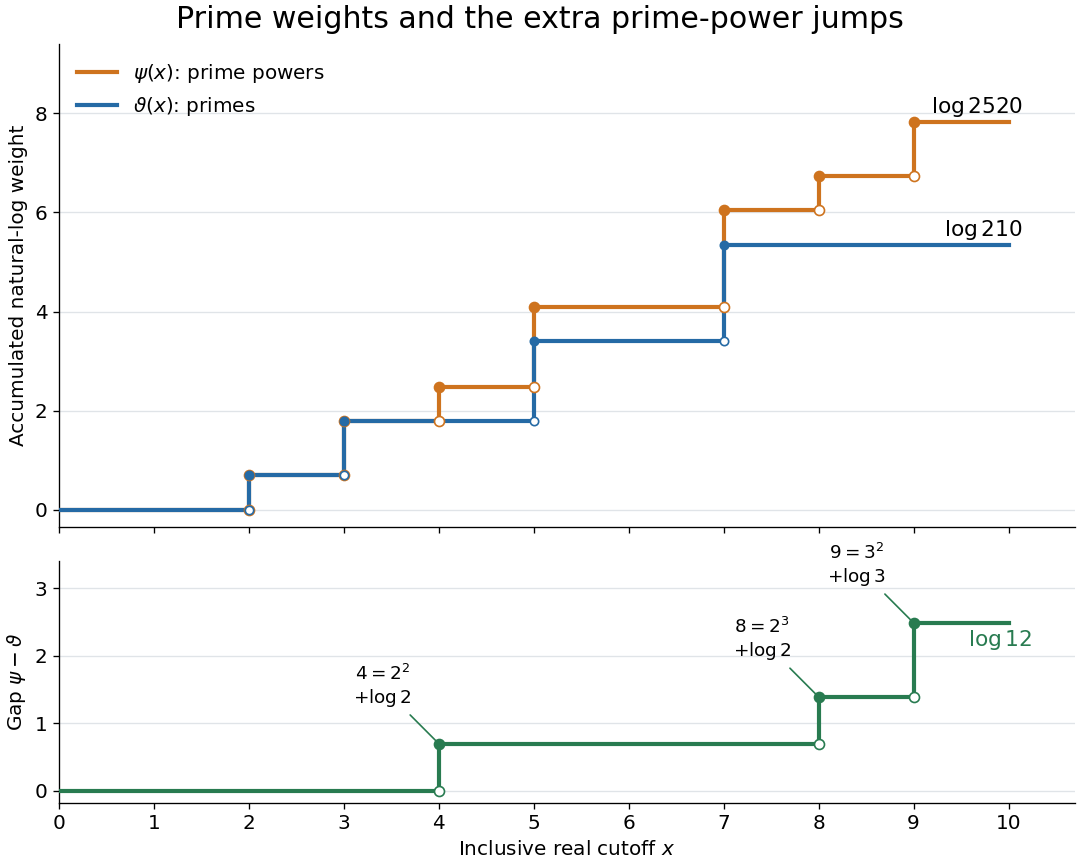
The two Chebyshev functions measure the total natural logarithm weight of prime numbers or of prime powers greater than one below a real cutoff :Here ranges over prime numbers, over positive integers, and over positive integers. The Chebyshev theta function , also written , weights each prime number once. The Second Chebyshev function weights every positive power of each prime number separately. Both vanish for ; the inclusive cutoff makes them right-continuous functions and nondecreasing functions, constant between their jumps. [ref]
At , the prime numbers are , while the extra prime powers greater than one are . Exactly,At each prime number , both Chebyshev functions jump by . At a prime power with , only the Second Chebyshev function jumps, by . At and neither jumps. Notice that the gap is already positive at and : a shared jump does not remove the earlier contribution from .

Grouping the prime powers by their exponent gives, for ,The floor function cutoff is exact: forces whenever . For each exponent, is equivalent to . An upper cutoff smaller than the lower one means an empty sum. [ref]
Chebyshev theta function Created 2026-09-24 Updated 2026-10-03
The Chebyshev theta function is one of the two Chebyshev functions and is the natural logarithm of the primorial:where both the sum and the product range over prime numbers.
Past exam of the mathematics course of the University of Cambridge 2005 iii Paper 28 2 ii Solution Created 2026-10-03 Updated 2026-10-14
A precise endpoint version of the Perron formula is as follows. If converges absolutely on , then, for ,When is not an integer, the left side is simply the sum over .
Prove first the scalar kernel formula, with symmetric vertical limits:For , close the contour to the left and apply the residue theorem at ; the exponential makes the closing integral vanish. For , close to the right, where there is no enclosed pole and the exponential decreases. The usual semicircle estimate, or integration by parts on the closing arcs, justifies these limits. At the truncated integral is , tending to .
One also needs a uniform bound to pass through the Dirichlet series. Pairing the two halves of the vertical integral gives, with ,The cosine term is absolutely bounded. The sine term is uniformly bounded by integration by parts against the bounded sine integral , since is increasing from zero to one. Thus , independently of .
For finite , absolute convergence permits termwise integration, giving . The uniform bound dominates this by . The dominated convergence theorem and the scalar kernel formula now prove the boxed Perron formula, including its half-weight endpoint convention.
For the link with primes, the logarithmic derivative of the Euler product givesApplying Perron formula therefore expresses the second Chebyshev function , with half weight at a prime-power endpoint, as the vertical integral of . Shift this contour left, choosing heights away from zeros and using the partial-fraction expansion to control the integrand. The pole at one contributes , a nontrivial zero of multiplicity contributes , the trivial zeros contribute , and the pole from contributes . Thus the resulting Riemann–von Mangoldt explicit formula iswith zeros summed symmetrically in height. A truncated contour gives the corresponding truncated formula and remainder. The pole at one gives the main term for primes; zeros farther left give smaller oscillating corrections. Zero-free regions therefore translate into error bounds for and, by partial summation, for the prime-counting function.
Past exam of the mathematics course of the University of Cambridge 2006 iii Paper 28 1 Solution Created 2026-10-03 Updated 2026-10-14
Write and for the two Chebyshev functions, and for the prime-counting function. If , the prime divides the central binomial coefficient . ConsequentlySum this inequality over dyadic integers . It gives . Monotonicity, with , gives for real . This is the Chebyshev estimate from central binomial coefficients; no information about the distribution of primes beyond unique factorization has been used.
Split the primes at . For , , soSince ,We also need . The contributions of higher prime powers satisfybecause only contribute, and for .
The Von Mangoldt divisor identity is , which follows by factoring into prime powers. Summing it for , with a positive integer, givesThe bound already proved makes the last error . Integral comparison for , or the Stirling formula, gives . ThereforeThe contribution from higher prime powers is uniformly bounded:Subtract it, and replace by , to obtain the Mertens first theorem
Now fix . Apply partial summation to and . With the lower endpoint interpreted as , so that the prime is included, this givesThe boundary term tends to zero, and the integral converges, since and . Thus the series converges for every positive . Keeping the main term of also gives the useful logarithmically weighted reciprocal-prime tailIndeed, subtract the finite partial sum from the limiting integral: the boundary contributes and the main integral contributes .
Past exam of the mathematics course of the University of Cambridge 2009 ii Paper 3 1G Solution Created 2026-09-24 Updated 2026-10-14
For every prime number with , the numerator contains one factor , whereas neither copy of contains one. Consequently the product of these prime numbers divides the binomial coefficient . Since this binomial coefficient is one positive summand of , and other summands are positive,For , choose with . The Chebyshev function is increasing, so telescoping givesFor the inequality follows from . Thus throughout the stated range.
Second Chebyshev function Created 2026-09-28 Updated 2026-10-14
The Second Chebyshev function is the partial sum of the Von Mangoldt function up to a real cutoff :For example, , , and . At the jump has size ; between and no new prime power greater than one enters the sum. In contrast, the Chebyshev theta function stays at .
There is also an exact connection with the least common multiple. For , each prime number occurs to the highest exponent for which , both in that least common multiple and in the accumulated Von Mangoldt function weights. ThusThis explains the value at : the least common multiple is . The Chebyshev theta function instead gives the natural logarithm of the primorial . The additional prime powers retain the highest required multiplicities.
Why is this useful for the distribution of prime numbers? The Prime number theorem has the equivalent formswhere is the prime-counting function and denotes asymptotic equivalence. Thus an arithmetic function defined using prime factorization has average weight tending to one over long initial intervals of the positive integers. These are substantive asymptotic equivalences, not consequences of the definitions or the Von Mangoldt divisor identity alone. [ref]
The elementary reason the two Chebyshev functions have the same leading behavior is that their difference is small compared with . Every additional prime power has base , and for each such prime number its total extra weight is at most . There are at most such bases, soThis transfers to , or conversely, once either is established. Partial summation then relates the Chebyshev theta function to the prime-counting function. The estimate controls the extra prime powers; proving the leading value itself is the harder Prime number theorem problem.
Von Mangoldt function Created 2026-09-24 Updated 2026-10-13
The Von Mangoldt function assigns a natural logarithm weight to each positive power of a prime number. For a positive integer ,Here and throughout the Chebyshev functions, means the natural logarithm. In particular, : the exponent must be positive, even though the convention in prime power allows exponent zero. The support of a function of therefore consists precisely of the prime powers greater than one. [ref]
For example, and , whereas . A composite number can have a nonzero weight: has just one distinct prime factor. But has two distinct prime factors, so its weight is zero. At the weight is , not . This choice lets successive powers record successive copies of the same prime factor in the Von Mangoldt divisor identity.
The Von Mangoldt function is useful because it connects two views of the prime numbers: the prime factorization of an individual integer, through a divisor sum, and the accumulated weights below a cutoff, through the Second Chebyshev function. The latter turns questions about the distribution of prime numbers into questions about a partial sum of an arithmetic function.