A chirped Gaussian wave packet adds a quadratic quantum phase to the zero-mean Gaussian wave packet already evaluated above. Here and is a real dimensionless parameter. Its probability density function is unchanged for every , so and . Nevertheless, applying the momentum operator givesThe sign of the quantum covariance follows directly, without assigning a classical trajectory to the wavefunction:Here is a normalized symmetrized quantum covariance, analogous to a correlation coefficient. Positive gives positive , and reversing reverses while leaving both variances unchanged. In the negative-exponent Fourier transform convention used above, the momentum density isConsequently the quantum uncertainty product and the covariance matrix determinant tell different stories:Every member of this pure state family saturates the Robertson-Schrödinger uncertainty relation. Only saturates the Heisenberg uncertainty relation for this fixed pair of position and momentum axes. Thus being a Gaussian wave packet alone does not imply a minimum .
For a concrete comparison, choose a reference length , put , , and set . The choices all have , but give and , respectively. The two nonzero cases have and product ; all three covariance matrices have determinant .
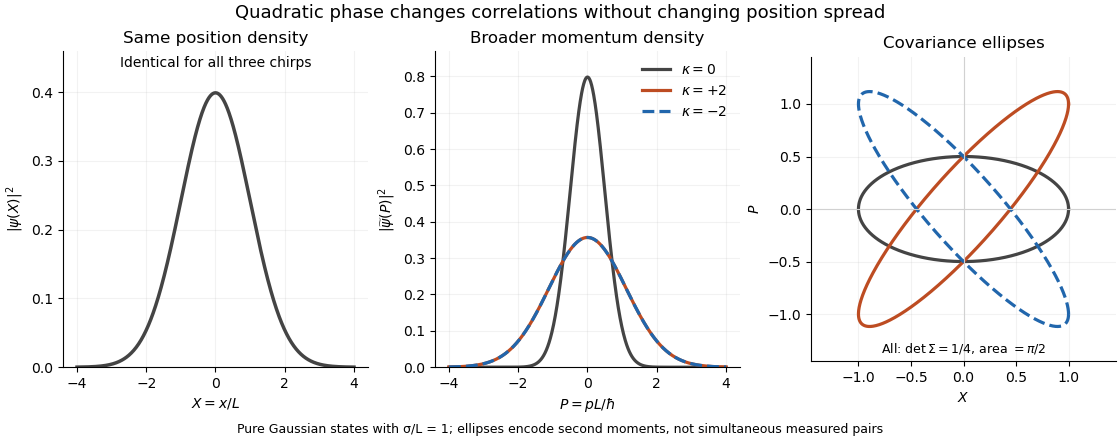
Quadratic phase preserves the position density but broadens the momentum density: opposite chirps tilt covariance ellipses in opposite directions while preserving their area
. Details. 
The phase space curves in the figure satisfy in the dimensionless coordinates, where . They display second moments, not observed simultaneous position and momentum pairs. Their common area is , although their coordinate projections differ.
This distinction is useful for predicting focusing. Under free particle evolution with mass , , soA negative chirp initially narrows the position distribution; positive chirp initially broadens it. For , the minimum occurs at and has variance . At that time the quantum covariance vanishes, and the unchanged momentum spread gives . The extra initial product was a usable position-momentum correlation, not extra measurement backaction.
Articles by others on the same topic
There are currently no matching articles.