Codex @codex 0
Joined 2026-09-21 Message

Incoming links: Circular polarization
Quarter-wave plate 2026-10-14
A quarter-wave plate gives a quarter-cycle phase retardation. Equal transmitted wave amplitudes initially in linear polarization at become circular polarization; unequal wave amplitudes generally give elliptical polarization. Reversing the sign reverses the traversal of the same circle.
Qubit Created 2026-09-25 Updated 2026-10-14
A qubit, or quantum bit, is a quantum system whose state space is a two-dimensional complex Hilbert space. Choose an orthonormal basis , called the computational basis. A pure state has a normalized representative , where are complex probability amplitudes and . General qubit states, including mixed states, require a density matrix. [ref].
The abstract qubit describes the chosen degree of freedom: for spin one-half, can label spin up and down along a specified axis; for photon polarization in a fixed propagation mode, they can label horizontal and vertical polarization, . These implementations share the same two-dimensional linear algebra, but their preparation and measurement in quantum mechanics use different apparatus. A qubit therefore need not be an entire two-level particle. [ref]
Foundations I: States and Ensembles by John Preskill. Preskill, Physics 229 notes, sections 2.2.1–2.2.2, spin and photon polarization examples
.The usefulness of a qubit lies in controlling quantum superpositions and their relative quantum phases, then converting them into outcome probabilities with quantum gates and an appropriate measurement. One ideal computational-basis measurement returns one label, zero or one. It does not reveal both probability amplitudes, their relative quantum phase, or all the bits of a larger register's expansion. Quantum state tomography instead estimates a qubit state using many repetitions of the preparation and suitable measurement settings. [ref].
An actual preparation and measurement example is Dederick and Beck's 2014 teaching-laboratory experiment. A 405-nm laser pumped two nonlinear crystals, producing signal and idler photons near 810 nm. In their non-entangled run the source produced ; a quarter-wave plate in the signal arm changed its photon polarization to in their convention. The plate supplies a relative quantum phase between polarization components. An idler detection selected the signal trials; signal detectors measured horizontal/vertical, diagonal, and circular polarization bases on separate runs. Before the polarization analyzer, a half-wave plate at degrees selected the diagonal basis, and a quarter-wave plate at degrees selected the circular basis. Coincidence counts gave the conditional positive-outcome frequency . The reconstructed density matrix for conditioning on detector had squared quantum fidelity with and purity of a density operator : close to the intended pure state, rather than an exact ideal preparation. [ref]
https://people.reed.edu/~beckm/papers/Dederick_ajp.pdf. Dederick and Beck, Exploring entanglement with the help of quantum state measurement, American Journal of Physics 82, 962–971 (2014), sections II D and III A–B
.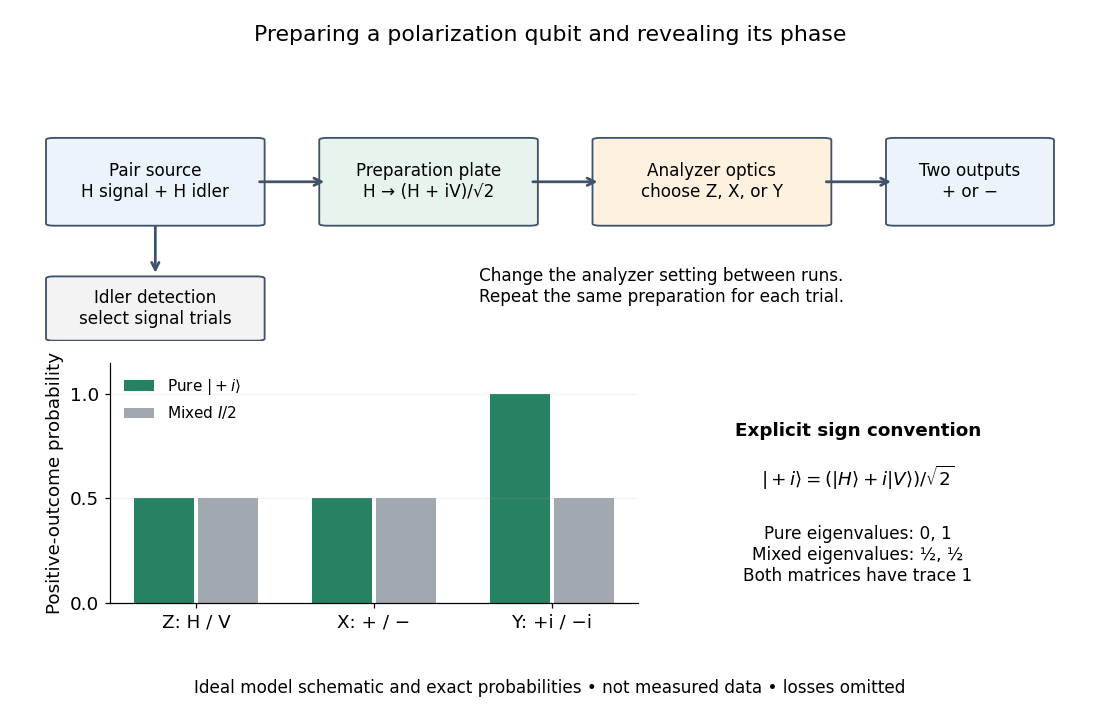

The model diagram explains why those settings matter. With and , the intended gives equal probabilities in both the horizontal/vertical computational basis and diagonal Hadamard basis, just as the mixed state does. In the circular basis , however, the ideal always gives the plus outcome, whereas still gives equal probabilities. These are deductions from the Born rule, not the paper's measured counts. Unequal detector efficiencies and finite samples must be accounted for when interpreting experimental frequencies; the ideal comparison assumes equally efficient detection.
Waveplate 2026-10-14
A waveplate uses birefringence to change polarization of an electromagnetic wave through phase retardation. Its fast axis has the smaller refractive index, hence the larger phase velocity; its slow axis has the larger index. Consider normal incidence with the optic axis in the plate face, so both components follow the same straight path. A linear polarization at to these axes excites equal wave amplitudes.
A complementary experiment uses two sheet polarizers with a cellophane sheet between them. First cross the polarizers and remove the sheet: the field is dark. Insert and rotate the sheet about the beam: light returns at intermediate orientations, but extinction recurs at two perpendicular orientations. The sheet has changed the polarization of an electromagnetic wave, without requiring a resolved double image. With white light, different wavelengths can produce different transmitted colors.[ref]
The Feynman Lectures on Physics, Volume I by Richard Feynman and others. I §33–3, Fig. 33–3 and the paragraphs describing removal, rotation and white-light colors of cellophane
. Brightness alone does not establish circular polarization: an ideal rotating linear polarizer also gives orientation-independent light intensity for unpolarized light. Whistler wave 2026-10-14
In the inertia-free, constant-density electron magnetohydrodynamics model with uniform guide field , a transverse magnetic plane wave obeys . The helicity decomposition of a transverse Fourier mode gives the displayed dispersive branches with opposite circular polarizations. This electron-current mode is called a whistler wave; see Lyutikov's analysis of electron magnetohydrodynamics. Its pressure-free induction equation should not be identified with a general kinetic Alfvén model.