For arbitrary topological spaces , an index set , a sequence , and a point in that Cartesian product, convergence in a product space to in the product topology is equivalent to coordinatewise convergence in every factor. No countability or Hausdorff assumption on the factors is needed. For a product space of copies of the real line, regarding each point as a function identifies this with pointwise convergence.
Proof outline: the forward implication follows because each projection map is continuous. Conversely, given a basic neighborhood of , each of its finitely many coordinate tests holds for all . Taking makes all tests hold simultaneously; if is empty, any threshold works. This proves eventual membership in every neighborhood, rather than only in a sampled collection of cylinders. The same equivalence holds for nets: a directed set supplies a common upper bound for finitely many thresholds. Sequences alone need not characterize the whole topology of an arbitrary product space.
Let and give each factor of the usual topology of the real line. The familiar standard basis vectors extend to unit sequences with when and zero otherwise. Their finite linear combinations are exactly the finitely supported sequences, rather than all of .
For every fixed coordinate , for all . Therefore in the product topology. More directly, any basic cylinder set containing zero contains every with : all of its tested coordinates are then zero. The moving unit entry escapes every fixed finite collection of observations.
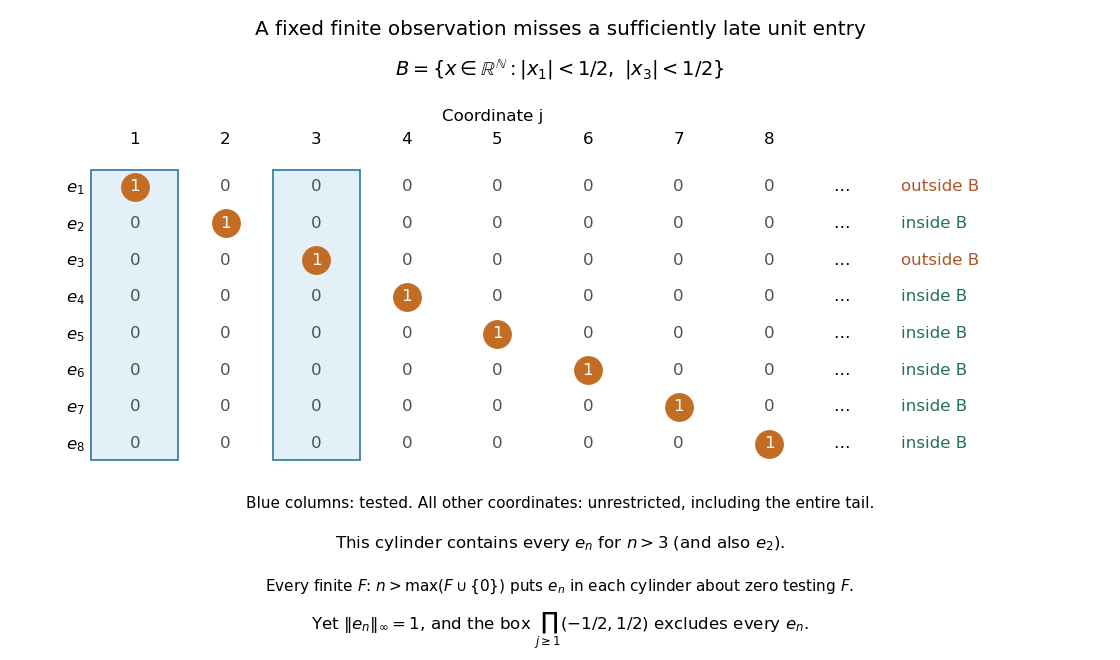

In the l-infinity sequence space of bounded real sequences, however,Thus the same sequence does not converge to zero in the supremum norm. Here the comparison is between the subspace topology inherited from the product topology and the norm topology on . The supremum norm is not a finite-valued norm on all of , which also contains unbounded sequences. In the box topology on , the neighborhood of zero excludes every , so is not a convergent sequence with limit zero there either.
Articles by others on the same topic
There are currently no matching articles.