A cryptographic protocol specifies an interaction between parties using cryptographic operations to achieve a security property under stated assumptions. A key-exchange protocol, for example, aims to establish a shared secret while controlling what an adversary can learn or alter. Messages need meanings, order, identities and session context in addition to encryption or signatures. A sound primitive does not by itself make every composition secure: replaying a valid message in the wrong session can break an otherwise plausible exchange. Correctness and security depend on the adversary model and the exact transcript rules.
A cryptographic transcript is the specified record of messages exchanged during a cryptographic protocol execution. Its content depends on the purpose: a public communication record differs from a participant's complete private view, which can also include its input, secret state and randomness. Order, message boundaries and the identities or roles associated with messages can matter.
For a concrete standardized use, Transport Layer Security 1.3 authenticates a transcript hash computed from selected handshake messages in their prescribed order. It includes handshake type and length headers, but excludes record-layer headers. Its retry path specifies a special replacement for the first client message.[ref]
The Transport Layer Security Protocol Version 1.3 (RFC 8446). §4.4.1, transcript hash and HelloRetryRequest exception; §4.4.4, Finished authentication
An original toy transcript makes the distinction between messages and concatenated payloads visible. Suppose a sender transmits
ab and then c. The payload sequence is . Another execution transmits a and then bc. Both flatten to ASCII bytes 61 62 63, even though they have different first messages. A length-prefixed encoding preserves the distinction as 02 61 62 01 63 versus 01 61 02 62 63. A hash cannot recover boundaries that were omitted before hashing.Direction can be equally important. The records “initiator sends
yes” and “responder sends yes” contain identical payloads but assert different behavior. A format used to authenticate those assertions must bind the relevant roles, either explicitly in the encoded record or through an unambiguous protocol context. This toy rule is not a replacement for the TLS transcript format.In a security proof, the observer's view and its correlations must be specified. A cryptographic simulator that samples messages with correct individual frequencies may still produce the wrong joint probability distribution with the cryptographic environment's retained inputs. A cryptographic transcript also discloses only the observations it records: a transcript omitting timing cannot by itself justify a security claim against timing observations.
A transcript hash is a compact fingerprint of the encoded record under the relevant cryptographic hash function assumptions. An unkeyed hash alone does not identify the speaker: a digital signature or message authentication code must bind it to an authenticated context when that is the intended guarantee.
A transcript hash is a cryptographic hash function applied to the defined encoding of a cryptographic transcript. The included messages, ordering, boundaries and algorithm are part of its definition:In TLS1.3 the inputs include handshake type and length headers but exclude record-layer headers. A retry has an explicit synthetic-message substitution; ordinary payload concatenation is not that protocol's definition.[ref]
The Transport Layer Security Protocol Version 1.3 (RFC 8446). §4.4.1, Transcript-Hash, included headers and HelloRetryRequest substitution
An original ten-byte example uses a deliberately separate toy format: one type byte, a two-byte big-endian payload length, then payload. The first message is
01 00 02 48 69, carrying ASCII Hi; the second is 02 00 02 4f 4b, carrying OK. The SHA-256 digest of these ten bytes in that order is2cd107ca2c002f392a6c26a4b2ed3caca0c23ecf0d67e3a790e787800caadc19.Reversing the two encoded messages gives
7efaeb2cd69eae34b41ea8316a104ba7964254bd86e9b9ba14df77bb29163b66.These are original computations, not TLS test vectors. Both message order and the encoded headers contribute to the input bytes.
Incremental hashing of a cryptographic transcript feeds those byte sequences into one continuing hash context and finalizes at the required point. It computes the same digest as hashing their full concatenation. Computing is a different operation: the finalized inner digest replaces the first message and introduces its own hashing boundary. A running internal state is not interchangeable with a completed digest.
An unkeyed transcript hash alone does not authenticate who spoke. A digital signature or message authentication code binds it to the required authenticated context. Nor can a hash recover message boundaries omitted by an ambiguous encoder. TLS's Finished message illustrates the separate authentication step by applying HMAC to the specified transcript hash.[ref]
Incremental hashing of a cryptographic transcript supplies successive encoded message bytes to one continuing cryptographic hash function state. Finalizing after the selected messages gives the same transcript hash as hashing their full concatenation in one call. TLS explicitly permits implementing the handshake computation using a running hash.[ref]
The Transport Layer Security Protocol Version 1.3 (RFC 8446). §4.4.1, transcript encoding; §4.4.4, running handshake hash
For an original SHA-256 example, updating with ASCII
ab and then c gives the same result as one update with abc:ba7816bf8f01cfea414140de5dae2223b00361a396177a9cb410ff61f20015ad.A chunk boundary is an input-delivery detail. It does not insert a separator byte or end a message. A continuing implementation must preserve the processed bit count and any incomplete block as well as its chaining state; final padding encodes the complete input length. SHA-256's specification processes 512-bit blocks and pads the complete message before its final compression operations.[ref]
In particular, and specify different inputs. The latter inserts a completed digest, with its already finalized hashing boundary, where the original bytes belonged. It is not an incremental implementation of the former.
The protocol must still define which bytes enter the state. TLS includes handshake headers in the transcript hash and specifies a special first-message substitution after a retry. A running hash implements that prescribed input, rather than defining the transcript by itself.[ref] An unkeyed digest also supplies no sender authentication by itself; the protocol must bind it through its specified digital signature or message authentication code.
Universal composability is a framework for specifying and proving security of cryptographic protocols so that their guarantees survive the framework's protocol-composition operation. It compares a real implementation with an ideal cryptographic functionality describing the intended service, permitted leakage and adversarial influence. Ran Canetti's primary work develops the composition guarantee, including concurrent executions.[ref]
Universally Composable Security: A New Paradigm for Cryptographic Protocols by Ran Canetti. Abstract, modular analysis and universal composition; version history
The comparison uses a cryptographic simulator in the ideal execution and a cryptographic environment trying to distinguish the executions. Schematically, in the computational formulation,Here is the real adversary, the simulator, the environment, an auxiliary input and the cryptographic security parameter. The participants have the specified computational bounds, and denotes computational indistinguishability. The simulator is chosen for the adversary before universally quantifying over environments; a different simulator chosen after seeing each environment would be a weaker requirement.[ref]
Universally Composable Security: A Tutorial by Ran Canetti. PDF pp. 23–25, protocol emulation and ideal functionalities; pp. 74–76, general formulation and technical restrictions
An original distinguishing example shows why permitted leakage belongs in the specification. Suppose an ideal channel hides a message's length before delivery, but a proposed real implementation exposes that length. An environment privately selects a uniform bit and supplies an honest sender a one-byte message if or a two-byte message if . It asks the adversary to guess before the honest recipient supplies any output. Visible length lets a real adversary guess perfectly. An ideal simulator receiving no length or content information can guess only with probability . The environment accepts when the guess equals its private bit, giving a probability gap .
That mismatch can be addressed by changing the implementation, for example with suitable padding, or by specifying the intended length leakage in the ideal service. The two choices describe different security properties. Correctly delivering messages does not by itself resolve the distinction.
The composition theorem permits replacing an ideal-service call by a protocol that realizes that service, under the theorem's interface and execution-model conditions. This supports modular proofs: a larger protocol need not reanalyse the lower-level implementation from scratch.[ref]
Universally Composable Security: A Tutorial by Ran Canetti. PDF pp. 48–49, universal composition theorem and quantitative version
The guarantee belongs to the modelled setup, identities and allowed interactions; an isolated confidentiality game is not automatically a proof of universal composability.A cryptographic environment is the interactive external context used to judge a cryptographic protocol in universal composability. It supplies honest parties' inputs, observes their outputs, communicates with the adversary, and ultimately outputs a decision bit. The comparison asks whether this bit's probability distribution changes detectably between the real execution and an ideal execution with a cryptographic simulator.[ref]
Universally Composable Security: A Tutorial by Ran Canetti. PDF pp. 20–24, execution model, protocol emulation and quantitative formulation
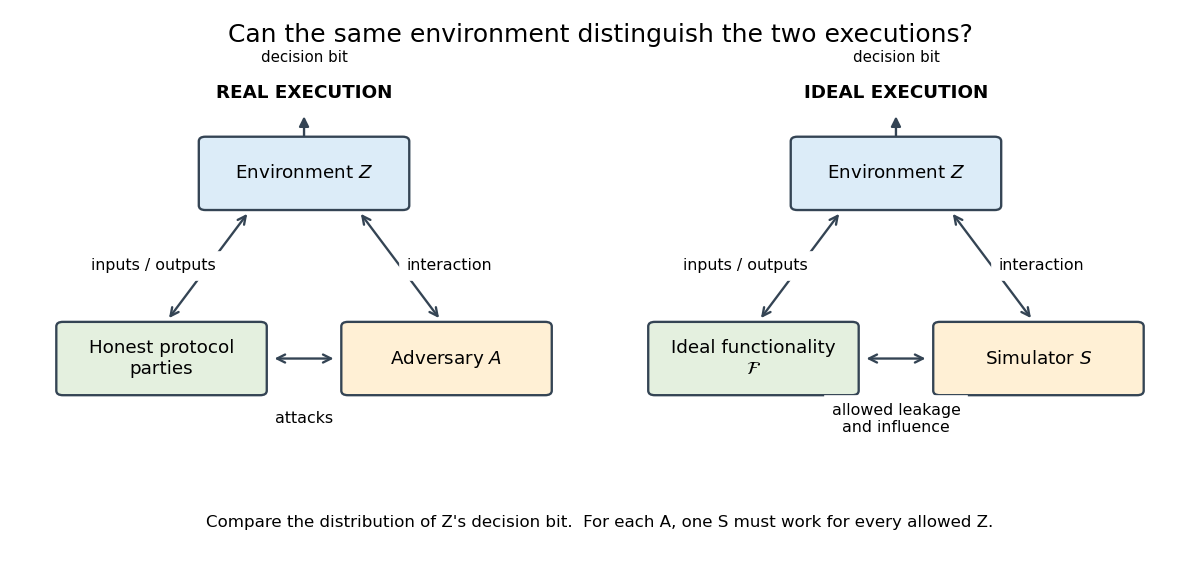
The same cryptographic environment observes either a real protocol and adversary or an ideal service and simulator. Honest-party forwarding is collapsed into the ideal-service box.
Details. The cryptographic environment models other software using the service, including choices depending on earlier outputs. It can retain private information with which to check later responses. Its view therefore includes the relationship between inputs, outputs and adversarial messages, not just isolated packet statistics.
An original two-bit example shows why that relationship matters. Let be a random variable with the uniform distribution on a finite set . One system returns ; another returns with an independent uniform bit. Each individual coordinate has the same marginal distribution in both systems. Nevertheless, the test “accept exactly when the two bits agree” has acceptance probabilitiesIts cryptographic distinguishing advantage is . Matching each output's marginal does not match their joint probability distribution. An interactive cryptographic environment can perform corresponding consistency checks against its retained inputs.
In the computational definition, the cryptographic environment has the specified polynomial time bound indexed by the cryptographic security parameter. For each real adversary, one cryptographic simulator must handle every allowed cryptographic environment; choosing a new simulator after learning which particular context will test it changes the requirement.[ref]
Universally Composable Security: A Tutorial by Ran Canetti. PDF p. 23, quantifier order; pp. 74–76, general formulation and restrictions
This breadth explains the usefulness of universal composability: a service can be analysed within a larger application context. The conclusion still concerns the interactions and cryptographic leakage admitted by the stated execution model.
A cryptographic simulator is an algorithm in a security proof that reproduces an adversary's externally observable behavior using the interfaces and cryptographic leakage allowed by an ideal cryptographic functionality. In universal composability, substituting it for the real adversary should leave every allowed cryptographic environment unable to distinguish real and ideal executions efficiently.[ref]
Universally Composable Security: A Tutorial by Ran Canetti. PDF pp. 23–26, emulation and realization of an ideal functionality
The central question is what information the simulator receives. An original elementary example uses a one-time pad. For a fixed -bit message , let its fresh secret key be uniform on . Its ciphertext is , where is bitwise exclusive or. For every -bit value ,A simulator told only can therefore reproduce this one ciphertext's distribution by generating independent uniform bits, without knowing . With , each of the 32 possible ciphertexts has probability in both constructions. This is a direct distribution calculation, not a complete universal composability proof for a messaging system: other visible inputs, outputs and correlations would also need to match.
Now modify the toy system so its visible packet includes a secret input bit in the clear. Suppose the cryptographic environment selected uniformly and the ideal service reveals neither nor any correlated information before the simulator must report its guessed packet bit . In the real system the environment's test succeeds with probability one. Any simulator whose information is independent of succeeds with probability , even without a computation bound. The cryptographic distinguishing advantage is therefore .
Allowing the ideal service to reveal would remove that particular simulation obstacle, but would specify a different disclosure policy. A valid simulator must use the actual permitted cryptographic leakage, rather than assume access to an honest party's private data.
More generally, reproducing a cryptographic transcript requires its correlations with the cryptographic environment's state to be correct. Sampling plausible-looking individual messages is insufficient. Efficiency also matters: an unbounded reconstruction algorithm does not supply a polynomial time simulator when the security definition requires one.
An ideal cryptographic functionality is an executable specification of a desired cryptographic service, represented as a trusted computation. Its interfaces specify inputs, outputs, state, permitted cryptographic leakage and permitted adversarial influence. In universal composability, honest-party forwarding interfaces connect it to the cryptographic environment, while the cryptographic simulator uses its adversarial interface.[ref]
Universally Composable Security: A Tutorial by Ran Canetti. PDF pp. 25–27, ideal functionality and its protocol wrapper
An ideal service is a way to state the security goal; it does not assert that the deployed system contains a physically trusted central machine. A cryptographic protocol realizes the service only if the relevant real/ideal comparison is proved.
For a concrete original specification, consider a single-message channel between two fixed, honest parties, with no party corruption in this toy model. Its state begins empty. On the designated sender's submission of , it stores the message under the session label and marks it pending. It reveals the session label, sender, recipient and byte length to the adversarial interface, but not . A later delivery instruction naming that pending session makes it output the stored to the designated recipient and mark the session delivered. Further delivery instructions for that session have no effect; a second submission for the same session is rejected.
This state machine gives both message authentication and message confidentiality specific meanings. The adversarial interface has no instruction for replacing the stored message or impersonating the designated sender. It can delay delivery indefinitely. Thus the toy specification permits length disclosure and denial of delivery, while excluding content disclosure through that interface, message replacement and repeated delivery. These are separate choices, rather than consequences of the word “secure”. The primary tutorial similarly distinguishes authenticated communication, delayed delivery, corruption and message-hiding guarantees.[ref]
Universally Composable Security: A Tutorial by Ran Canetti. PDF pp. 28–33, successive communication functionalities and their exposed information
For an example execution, the sender submits ASCII bytes
41 42 43 under a fresh session label. Before delivery, the simulator learns length three and the endpoints. On the first delivery instruction the recipient receives those three stored bytes. A second delivery instruction produces no new recipient output. If no delivery instruction arrives, the message remains pending. An observed recipient output 41 42 44 would violate this toy specification, regardless of whether it had the correct length.Stating these transitions makes a proof obligation testable: an implementation must match the specified service's observable behavior against every allowed cryptographic environment. Changing the permitted cryptographic leakage, delivery rule or corruption behavior changes the service being implemented.
A cryptographic security parameter is an integer indexing a family of cryptographic protocols or algorithms. It controls the scale at which efficiency and security guarantees are stated. Theoretical algorithms are often given , a string of ones, so polynomial time in that input length means polynomial time in .[ref]
Zero-Knowledge chapter draft of Foundations of Cryptography by Oded Goldreich. Protocol Input Specification, unary security parameter
A typical asymptotic guarantee requires a cryptographically negligible probability: for every fixed , the relevant probability eventually falls below . An exponential such as has that property; does not, because it fails the requirement for .
An original idealized guessing example separates a parameter from a concrete security claim. If a secret is uniform among possible values and no other information about it is supplied, one fixed guess succeeds with probability . Checking distinct guesses covers at most a fractionof those possibilities. This is a counting argument under the stated uniform-secret model, not a guarantee for every scheme described as having a128-bit key.
The parameter's numerical value, key length, algorithmic cost and actual adversary advantage are related through the particular construction. Naming the parameter alone does not establish a concrete work estimate or compensate for a flaw in the protocol.
A cryptographically negligible probability is a function of the cryptographic security parameter that eventually becomes smaller than every inverse power of that parameter. Formally,The threshold may depend on . This is the inverse-polynomial definition of negligibility used in asymptotic cryptography.[ref]
In a World of P=BPP by Oded Goldreich. Printedp.107, preliminary definitions of negligible and noticeable probabilities
For example, is negligible because an exponential eventually dominates every fixed power. The function is not negligible: it exceeds whenever . Even the constant is not negligible as a function of , although it is numerically small. Negligibility describes a family of experiments as the parameter grows, rather than a synonym for “unlikely” in one experiment.
An original closure calculation explains why the definition is useful. Suppose an adversary gets at most attempts and each has success probability at most . The union bound gives total success probability at most , without requiring independent attempts. Given any , negligibility with exponent eventually givesThus a polynomial number of opportunities preserves negligibility. A concrete numerical guarantee still requires an explicit bound at the chosen parameter; the asymptotic quantifiers alone do not supply that value.
Cryptographic setup is the generation and distribution of initial parameters or other resources required by a cryptographic protocol. Its specification includes the input cryptographic security parameter, the sampling procedure, the public output and any information that must remain secret. Setup is part of the protocol's security model, rather than an arbitrary source of well-formatted constants.
A common reference string gives one example. Parties to a non-interactive zero-knowledge proof may share a public string sampled by the prescribed setup. The definition describes both its distribution and how that setup participates in real and simulated proof experiments.[ref]
Zero-Knowledge: a tutorial by Oded Goldreich. Section8, shared reference-string model and joint simulation
An original distribution example makes the generation rule explicit. Let a toy setup sample two independent uniform bits and publishIts support is , each with probability . A uniformly sampled three-bit string instead has eight possible values, each with probability . The two generators publish strings of the same length, but the second satisfies the parity equation only half the time.
This toy setup is not a secure proof-system construction. It demonstrates why replacing a specified generator by a different random-looking source changes the experiment. Public availability of setup data and correctness of its generation are separate properties.
A proof of knowledge is a proof protocol whose success is linked to an efficient procedure for obtaining a cryptographic witness from the prover's behavior. The procedure is a knowledge extractor, with access to the prover specified by the definition. The ordinary verifier in an interactive proof need not receive the witness during the real exchange.[ref]
On Defining Proofs of Knowledge by Mihir Bellare and Oded Goldreich. Definition3.1, knowledge verifier and universal extractor
A standard formulation measures a prover's acceptance probability against a knowledge error . When on an input with a witness, extraction has an expected-time bound of the formfor an appropriate fixed constant . The relation, oracle access and false-input guarantees must also be specified; this expression alone is not the complete definition.[ref]
On Defining Proofs of Knowledge by Mihir Bellare and Oded Goldreich. Definition3.1 and section4, extraction bound and qualifications
For an explicit graph-isomorphism proof protocol extraction, suppose the same commitment graph has accepting responsesto the two possible challenges. The compositionis a graph isomorphism, hence a witness for the public claim. Rewinding in cryptographic proofs can provide the extractor with differently challenged continuations of a common earlier state.
The formula explains a knowledge claim without invoking a human notion of understanding. Soundness of an interactive proof and zero-knowledge proof privacy are separate requirements: excluding false statements and hiding information do not by themselves establish extraction.
Rewinding in cryptographic proofs is a simulation or extraction technique that returns an algorithmic participant to an earlier state and explores another continuation. The saved state includes the relevant earlier messages and randomness. The technique is justified by the simulator's or extractor's access in the mathematical model; it is not an extra power of the ordinary verifier during a live exchange.[ref]
Probabilistic Proof Systems: A Primer by Oded Goldreich. Section2.2.1, general-verifier simulation and repeated continuations, printedpp.27–28
For the graph-isomorphism proof protocol, two accepting continuations of the same first message can answer different challenge bits. A knowledge extractor can combine their response mappings to obtain a cryptographic witness. If the prover instead starts again with a different first message, the responses need not combine in that way.
An original retry calculation explains an efficiency condition. Suppose independent simulation attempts succeed with probability and each failed attempt returns to the required earlier state. The attempt count has a geometric distribution:At , the expected number of attempts is2; at , it is100. Constant or inverse-polynomial success can therefore support expected polynomial time, whereas exponentially rare success generally cannot.
A valid argument must also account for the cost of each attempt and show that the resulting output distribution is correct. Restoring a state, conditioning on success and restarting an entire protocol are distinct operations.
The knowledge error of a proof of knowledge is a threshold in its extraction guarantee. If a prover's acceptance probability exceeds that threshold, the definition requires a knowledge extractor with an appropriate expected extraction time. It is not simply the probability that the extractor outputs an incorrect witness.[ref]
On Defining Proofs of Knowledge by Mihir Bellare and Oded Goldreich. Definition3.1, knowledge-error function and validity condition
In one standard formulation, on an input in the witness relation's domain,where is an appropriate polynomial. The extraction guarantee includes the relation and oracle-access conditions as well as this bound.[ref]
On Defining Proofs of Knowledge by Mihir Bellare and Oded Goldreich. Definition3.1 and section4, qualifications to the extraction condition
For an original numerical comparison, set . Acceptance probability leaves a gap of0.1, giving a factor10 multiplying in this bound. At , the factor is100. As success approaches the threshold, the permitted expected running time worsens. At , this displayed guarantee does not apply.
The single-challenge graph-isomorphism proof protocol illustrates why a nonzero threshold can be meaningful. A strategy can prepare a relabeling of one public graph and answer only its corresponding challenge, succeeding with probability without using an isomorphism between the two public graphs. Success beyond that baseline is what the extraction analysis exploits.[ref]
On Defining Proofs of Knowledge by Mihir Bellare and Oded Goldreich. Section4.4, graph-isomorphism example and knowledge error1/2
A knowledge extractor is the algorithm that turns sufficiently successful proving behavior into a valid cryptographic witness in the definition of a proof of knowledge. The definition specifies its access to the prover and its efficiency guarantee, often in terms of acceptance probability above a knowledge error. The real verifier need not execute the extractor or learn the witness.[ref]
On Defining Proofs of Knowledge by Mihir Bellare and Oded Goldreich. Definition3.1, universal knowledge extractor
A concrete algebraic step appears in the graph-isomorphism proof protocol. Suppose two accepting continuations with the same commitment supply mappingsThe extractor returnsTo check it, take any edge of . The first mapping sends it to an edge of , and the inverse second mapping sends that edge to an edge of . Both mappings are bijections, so their composition is a graph isomorphism. The same argument handles nonedges.
This verifies the output once the two continuations have been obtained. A full extraction proof must also justify obtaining them, for example through permitted rewinding in cryptographic proofs, within the promised expected extraction time.
A zero-knowledge simulator solves a different task: it reproduces a verifier-view distribution without the witness. An extractor produces a witness from successful proving behavior. Confusing those output requirements would obscure both the privacy and knowledge guarantees.
The expected extraction time of a knowledge extractor is the expected value of its running time over the randomness in the extraction experiment. The definition specifies the extractor's access to a prover and the cryptographic witness it must return. A common proof of knowledge formulation bounds that expectation, on valid inputs and for acceptance probability above knowledge error , bywhere is a fixed polynomial. The access and output conditions are essential parts of the definition.[ref]
On Defining Proofs of Knowledge by Mihir Bellare and Oded Goldreich. Definition3.1, validity and universal extraction; section6, equivalent formulation
An original asymptotic comparison makes the denominator meaningful. Write and suppose . A gap gives an expected bound . A gap instead gives . The displayed extraction theorem therefore does not promise polynomial time uniformly for arbitrarily tiny positive gaps.
An expected bound also permits rare long executions. As a separate toy running-time distribution, let with probability and with probability . Thenalthough the worst-case execution is exponential. This distribution illustrates the distinction; it is not itself an extraction construction. Markov's inequality turns an expected bound into the tail estimate for . Converting an extractor into a procedure with a fixed deadline must account for the resulting probability of stopping before it finds a witness.
A cryptographic witness is auxiliary information that satisfies an efficiently checkable relation for a public statement . Writing the relation as separates the claim from the information that certifies it. In a zero-knowledge proof, a prover may use such a witness without revealing it.[ref]
Probabilistic Proof Systems: A Primer by Oded Goldreich. Section2.3, witness information and proofs of knowledge
For an original graph isomorphism example, let the public graphs and both be the path with edges . A witness is a bijection of vertices preserving adjacency. Bothandare valid. A witness need not be unique. With an adjacency-matrix encoding, a verifier can check all vertex pairs and their images in comparisons for an -vertex pair.
The public assertion is that a suitable mapping exists; the witness supplies one particular mapping. Whether that mapping is secret depends on the application. Calling it a witness does not inherently make it a password or a secret key.
A further distinction concerns what a proof establishes. Soundness of an interactive proof protects against acceptance of false statements. A proof of knowledge requires an additional formal relationship between a successful prover and extraction of a witness. Validity of a statement and knowledge of its certificate are not interchangeable claims.
A common reference string is public setup data shared by the parties to a cryptographic protocol. Its distribution is specified by the cryptographic setup. In a non-interactive zero-knowledge proof, the prover and verifier can use the same string without exchanging a new challenge during each proof.[ref]
A common random string is the special case in which the setup string is uniformly sampled; more general reference-string models specify another efficiently generated distribution. Being public is compatible with its purpose: the cryptographic witness may be secret even though the reference string is available to everyone.
An original eight-bit example shows why format and distribution are distinct. A uniform eight-bit string satisfiesA generator that always outputs those eight zeros satisfies the same length requirement but gives that event probability one. Checking length alone cannot establish the intended sampling law. This example illustrates a distributional distinction, not a proposed secure setup.
The zero-knowledge simulator may also simulate the joint distribution of setup data and proof. Consequently, the definition must state how setup is generated and what generation-related information the relevant parties possess. A public string with the right shape is not by itself evidence for the security properties of a proof system.[ref]
Zero-Knowledge: a tutorial by Oded Goldreich. Section8, real and simulated reference-string/proof pairs
A zero-knowledge proof is a proof protocol that convinces a verifier of a public statement's validity while revealing no additional information that the verifier could not efficiently obtain from that statement and its permitted prior information. The formal comparison uses a zero-knowledge simulator: an efficient randomized algorithm that reproduces the verifier's view without the prover's secret cryptographic witness.[ref]
Proofs that Yield Nothing But Their Validity or All Languages in NP Have Zero-Knowledge Proof Systems by Oded Goldreich and others. Definition of zero knowledge, simulator and verifier-view distributions
An interactive proof system separates three questions. Completeness of an interactive proof asks whether an honest prover can convince the verifier of a true statement. Soundness of an interactive proof bounds acceptance of false statements. Zero knowledge concerns information disclosure, so a protocol can pass a soundness test without being zero knowledge. The simulator comparison may require equality of distributions, statistical closeness or computational indistinguishability, depending on the definition.[ref]
Proofs that Yield Nothing But Their Validity or All Languages in NP Have Zero-Knowledge Proof Systems by Oded Goldreich and others. Definitions of interactive proofs, zero knowledge and distribution comparison
For an original soundness calculation, suppose a fixed false-statement strategy can answer only one of two equally likely challenges. Its acceptance probability is at most . If this conditional bound continues to hold after every preceding transcript and fresh challenges are used, sequential successful rounds have probability at mostAt , the bound is . This stipulated calculation does not prove that any particular protocol has the required per-round bound, nor does it establish zero knowledge.
The simulator supplies the separate privacy argument. It must reproduce the relevant distribution efficiently, rather than merely output one accepting transcript. A zero-knowledge proof can be interactive or a non-interactive zero-knowledge proof; its precise verifier and setup assumptions are part of its security claim.
The graph-isomorphism proof protocol is a three-message interactive proof system for the claim that public graphs are isomorphic. An honest prover in an interactive proof knows a cryptographic witness .[ref]
Probabilistic Proof Systems: A Primer by Oded Goldreich. Construction2.3, printedpp.26–27
The prover samples a uniform vertex permutation and sends . The verifier in an interactive proof replies with a uniform bit . The prover then sends an isomorphism : use or . The verifier checks the mapping and its effect on all edges.
For an original three-vertex example, let have edges , and let map to . Then has edges . Choose mapping to ; the sent graph has edges . The two responses areEach maps the corresponding input graph's edges to those of . These tiny graphs illustrate the checks, not a difficult cryptographic instance.
An honest prover always passes. If the public graphs are not isomorphic, a fixed cannot have valid responses to both challenges: composing them would give an isomorphism between the inputs. Thus a cheating strategy answers at most one of the two equally likely challenges for that commitment, giving single-round acceptance at most .
The standard protocol also admits zero-knowledge simulator constructions. An elementary sampler proves honest-verifier zero knowledge; treating arbitrary verifier strategies requires an additional simulation argument.[ref]
Probabilistic Proof Systems: A Primer by Oded Goldreich. Construction2.3 and subsequent honest/general-verifier simulations, printedpp.27–28
Honest-verifier zero knowledge is the zero-knowledge proof simulation requirement restricted to a verifier that follows its prescribed algorithm. The zero-knowledge simulator reproduces that verifier's view without the prover's secret cryptographic witness. General zero knowledge must account for permitted deviations by the verifier as well.[ref]
Zero-Knowledge: a tutorial by Oded Goldreich. The Basics, restriction to honest verifiers and simulation variants
In the graph-isomorphism proof protocol, the honest verifier chooses an independent uniform challenge bit. A simulator can first choose , sample a uniform permutation , set and output . For isomorphic public graphs, this has the same distribution as the honest conversation.[ref]
Probabilistic Proof Systems: A Primer by Oded Goldreich. Construction2.3, honest-verifier simulation on printedp.27
An original small example shows what changes if the verifier deviates. Suppose is a uniform relabeling of a three-vertex path. There are three labeled paths; two contain the edge . A different verifier could choose exactly when that edge is present, soThe elementary honest-verifier simulator chooses a uniform bit and instead gives . It therefore fails to reproduce this changed verifier's view.
This comparison does not show that the standard graph protocol lacks general zero knowledge. It shows that a simulator for the honest verifier does not automatically prove the stronger property. The general analysis may use rewinding in cryptographic proofs to simulate challenges that depend on the first message. The stated adversary model is part of the theorem.
A zero-knowledge simulator is an efficient randomized algorithm that reproduces the relevant verifier-view distribution of a zero-knowledge proof without receiving the prover's secret cryptographic witness. Depending on the definition, the real and simulated views must be identical, statistically close or satisfy computational indistinguishability.[ref]
Zero-Knowledge: a tutorial by Oded Goldreich. The Basics, simulator and level of distribution similarity
The graph-isomorphism proof protocol provides an illuminating example for honest-verifier zero knowledge. On a fixed public isomorphic pair , a real prover sends a random relabeling , receives a uniform challenge bit , and supplies a graph isomorphism from to .[ref]
Probabilistic Proof Systems: A Primer by Oded Goldreich. Construction2.3 and the honest-verifier simulation immediately following it, printedpp.26–27
An explicit simulation reverses that construction. First choose a uniform bit and a uniform vertex permutation . Setand output the transcript . The simulator never needs a mapping between and . For an isomorphic public pair, random relabelings of either graph have the same probability distribution; conditional on , the response mapping is uniform in both constructions. Thus the honest verifier's transcript distribution is reproduced exactly.
This does not give a live cheating prover control of the verifier's future challenge. The simulator chooses a complete transcript in a different order from the real exchange. Nor does this simple sampler establish security against an arbitrary malicious verifier, whose challenge could depend on .
The example exposes the central requirement: producing one plausible accepting transcript is insufficient. The simulator must reproduce the specified distribution within the required efficiency bound and adversary model.
A non-interactive zero-knowledge proof allows a prover to send one proof message that a verifier can check without an ensuing challenge-response conversation, while satisfying an appropriate zero-knowledge proof definition. Non-interactive describes the proof exchange; it does not mean that setup assumptions disappear.[ref]
Zero-Knowledge: a tutorial by Oded Goldreich. Section8, single-message model and shared reference string
In a common reference string model, both parties use public setup data . The prover constructs a proof for a public statement , and the verifier evaluatesThe setup's distribution and the adversary's knowledge of its generation must be specified. In the tutorial's basic common-random-string model, the zero-knowledge simulator produces a reference-string/proof pair with the required computational indistinguishability from a real pair.[ref]
Zero-Knowledge: a tutorial by Oded Goldreich. Section8, real and simulated reference-string/proof distributions
An original toy relation separates a statement from a cryptographic witness. Let the public values be and , and ask whether there is a value withThe value satisfies the relation because . Sending directly verifies that example but reveals that witness; it does not demonstrate a zero-knowledge property. A non-interactive proof would instead require a defined proof construction, verifier and simulation argument.
The tiny modulus is chosen only for transparent modular arithmetic; it is not a secure cryptographic parameter. Likewise, a single short message is not automatically a non-interactive zero-knowledge proof: efficient verification, soundness and information disclosure remain separate obligations.
Articles by others on the same topic


A cryptographic protocol is a formal set of rules that dictate how data is exchanged and secured between parties using cryptographic techniques. These protocols are designed to ensure confidentiality, integrity, authenticity, and non-repudiation in communications and transactions. Key aspects of cryptographic protocols include: 1. **Encryption**: This involves converting plaintext data into ciphertext to ensure that only authorized parties can read it. Different algorithms, such as AES or RSA, may be used.