A detector trigger decides which candidate events cause a readout or recording. It can concentrate a limited recording capacity on rare interactions, but the accepted events then form a selected sample. A coincidence circuit uses a timing relation between several detectors; the Blackett-Occhialini triggered cloud-chamber experiment made that relation operate an entire camera-and-expansion sequence.
A coincidence circuit responds when detector signals occur within a specified time window. Two counters placed on opposite sides of a chamber can preferentially select a charged particle that crosses both. Simultaneity within the electronics' window alone does not establish that two signals have the same physical cause: unrelated detections produce accidental coincidences.
Suppose two independent background streams follow Poisson processes with rates and . Define a coincidence by : is the full accepted time-difference width. Around each first-counter signal, the expected number of second-counter signals is . The expected pair rate is therefore . A circuit producing at most one output per first signal instead givesThe distinction matters when multiple detections occur in one window. If a different convention accepts , its full width is and the dilute expression is .
For a chosen numerical model, take background rates , and . The dilute pair rate is . These are stipulated teaching inputs, not measurements of the historical chamber.
Making smaller also rejects some genuine events. Suppose true pairs arrive at rate before the timing cut, and their time difference has a centered normal distribution with standard deviation . Its accepted fraction, using the error function, isFor chosen and , the window retains about of true pairs. In the dilute background model the fraction of accepted events that are true is . A narrow window trades detection efficiency against background; it does not make either quantity equal to one. Delaying one counter's signal far beyond genuine event correlations gives a proposed background check under stationarity, without assuming that the zero-delay excess itself is accidental.
A trigger changes which particle populations are common in the recorded sample. Let be the number of particles in an event, and stipulate an independent Bernoulli distribution for each particle's ability to produce an accepted telescope signal, with success probability . If any successful particle suffices, the event acceptance isThis is a deliberately simplified model. Its includes the joint geometrical acceptance and response of the whole telescope; it is not an assumed universal single-counter efficiency. Actual shower directions, spatial correlations and shared electronics can violate the independence assumption.
The conditional probability formula givesFor chosen underlying fractions , and , the two acceptances are and . Five-particle events consequently form about of recorded events. A population that is only of incoming events can occupy nearly of the photographs. This is selection bias, not evidence that the source population changed.
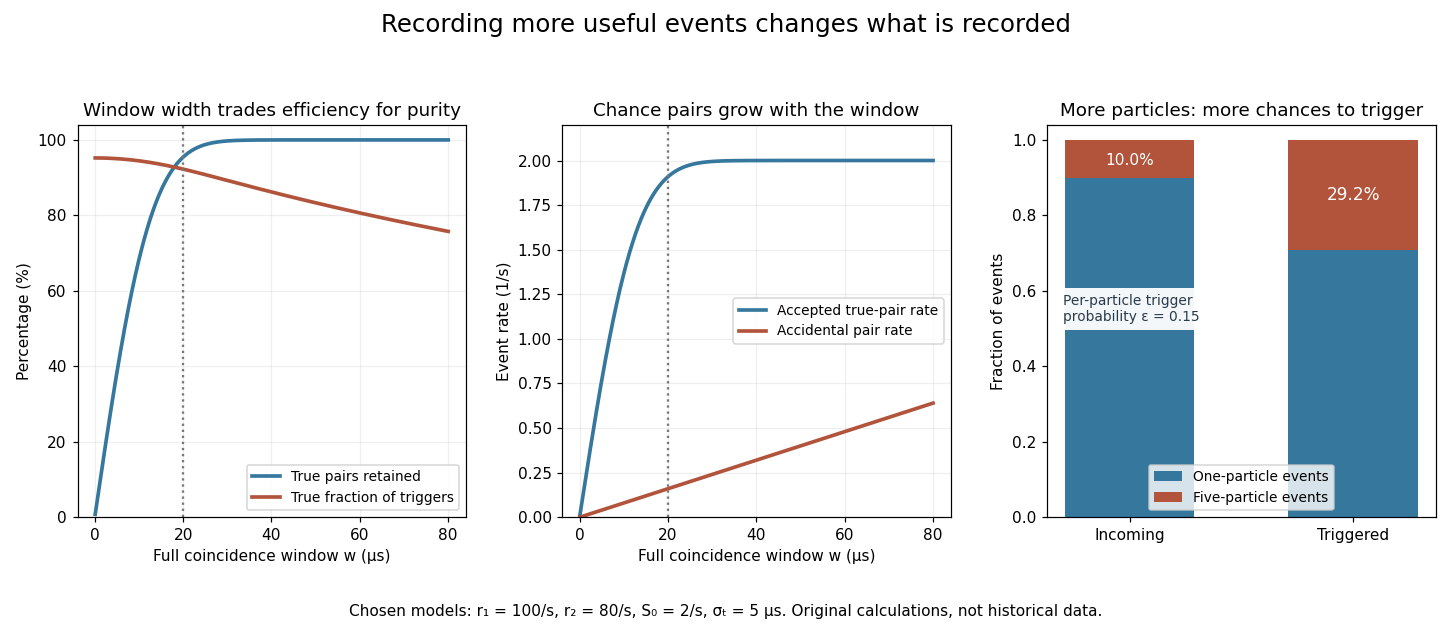
A coincidence window trades timing acceptance against background, while a trigger enriches events with more particles
. Original calculations with the explicitly chosen rates, Gaussian timing spread and independent-particle acceptance model in the text. No historical event counts or measured timing curves are reproduced. Details.
