Elastocapillarity is the coupling between surface tension and elastic deformation. Changing an interface can reduce surface energy while bending a compliant solid increases bending energy. Thin structures can deform strongly when the available capillary energy competes with their elastic resistance.
For an isotropic thin elastic plate, its bending stiffness iswhere is Young's modulus, the thickness and Poisson's ratio. A sheet bent over a size has curvature of order . Its bending energy scales as , while the capillary energy scale is , where is surface tension. Balancing these scales gives the elastocapillary lengthHere has units of energy and energy per area, so the ratio has units of length squared. At fixed material properties, ; doubling thickness multiplies this length by . Geometry and contact angle enter the more detailed wrapping criterion.[ref]
Capillary Origami: Spontaneous Wrapping of a Droplet with an Elastic Sheet by Charlotte Py and others. Equation1 and surrounding thin-plate energy balance
The 2007 capillary origami experiments of Charlotte Py and collaborators provide a direct demonstration. They cut polydimethylsiloxane membranes, 40–80 micrometres thick, into planar shapes, placed them on a water-repellent support, added a water droplet and recorded the deformation during evaporation. Suitable triangular sheets folded around the shrinking drop into a tetrahedral enclosure. Smaller or stiffer sheets failed to close completely. The observations connected a controlled material thickness and initial shape to the competition between surface energy and bending energy.[ref]
Capillary Origami: Spontaneous Wrapping of a Droplet with an Elastic Sheet by Charlotte Py and others. pp.156103-1–156103-2; Figure1: apparatus, evaporation sequence and shape-dependent wrapping
Capillary origami uses surface tension to fold an initially flat elastic plate around a liquid droplet. The fold trades a reduction in surface energy for an increase in bending energy; the initial outline helps select the resulting enclosure.[ref]
In the 2007 experiments of Charlotte Py and collaborators, 40–80 micrometre polydimethylsiloxane sheets rested on a water-repellent support. A water droplet reached the sheet's corners; time-lapse images followed its evaporation. Squares changed from four-corner bending to a tubular shape; triangles formed a tetrahedron. Smaller or thicker sheets could bend and then reopen without enclosing the droplet.[ref]
Capillary Origami: Spontaneous Wrapping of a Droplet with an Elastic Sheet by Charlotte Py and others. pp.156103-1–156103-2: preparation and square/triangular evaporation sequences
The elastocapillary length makes the thickness dependence quantitative. For fixed Young's modulus, Poisson's ratio and surface tension, the bending stiffness obeys and . Halving thickness therefore reduces by , about . At the same lateral size , the sheet elastocapillary energy ratio increases eightfold. This calculation explains why making the sheet thinner can enable wrapping even without changing its outline.
The sheet elastocapillary energy ratio compares available energy scales; it does not determine a unique final shape. The contact angle, initial liquid volume and outline also matter. A cut chosen to permit several panels to meet is a mechanical design choice, while the surface tension supplies the driving force. Predicting the complete folding path requires more than the scalar energy comparison. The same group reported cross-shaped templates forming a cube and flower-shaped templates forming nearly spherical enclosures.[ref]
For a thin elastic plate interacting with a liquid interface, the elastocapillary length isHere is the plate's bending stiffness, the surface tension, Young's modulus, the thickness and Poisson's ratio. In this plate convention has units , while has units ; their ratio has units of length squared. The quantity is different from the gravity-dependent capillary length.
To see the balance, bend a portion of sheet of lateral size through an angle of order one. Its curvature is of order , so its bending energy scales as . The competing surface energy scale is . Their dimensionless quantity is the sheet elastocapillary energy ratioLarge means that the capillary energy scale is large relative to the bending energy scale. This dimensional analysis does not make a universal threshold for complete closure in capillary origami.[ref]
Capillary Origami: Spontaneous Wrapping of a Droplet with an Elastic Sheet by Charlotte Py and others. Equation1 and its dimensional argument
For chosen illustrative values and , the elastocapillary length is . A lateral size of gives , whereas gives . These are calculations with assumed parameters, not measurements of a particular material.
Two ways of changing size give opposite trends. Keep Young's modulus, Poisson's ratio and surface tension fixed, and let be a lateral scale factor. At fixed thickness, stays fixed and . If all sheet dimensions shrink in the same proportion, then , and . Halving lateral size alone decreases the sheet elastocapillary energy ratio fourfold; halving lateral size and thickness together doubles it. The phrase "smaller sheets" therefore needs a specified thickness rule.
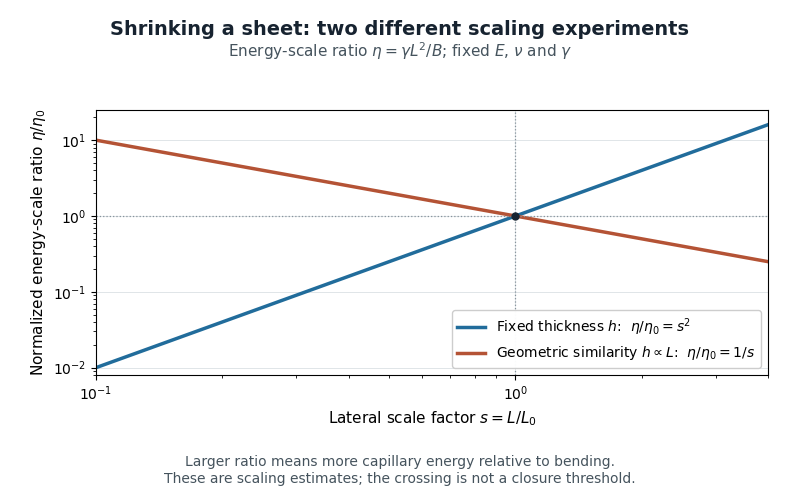
Changing lateral size at fixed thickness versus scaling all sheet dimensions: opposite trends in the capillary-to-bending energy-scale ratio
. Details. The length can also be calibrated directly: the 2007 study fitted an elastic-loop model to a long polydimethylsiloxane strip held by an ethanol meniscus. For their complete-wetting configuration, loop width was . The coefficient belongs to that model and geometry.[ref]
Capillary Origami: Spontaneous Wrapping of a Droplet with an Elastic Sheet by Charlotte Py and others. p.156103-2, Equation2 and loop-calibration paragraph
The sheet elastocapillary energy ratio compares capillary and bending energy scales for an elastic sheet:Here is a lateral size, is surface tension, is plate bending stiffness and is the elastocapillary length. The ratio is a dimensionless quantity: and both have units of energy.
The estimate assumes bending through an angle of order one over size . Then curvature scales as and integrating the bending energy density over area gives a scale . A comparable change in interfacial area gives a surface energy scale . The same balance underlies the capillary origami study's definition of elastocapillary length.[ref]
For an original calculation, take , and . Then . Doubling alone raises it to 10. Halving thickness at fixed , Young's modulus and Poisson's ratio divides by eight and raises to 20.
Changing all dimensions gives another trend. Write and keep material properties and surface tension fixed. At fixed thickness, ; at fixed aspect ratio , and . Thus halving alone gives one quarter of the initial ratio, while halving both and doubles it.
Two size-scaling paths for the sheet elastocapillary energy ratio
. Reuses the original normalized scaling plot: fixed thickness gives , while geometric similarity gives . The curves are dimensional estimates, not measured wrapping thresholds. Details.A larger ratio makes capillary energy more competitive with bending, but does not establish complete closure. Actual wetting, contact angle, droplet volume, contact-line pinning and accessible deformation paths also matter. The ratio compares scales rather than computing the full change in energy along a folding path.
Articles by others on the same topic


Elasto-capillarity is a fascinating phenomenon that emerges at the intersection of elasticity and capillarity, which refers to the forces exerted by surface tension in liquid interfaces. It describes how soft, elastic materials interact with liquids, particularly how the elastic deformation of a solid can be influenced by the presence of a liquid's surface tension.