An RLC circuit combines electrical resistance , inductance , and capacitance . The capacitor stores energy in its electric field; the inductor stores energy in its magnetic field. Their exchange can produce an oscillation, while Joule heating removes energy. A series RLC circuit gives a particularly clear example: changing turns ringing into a direct return to equilibrium, and changing or tunes a resonance.
These circuits connect two useful viewpoints. In time, they describe how stored energy is released after switching. In frequency, they select a range of signals: the resonant series RLC response explains radio tuning and simple filters. The same mathematics describes a damped harmonic oscillator, so insight about mechanical ringing transfers directly to an electrical circuit. [ref]
https://www.feynmanlectures.caltech.edu/I_23.html#Ch23-S3. Feynman lectures, I.23.3: electrical and mechanical resonance
; [ref]https://www.feynmanlectures.caltech.edu/II_22.html#Ch22-S7. Feynman lectures, II.22.7: frequency filters
.An ideal sinusoidal voltage source drives a series branch and a separate resistor in parallel. At the series resonance, the reactive stored energy is , while both resistors together dissipate per cycle. Counting only the series resistor overestimates the stored-energy-to-dissipation ratio by a factor of two.
An ideal resistor, inductor and capacitor connected across the same voltage have admittance in the convention. At the reactive branch currents cancel, giving minimum source current and maximum impedance . This differs from a lossy series coil placed across a capacitor.
With no external current, Kirchhoff's current law is , and . Differentiating gives the title equation. For , its real solutions are with . The original current balance fixes the compatible initial inductor current. A single complex exponential represents a physical voltage through its real part; general complex solutions require both conjugate characteristic roots.
When is in series with a parallel RLC circuit, the ratio of parallel-network voltage to voltage across is its impedance divided by . Its peak is , and its phase passes from through zero to as angular frequency rises through . This is not the transfer ratio relative to the total input voltage, which includes the additional series voltage drop and has peak . Identifying voltage endpoints is necessary before using the voltage divider formula.
For the ratio of resistor-current amplitude to total-current amplitude to exceed , . The exact positive endpoint difference is and the quality factor is . Greater shunt resistance means weaker dissipation, unlike increasing a series resistance.
In a series RLC circuit, the same electric current flows through the resistor with electrical resistance , the inductor, and the capacitor. Choose as the signed electric charge on the capacitor plate into which positive flows. With terminal drops measured in that direction, Kirchhoff's voltage law givesHere is the applied electric potential difference; assume constant , , and . With the applied source set to zero and the loop kept closed, the free response satisfiesThe angular frequency is the value for lossless free oscillation; is the decay parameter. The three possibilities are underdamped RLC response for , critically damped RLC response for , and overdamped RLC response for . [ref].
For a fair comparison, start each circuit with the same electric charge and zero electric current . Set and ; then obeys . The plot compares . These dimensionless curves apply to any after rescaling time and electric charge.
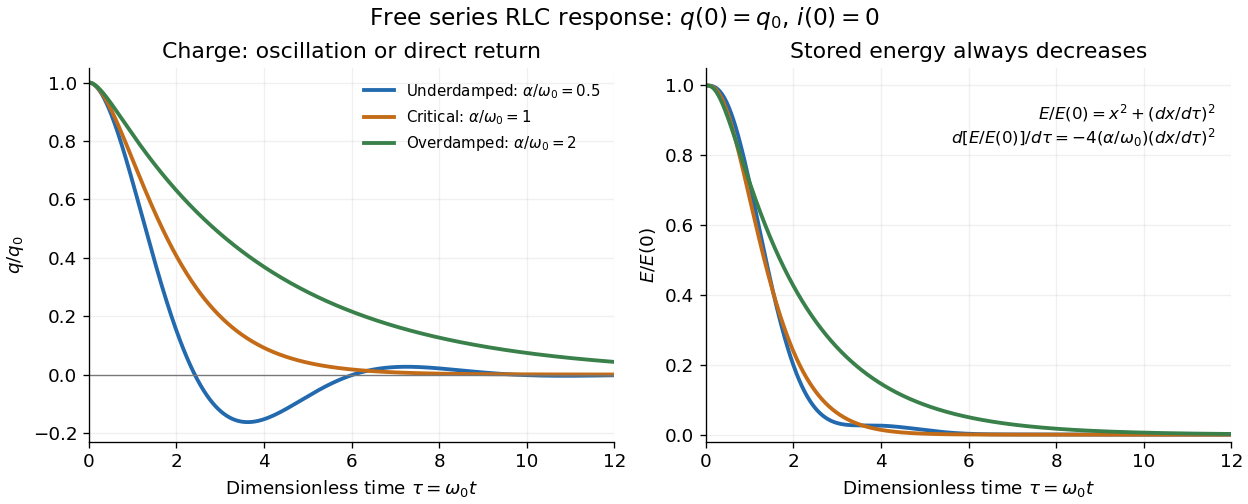
The stored energy is the sum of magnetic energy and capacitor energy:Differentiating and using the circuit equation gives the complete power balance,In the free response, : Joule heating accounts exactly for the lost energy. For the plotted initial conditions, and . Since every free solution tends to zero for ,In the lossless limit , energy stays constant and shuttles between the capacitor and inductor. Thus an oscillation of electric charge and a decrease of total energy are compatible statements.
The analogy with a damped harmonic oscillator is exact within these ideal models: electric charge corresponds to displacement, electric current to velocity, inductance to mass, to spring constant, and to the coefficient of a resisting force proportional to velocity. The two stored energy terms play the roles of kinetic energy and elastic potential energy. [ref]
https://www.feynmanlectures.caltech.edu/I_23.html#Ch23-S3. Feynman lectures, I.23.3: the oscillator analogy
.Differentiating the driven equation also gives . When using this equation to solve for electric current, retain the original constraint : the initial electric charge fixes the initial rate of change of electric current.
For series resistance , inductance and capacitance , with output measured across the inductor, the transfer function is . At current resonance its modulus is . Large and oppositely phased inductor and capacitor voltages nearly cancel in the loop sum. This is voltage magnification in a passive circuit, not power gain. The maximum of need not occur exactly at the current-resonance frequency.
Write and for a series RLC circuit. The squared charge response has denominator . Its nonzero resonance peak occurs at . The two squared half-height frequencies, when both exist, areTheir difference in angular frequencies is only approximately at large quality factor. The electric current instead has . Its exact half-power frequencies satisfy , whose positive roots differ by , independently of capacitance. Thus an exact capacitance-independent bandwidth applies to current or resistor-voltage output; capacitor-voltage output is a low-pass response with a possible resonant peak.
Drive a series RLC circuit with electric potential difference , where and . After the free transient decays, the electric current has the same angular frequency as the source:For fixed positive , the electric current amplitude is largest exactly at . The two electrical reactance contributions cancel there, leaving only the drop from electrical resistance. In particular,Every solution approaches this periodic response because its difference from the displayed solution is a decaying free response. The peak remains at even for an overdamped RLC response; free ringing is not required for a maximum of driven electric current. [ref]
University Physics Volume 2 by Samuel J. Ling and others. OpenStax University Physics 2, §15.3: current amplitude, phase, and resonance
.For example, stipulate , , , and . Then , , and the peak electric current amplitude is . Holding the source amplitude fixed is essential when comparing responses at different frequencies.
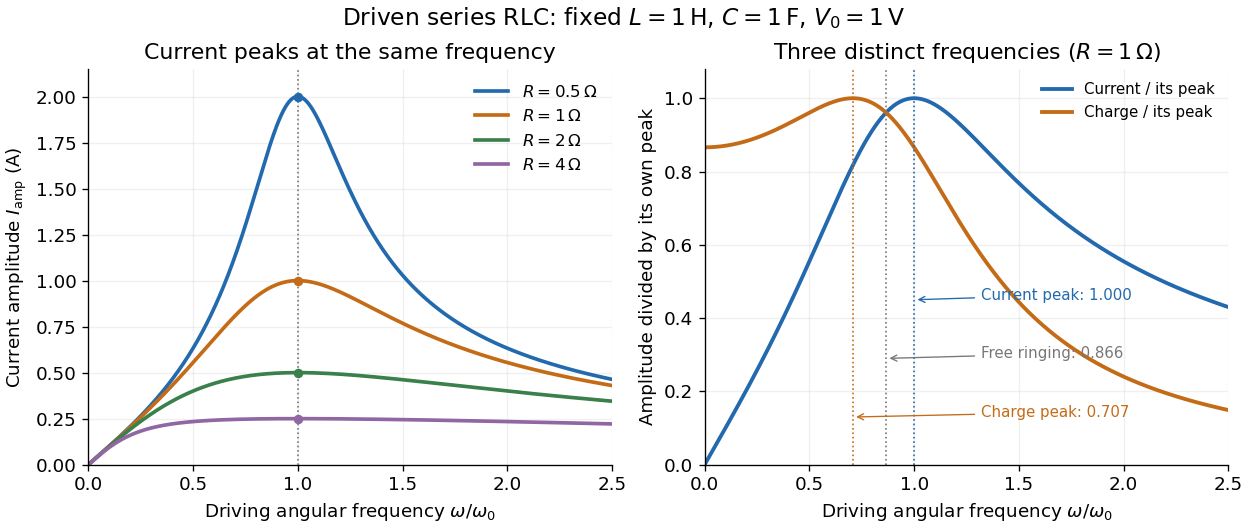
Three frequencies must be distinguished. The free underdamped RLC response rings at . Driven electric current peaks at . Driven electric charge has amplitudewhose peak occurs at only if . Otherwise it decreases from its zero-frequency limit , with no positive-frequency peak. The different peak locations follow because electric current is the time derivative of electric charge, multiplying a sinusoidal amplitude by . The limiting responses are as and as .
The Q factor measures selectivity:The average Joule heating power is . Its half-maximum angular frequencies and their separation are exactlyThese follow by setting . In the numerical example, and . Reducing makes a taller, narrower electric current peak; varying tunes the selected frequency. Measuring the drop gives a band-pass filter that suppresses very low and very high frequencies while passing a range near resonance. This is useful for selecting a radio signal, though the range must be broad enough to pass its modulation. [ref]
https://www.feynmanlectures.caltech.edu/II_22.html#Ch22-S7. Feynman lectures, II.22.7: resonant filters and radio sidebands
.An overdamped RLC response is a free series RLC circuit response with , equivalently . Put . The distinct negative characteristic roots are , so the general electric charge isFor initial conditions , ,For , this electric charge decreases to zero without reversing sign. In the dimensionless example , , the characteristic roots are . The slow term dominates late times. Stronger damping can therefore make the final return slower: for , . Nonoscillation alone does not imply a fast response, and monotonicity here uses the specified initial conditions.
A critically damped RLC response is the boundary between underdamped RLC response and overdamped RLC response. The free series RLC circuit has a repeated characteristic root , with general solutionFor initial conditions , ,In the plotted normalization, and . The electric charge returns without ringing; the polynomial factor matters, so a single exponential function does not give the whole response.
For fixed and these initial conditions, critical damping avoids ringing while giving a faster asymptotic return than any larger : the overdamped RLC response has a root closer to zero. This makes critical damping a useful tuning target for settling after switching. An MIT laboratory exercise makes the distinction observable by asking students to compare all three cases with and . Those values give and . [ref].
An underdamped RLC response is a free series RLC circuit response with , equivalently . Its characteristic roots are , and its general electric charge isFor initial conditions , ,In the dimensionless example , , the ringing angular frequency is , below the driven electric current resonance at . The electric charge first crosses zero at and reaches its first negative extremum at , where .
The sinusoidal factor changes sign while its envelope decays as . The total energy follows the exact balance , rather than a pure exponential decay at every instant; in particular, its rate of loss is zero whenever . As , the displayed solution tends to the lossless harmonic oscillator . As from below, , recovering the critically damped RLC response continuously. The overdamped RLC response reaches the same limit through .


