The Thomson charge-to-mass experiment infers the magnitude of an Electron's charge-to-mass ratio by combining electric and magnetic deflection of cathode rays. The central idea is to determine speed separately from magnetic curvature: a known speed turns the observed gyroradius into a measurement of .
In 1897, J. J. Thomson used two grounded slits in an evacuated glass tube, then aluminium plates long, wide and apart. A battery supplied their electric potential difference. Deflected cathode rays produced a phosphorescence patch on the glass; an external scale and movable luminous pointer recorded its position in darkness. Greater evacuation reduced gas electrical conductivity that screened the electric field; reversing plate polarity reversed deflection. External coils supplied the magnetic field, calibrated by induction against larger coils. He adjusted equal electric and magnetic deflections. [ref]
Cathode Rays by Joseph John Thomson. Cathode Rays (1897), Fig. 2; second m/e method, apparatus and calibration
His comparison included air, hydrogen, carbon dioxide, and aluminium versus platinum cathodes, supporting a common carrier. He explicitly noted uncorrected magnetic bending outside the plates. His tables give , the reciprocal of the magnitude used here. The inferred ratio alone could not separate electric charge from mass. [ref]
Cathode Rays by Joseph John Thomson. Cathode Rays (1897), second m/e method: table, corrections and interpretation
To connect this readout with the Lorentz force, derive a simple nonrelativistic model in modern SI notation. Let the uniform deflecting region have length , followed by a field-free drift of length . Assume a narrow speed distribution, small deflection angles, negligible collisions, and matching electric and magnetic field profiles. For an Electron with speed , the electric acceleration has magnitude , the transit time is approximately , and the subsequent drift adds exit transverse velocity times . Thus the displacement magnitudes measured separately with only electric field or only magnetic field areThe electric expression follows from constant transverse acceleration; the magnetic expression uses its small-deflection approximation. Equal displacement magnitudes then giveThis is an ideal derivation of the comparison principle, not a numerical reanalysis of the historical tube. Different exterior magnetic field profiles invalidate cancellation of the common geometrical factor. The comparison determines through deflection and the known apparatus dimensions; it does not require a downstream semicircle.
For a second, deliberately different teaching geometry, combine a velocity selector with a separate region containing only a uniform magnetic field perpendicular to the selected velocity. Here belongs to the velocity selector, while belongs to the analyzer: they need not be equal. The magnetic Lorentz force supplies the centripetal acceleration, soIf the analyzer turns the beam through a semicircle before it hits a screen in the entry plane, the separation between entrance and impact is the diameter: . For a shorter observed arc, the screen displacement is not generally a radius; fit the appropriate circle geometry. This two-stage velocity selector and curvature apparatus is an original ideal teaching model, not a claim that Thomson's Fig. 2 used a separate selector and semicircular analyzer.
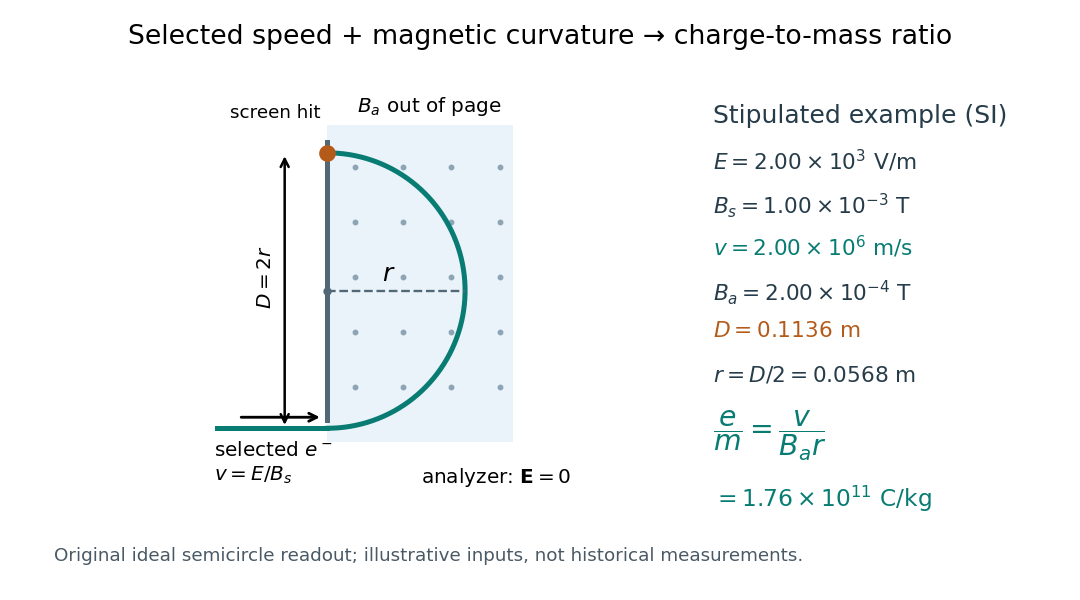

For a worked example, stipulate , , , and . The selected speed and inferred charge-to-mass ratio magnitude areThe SI units provide an independent check: and , because . The charge-to-mass ratio of the Electron is negative; this calculation gives its magnitude. The bending direction gives the sign of the electric charge once the magnetic field direction is known. Scaling both and by the same positive factor preserves every displayed trajectory, so an independent electric charge measurement is required to determine mass separately.
The curvature formula assumes nonrelativistic momentum . At higher speeds, the relativistic cyclotron orbit gives , hence , where is the Lorentz factor; the ideal straight-through selection still follows from vanishing Lorentz force. The stipulated speed is about times the speed of light, making about . For this example the nonrelativistic approximation is adequate, but no massive particle can be selected at . Finite slit widths, collisions with residual gas, uncertain magnetic field calibration, and fields outside the ideal boundaries limit a real inference; repeat at several selected speeds and analyzer strengths to test consistency of rather than trusting one spot position.
Articles by others on the same topic
There are currently no matching articles.