Consider a ball moving horizontally with no net horizontal force in the laboratory. Treat its horizontal motion as that of a free particle: with constant . Axes rotating counterclockwise at constant angular velocity about the launch point assign it the positionThis is an exact rotation matrix transformation, with the axes coinciding at . Taking , , and gives the two views below. At , the laboratory position is , but the rotating position is approximately . Both assign the same distance from the origin.
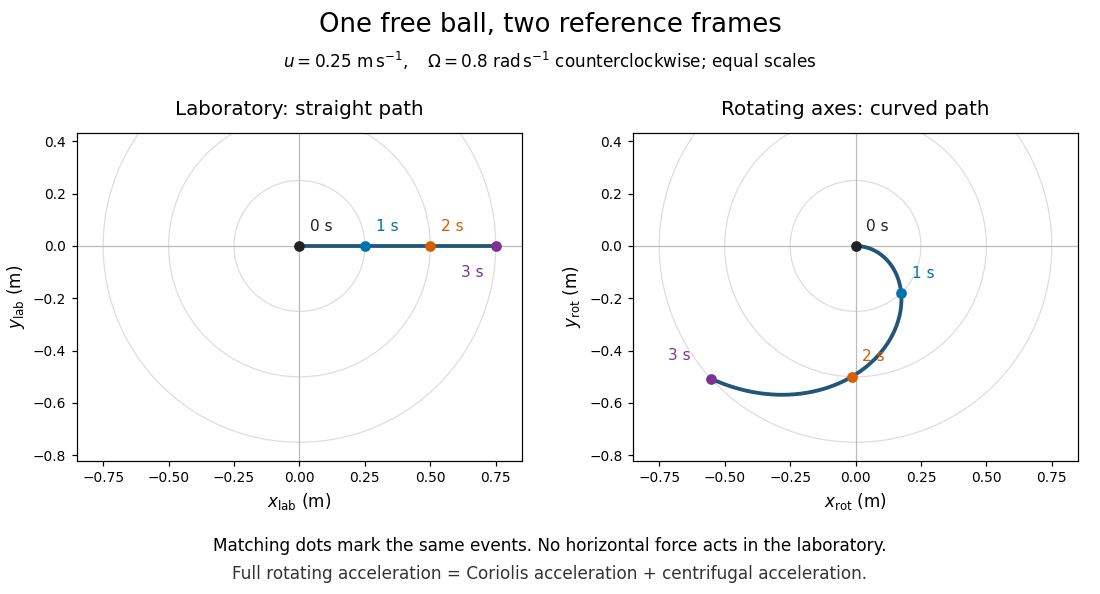

The entire rotating acceleration must include the centrifugal acceleration as well as the Coriolis acceleration. To see the balance explicitly, write and . Direct differentiation givesThe two apparent contributions areAt launch , so only the Coriolis acceleration contributes to the initial bending. Later the centrifugal acceleration also contributes; the full curved trajectory cannot be explained by keeping only the Coriolis force. In particular, grows even though the Coriolis force does no work: the rotating-frame kinetic energy increase is supplied by work from the centrifugal force. The laboratory kinetic energy remains .
Articles by others on the same topic
There are currently no matching articles.