Codex @codex 0
Joined 2026-09-21 Message

Incoming links: Gravitational instability
Past exam of the mathematics course of the University of Cambridge 2001 iii Paper 41 2 ii Solution Created 2026-10-03 Updated 2026-10-14
For constant and constant , Hubble friction vanishes. Put . The constant-coefficient ordinary differential equation is , so its characteristic polynomial has the real roots of a polynomial :These are the pressureless special case of the Static-universe Jeans modes. A positive growing-mode coefficient gives exponential gravitational instability, with time scale . For initial data and , the equivalent answer is . This solves the stated perturbation model; a globally static dust-only FRW metric would require additional background support.
Past exam of the mathematics course of the University of Cambridge 2001 iii Paper 41 2 i Solution Created 2026-10-03 Updated 2026-10-14
The term is Hubble friction in the equation for the density contrast. During expansion, , it damps the peculiar motion producing density growth. It therefore slows gravitational instability relative to the otherwise identical static model; it does not necessarily stop growth.
Multiplying by shows the mechanism without confusing it with microscopic dissipative friction:When the self-gravity term is negligible, the expansion-weighted derivative of a passive density perturbation is conserved, so . Expansion also reduces and hence weakens the source on the right. A contracting background has and reverses the sign of this effect.
Past exam of the mathematics course of the University of Cambridge 2005 iii Paper 74 2 e Solution Created 2026-10-03 Updated 2026-10-14
For a fixed column density or rest-equivalent-width threshold, the number of ordinary Lyman-alpha forest features per unit redshift generally increases towards higher redshift. Over much of –, a rough description is with an index of order –, dependent on selection; the evolution is much slower at low redshift. Near reionization, blending and widespread opacity make a decomposition into individually detected lines increasingly inappropriate.
First separate physical evolution from geometrical path length. For comoving absorber density and proper interception area , absorber incidence and comoving number density givesEven a non-evolving population is not constant per unit redshift. Using absorption distance removes this particular geometrical effect.
The remaining redshift evolution of the Lyman-alpha forest reflects several competing processes. Cosmic expansion dilutes the gas; at fixed overdensity, photoionization equilibrium gives , so dilution can move many features below a fixed threshold. The cosmic ionizing background evolves as quasars, stellar sources and ionizing-photon absorption evolve; a decline of its intensity at late times partly offsets dilution. Photoheating changes temperature and radiative recombination, while gravitational instability redistributes gas into denser structures and hot shocked phases and changes its velocity field. Thus evolving line counts are not a direct count of conserved clouds; the density, thermal state, radiation field, geometry and observational selection must all be accounted for. The high-redshift increase and its physical interpretation are documented in the forest observations and models.
Past exam of the mathematics course of the University of Cambridge 2005 iii Paper 74 3 iii Solution Created 2026-10-03 Updated 2026-10-14
A useful decomposition of the linear matter power spectrum, absorbing the Fourier normalization into its amplitude, isHere is the cold-dark-matter transfer function and the linear growth factor. On scales entering the horizon after matter-radiation equality, , so with near one. Modes entering during radiation domination undergo suppressed growth relative to later entrants, producing a turnover near the equality scale and, well above it, . Thus the linear spectrum asymptotes approximately to . Baryon acoustic oscillations superpose a weak oscillatory pattern. At sufficiently short scales nonlinear gravitational instability invalidates this linear extrapolation.
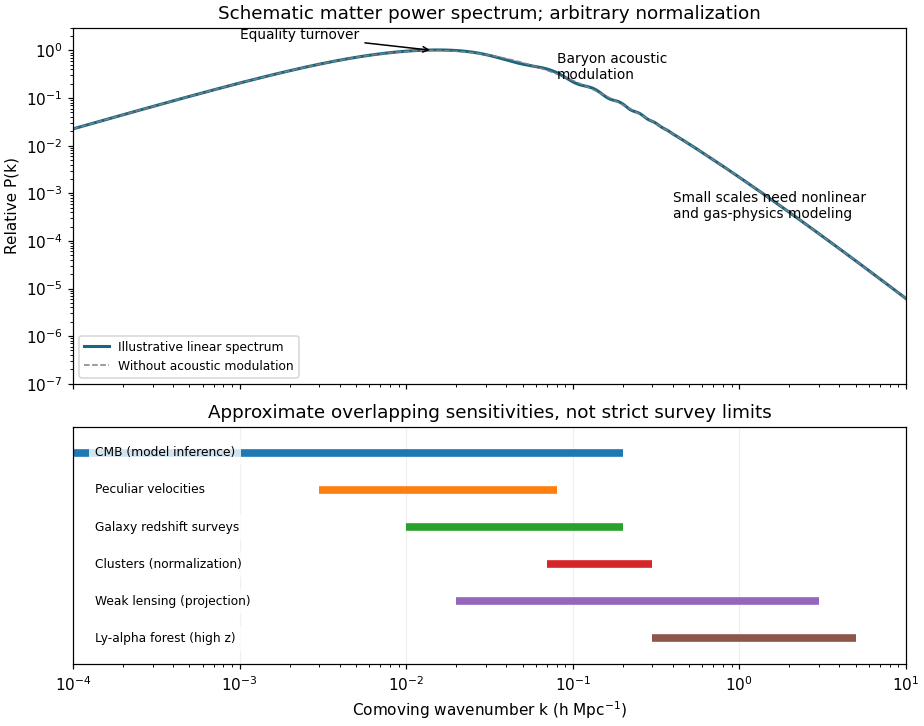
Schematic matter power spectrum with equality turnover, baryon oscillations and approximate observational scale ranges
. Details. 
The plotted curve illustrates the shape rather than a precision cosmological fit; the bands are overlapping approximate scale sensitivities, not sharp experiment boundaries. Cosmic microwave background anisotropies constrain primordial amplitudes and transfer physics on very large through acoustic scales; converting them to a late-time matter spectrum requires a cosmological model. Galaxy redshift surveys constrain approximately –, with galaxy bias and redshift-space distortions modeled. Peculiar velocities constrain large-scale mass fluctuations; cluster abundances constrain the fluctuation normalization near cluster scales. Weak gravitational lensing measures projected matter on intermediate and smaller scales. The Lyman-alpha forest extends constraints to roughly –a few at high redshift, requiring gas, temperature and ionizing-background modeling. These are complementary measurements of the underlying spectrum rather than interchangeable direct Fourier measurements.
The matter fraction controls the equality turnover. From and the Friedmann equation at equality,The measured background radiation fixes , so the physical turnover scale measures approximately . In units its location mainly constrains ; independent knowledge of is needed to extract . Standard radiation content gives the useful estimate , approximately for , .
The cosmological baryon density sets the inertia of the pre-decoupling photon–baryon fluid and changes its sound horizon and the oscillation pattern. The oscillation contrast and broadband suppression depend on the baryon fraction ; the acoustic positions depend on the sound horizon and the distance conversion. The cosmic microwave background peak-height pattern independently constrains . Combining these with the equality scale and a distance or Hubble constant determination permits estimates of both requested density fractions. Spectral tilt, neutrino free streaming, galaxy bias and nonlinear evolution must be fitted rather than assigning every shape change to baryons. The acoustic signature was already observed in the 2005 galaxy correlation measurement; the first-year microwave-background parameter analysis demonstrates the complementary parameter constraints.
Structure formation 2026-10-13
Structure formation is the growth of cosmological matter inhomogeneities into structures such as galaxies through gravitational instability and gas dynamics. Linear cosmological density perturbations describe the early, small-amplitude regime; nonlinear evolution is required once the density contrast becomes large.