On the punctured plane , consider the vector fieldWith , its partial derivatives satisfyThus the field has zero scalar curl everywhere it is defined. Nevertheless, on any counterclockwise circle with ,The radius cancels exactly.
Applying Green theorem to the enclosed disk would be invalid: is undefined at the origin, inside that disk. Zero curl on the path alone is insufficient.[ref]
V5. Simply-Connected Regions. 18.02SC Multivariable Calculus, Fall 2010; V5. Simply-Connected Regions, pp. 1–2, §2: excluded origin prevents filling a closed curve within the field's domain
Now take the annulus . Its positive boundary orientation is counterclockwise on the outer circle and clockwise on the inner circle. The complete boundary line integral is thereforeHere Green theorem applies: an open set containing the closed annulus can avoid the origin. The inner contribution remains even for an arbitrarily small positive inner radius. Decreasing the hole's area does not decrease this line integral.
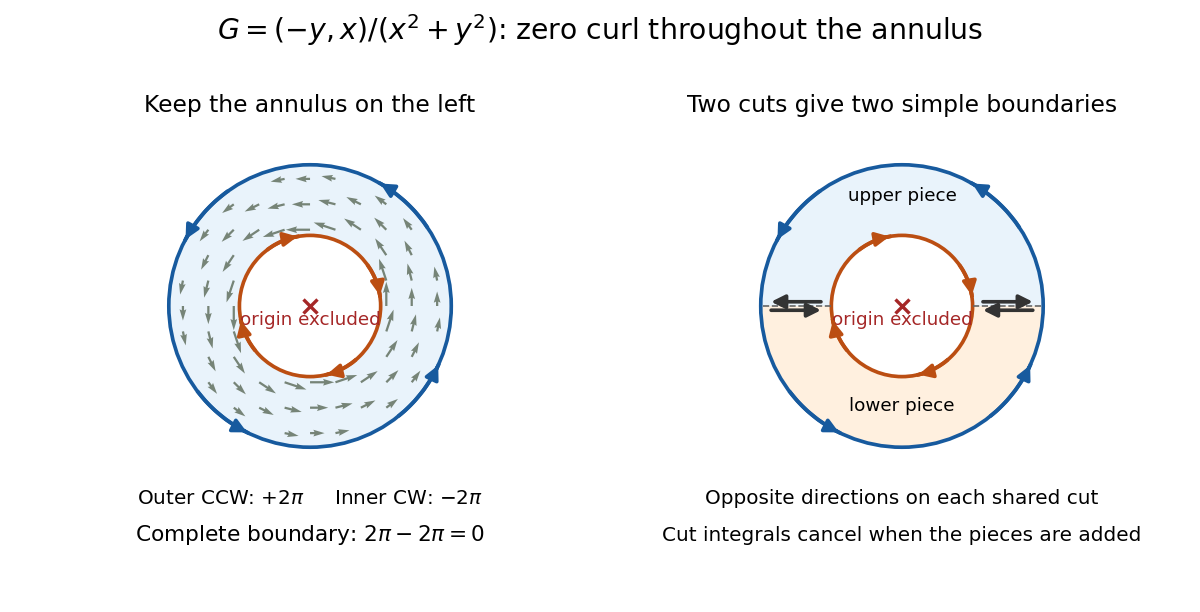
Zero curl away from an excluded origin: the outer circle contributes two pi, the clockwise inner circle minus two pi, and the annulus boundary sum is zero
. Details. 
The cancellation has a useful proof picture. Cut the annulus along two radial segments into two half-annuli. Each piece has a single simple closed curve as its boundary; along each cut, the two induced boundary orientations oppose, so those line integrals cancel when the two applications of Green theorem are added. Only the outer and inner circles remain.[ref]
V5. Simply-Connected Regions. 18.02SC Multivariable Calculus, Fall 2010; V5. Simply-Connected Regions, p. 1, §1, subdivision proof: integrals over cuts cancel in opposite directions
Locally, a choice of angle in polar coordinates has gradient . Globally, following a circle once increases that angle by , so it cannot be a single-valued potential of a conservative vector field on the punctured plane. The nonzero closed-path line integral also rules out such a potential by the fundamental theorem for line integrals.
On a simply connected open region, a continuously differentiable planar vector field with zero scalar curl does have a global potential. The hole is what separates the local derivative condition from the global conclusion.[ref]
V5. Simply-Connected Regions. 18.02SC Multivariable Calculus, Fall 2010; V5. Simply-Connected Regions, pp. 2–3, theorem (3) and Curl Theorem: simply connected domain hypothesis for a global gradient field
Articles by others on the same topic
There are currently no matching articles.