The Haar projection at level is the orthogonal projection onto the functions constant on level- dyadic intervals. On each cell it replaces by its cell average. This is the closest cellwise-constant approximation in the L2 norm, because choosing a constant on a cell minimizes at its cell average.
On , take the step function with values on successive quarter-intervals. At level zero, its Haar projection is the constant . At level one, it has values and on the two halves. At level two, it recovers the four original values exactly. With normalized Haar wavelets, these approximations areThe coefficients are L2 inner products, so they differ from the discrete vector coefficients by the factor . Their squared sum also has a direct meaning:The approximation errors in squared L2 norm of are respectively : each added detail removes exactly its own squared coefficient from the error.
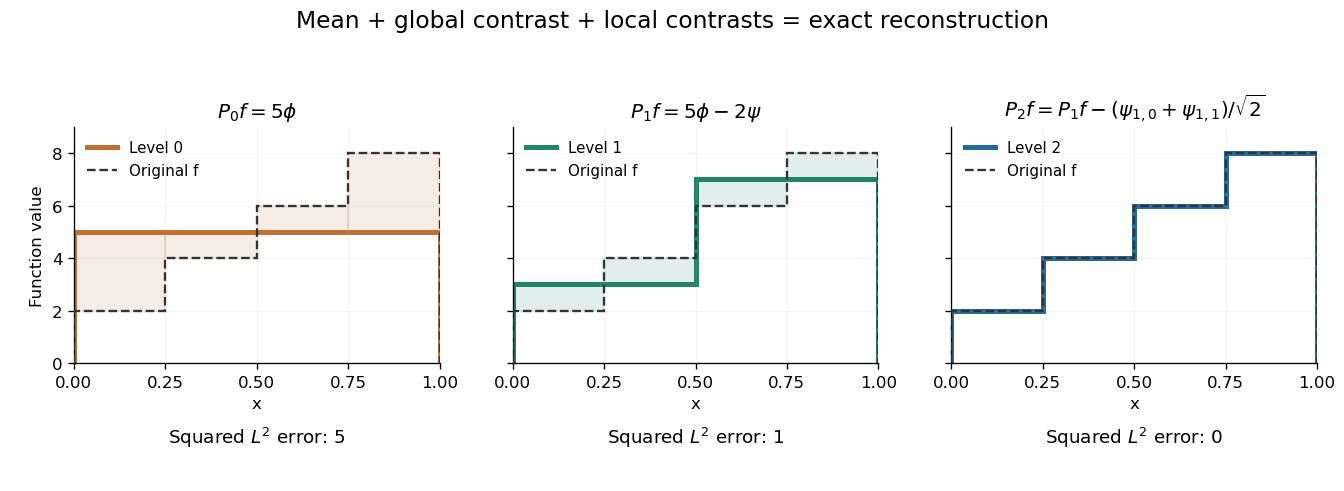
Coarse mean, half-interval contrasts and quarter-interval details reconstruct the same four-step function
. Details. 
The Haar projection can be expressed using level- Haar scaling functions, or through a coarse scaling family and the Haar wavelets at intermediate levels. On with lowest level zero, that coarse family is the single constant function . On the whole real line, use the integer translates of a coarse Haar scaling function instead; one global constant is not square-integrable. Refinement improves the representation while retaining the earlier coefficients.
The Haar projection replaces a function by its mean on each dyadic interval of length . For a function satisfying Lipschitz continuity with constant , every value in a cell differs from its cell mean by at most . This bound holds for all points with a consistent endpoint convention, and requires no global L2 norm assumption when the projection is defined by local averages.
Finite total variation of a function on gives the following error bound for averaging on dyadic cells of length :The cell error is at most its length times the oscillation on that cell, and the sum of the oscillations is at most the total variation. This proves that the difference is integrable even if is not globally in . For an even function decreasing to zero on the positive half-line, and the bound becomes .
In the Gaussian white noise model, estimate a Haar scaling function coefficient by . The resulting Haar projection estimator is an unbiased estimator with independent coefficient errors of variance . On each cell it is the observed path increment divided by the cell length. This gives a finite-dimensional estimator without imposing smoothness on the drift.
The cellwise error of the Haar projection estimator in Gaussian white noise is times a standard normal variable. Its supremum norm is therefore exactly that factor times the Gaussian maximum over cells. The Gaussian maximum bound without independence gives expected error at most . This concerns the stochastic error about the projection; approximation bias must be added when estimating the full drift.
Articles by others on the same topic
There are currently no matching articles.