The equilibrium calculation determines where the two temperatures end, without determining how long they take. Stipulate a constant thermal conductance and the linear heat transfer law underlying Newton's law of cooling. With positive from body 1 to bath 2, the ordinary differential equations areThe dot denotes a derivative with respect to time. This model assumes internal equilibration is fast compared with exchange between the bodies. Adding the two energy rates gives zero; subtracting the temperature rates givesThe temperature difference has exponential decay with time constant . For the finite heat bath example and the stipulated , , and solving the ordinary differential equations givesAt one time constant, , and . Equal temperatures are approached as a limit at infinite time. The finite bath causes the temperature difference to shrink faster than the fixed-bath model, because both bodies change temperature.
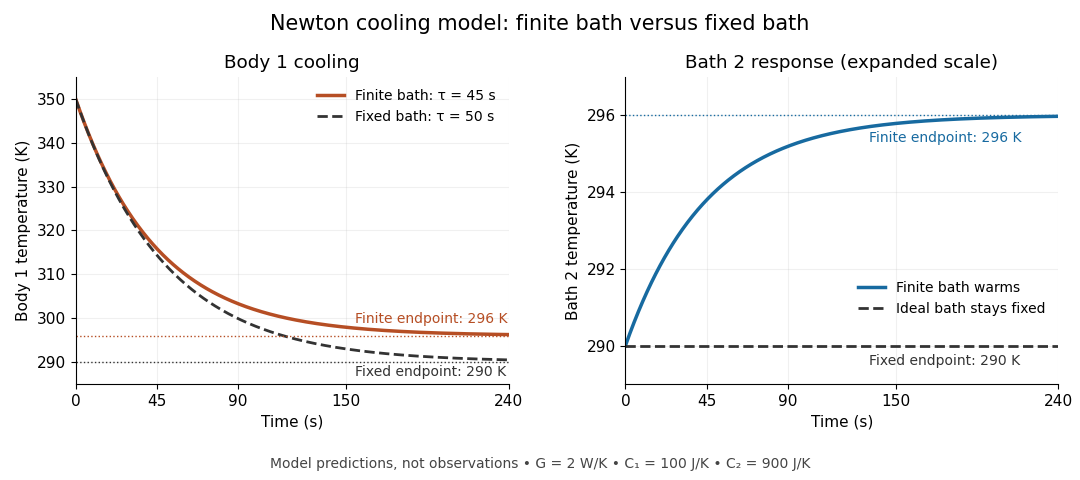
Finite bath and fixed bath Newton's law of cooling histories
. Original analytical model predictions with , and ; time is in seconds. Solid lines show the two finite bodies approaching with time constant . Dashed lines show body 1 cooling toward a bath held at , with time constant . The two panels use different vertical scales so that the finite bath's warming remains visible. Details.
For an ideal heat bath with the same , set rather than evolving its temperature. Newton's law of cooling then yieldsChanging changes these time constants, while the final temperature is fixed by the capacities and initial conditions. The dynamical model independently checks the Second law of thermodynamics:Its integral over the relaxation reproduces the endpoint entropy change. The useful separation is between capacity, which governs how much the bath temperature shifts, and thermal conductance, which governs the exchange rate. Neither alone establishes a reliable heat bath.
Articles by others on the same topic
There are currently no matching articles.