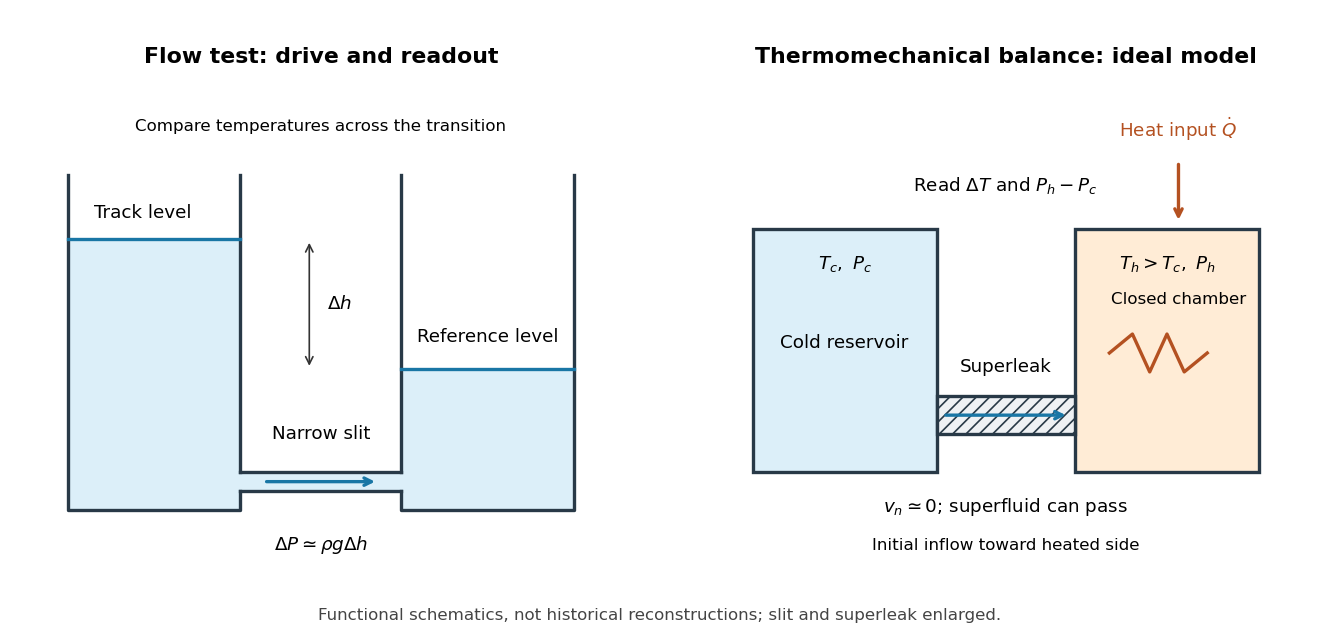
Pyotr Leonidovich Kapitza's 1938 test compared helium flow through optically flat glass disks. Suspension set the tube-to-bath level difference; a cathetometer read levels. The gap was estimated as . Levels barely moved over minutes above the transition, but equalized in seconds below. A laminar flow viscosity calculation gave only an upper bound.[ref]
Viscosity of Liquid Helium below the λ-Point by Pyotr Leonidovich Kapitza. Kapitza, 1938 viscosity paper, reprint chapter 34, pp.506–507
The essential control is to compare the same restriction and level readout at different temperatures. A changed pressure head is not itself evidence for a changed material response: the driving head must be included when interpreting the flow. For an idealized comparison at equal vapor pressure, negligible surface tension corrections and nearly constant mass density , hydrostatic equilibrium givesHere is the difference in free-surface heights and is gravitational acceleration. This explains why following a liquid level provides both a driving pressure and a transported volume; it does not turn a finite-resolution observation into proof of zero viscosity.

Articles by others on the same topic
There are currently no matching articles.