Suppose one qubit is prepared in either of the known pure states and , with equal prior probabilities. Measuring in the computational basis seems natural, but a tilted projective measurement gives better quantum state discrimination. The two density operators and their difference areThe Pauli matrices give , and the eigenvalues of are . Their absolute sum gives trace distance , agreeing with trace distance between qubit states.
The positive spectral projector points along the unit Bloch vector :The outcome labels and here refer to the sign of the eigenvalue of ; they do not denote a Hadamard basis measurement. Guess after and after . This sign choice is the equal-prior Helstrom measurement for two pure states, a case of the Holevo–Helstrom theorem. [ref]
https://cs.uwaterloo.ca/~watrous/TQI/TQI.3.pdf. Watrous, The Theory of Quantum Information, Theorem 3.4, equation (3.17)
An explicit orthonormal basis for this projective measurement iswith . Thus the real coefficient rotation angle is relative to the computational basis, while the Bloch vector of is tilted by from the positive axis toward negative . State-vector and Bloch sphere angles differ by a factor of two.
Write and , so . The Born rule gives the conditional outcome probabilitiesThe event has probability gap , attaining the variational characterization of trace distance. Both preparations are identified correctly with conditional probability , so
For comparison, a projective measurement in the computational basis has conditional outcome probabilities on and on . Guess zero on outcome zero and plus on outcome one. The average success isand the measured total variation distance is only . The optimal tilted projective measurement gains about in absolute success probability by balancing the two conditional error rates instead of identifying perfectly at the expense of .
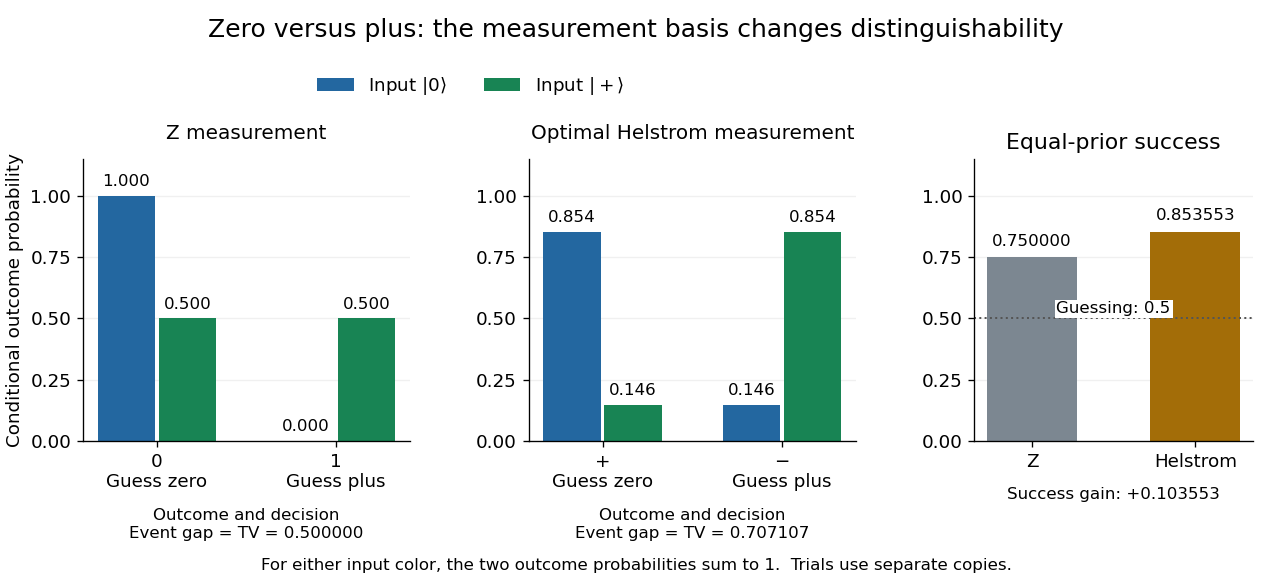
Conditional outcome probabilities and equal-prior success for Z and optimal Helstrom measurements of zero versus plus
. Details. 
These are statistics for alternative measurements on independently prepared copies. Applying first and then the tilted projective measurement is a different experiment, because the first measurement in quantum mechanics changes the density operator.
Two pure states can be distinguished with certainty in one measurement exactly when their inner product is zero.
Unambiguous quantum state discrimination allows an inconclusive outcome but forbids a wrong conclusive identification. Two distinct pure states admit such a measurement, whereas two full-rank density operators on the same support do not.
For normalized linearly independent pure states, their Gram matrix is positive definite. The displayed reciprocal vectors satisfy . The operator has nonzero eigenvalues equal to those of : use the polar factorization of the matrix whose columns are . Choosing gives the POVM effects and . Each conclusive outcome has probability on its own state and zero on every other input. The inconclusive effect preserves positivity, so the construction is a physical measurement in quantum mechanics.
Articles by others on the same topic
There are currently no matching articles.