Permeability of a porous medium is the coefficient that measures how readily its connected pore geometry transmits a fluid in Darcy law. Its units are , since converts a pressure gradient in into a Darcy velocity in . Large open, well-connected passages generally give larger permeability of a porous medium than narrow or winding passages. Porosity alone cannot determine it: two samples can contain the same void volume but have different passage sizes and connectivity.
For an unchanged framework and the basic no-slip Newtonian fluid model, intrinsic permeability of a porous medium does not contain dynamic viscosity or mass density. These properties instead enter hydraulic conductivity . At the same horizontal pressure gradient, replacing a liquid with another of twice the dynamic viscosity halves Darcy flux even though stays fixed. Structural changes, such as swelling or clogging, can change ; the independence claim assumes the pore geometry stays fixed.[ref]
An isotropic sample has scalar permeability of a porous medium. An anisotropic sample requires a tensor in , so discharge need not be parallel to the net driving force. Layered porous permeability gives a concrete example: arranging individually isotropic materials in horizontal layers produces different vertical and horizontal effective permeabilities.
A dimensionless reduction of a porous formation's intrinsic permeability of a porous medium for one fluid phase in multiphase flow. Its effective phase permeability is , and its phase mobility is . It depends on saturation and pore-scale phase configuration; it is not the magnetic use of relative permeability.
Relative permeability divided by the phase's dynamic viscosity. In the phase Darcy law, without body forces. Ratios of mobilities determine fractional flow when the phases have a common pressure gradient.
Effective permeability is a bulk permeability of a porous medium that reproduces the total Darcy flux through a heterogeneous sample under specified boundary conditions. For a horizontal sample with length , dynamic viscosity , and positive inlet-to-outlet fluid pressure drop , define by . The description is useful when individual layers or passages are smaller than the scale of the calculation. It depends on direction, geometry and boundary conditions; it is not generally the arithmetic mean of local intrinsic permeabilities.
Layered porous permeability illustrates the mechanism: when every path must cross a resistant layer, successive hydraulic resistances add; when more permeable paths span the whole sample alongside less permeable ones, their discharges add. This is the same organizing idea as series and parallel resistors. For fixed fluid properties the corresponding hydraulic conductivities average in the same way.
Consider planar horizontal layers with positive scalar intrinsic intrinsic permeabilities , thicknesses , and fractions . Assume each layer is uniform and isotropic, fully saturated by the same Newtonian fluid of constant mass density and dynamic viscosity, with perfect hydraulic contact and steady incompressible flow. Use boundaries that impose pure flow normal to the layers or a common gradient of hydraulic head along them; additional interface resistance and finite-edge effects are excluded.
For vertical flow normal to the layers, every layer carries the same normal Darcy flux by mass conservation. The hydraulic head drops add. Writing and taking positive as the drop along the flow direction givesThis is the thickness-weighted harmonic mean. It is hydraulic head, rather than fluid pressure alone, that accounts correctly for gravity in the vertical calculation. A thin layer of very small permeability of a porous medium can control the whole discharge because all flow must pass through it.
For horizontal flow parallel to the layers, each layer experiences the same gradient of hydraulic head. For width , each area is , and the individual volume fluxes add:This is the thickness-weighted arithmetic mean. A highly permeable layer can carry most of the horizontal flow because it supplies a continuous route from inlet to outlet. Woessner and Poeter derive both cases for hydraulic conductivity; identical fluid properties allow the common factor to cancel.[ref]
For two equally thick layers, take and , where . The values 1 and 9 are therefore permeabilities in units of , rather than dimensionless intrinsic intrinsic permeabilities. ThenAcross the layers, the less permeable half takes of the total hydraulic head drop and the more permeable half only . Along the layers, the more permeable half carries of the total volume flux. At the same magnitude of imposed gradient of hydraulic head, horizontal Darcy flux is times the vertical Darcy flux.
The arrangement thus creates physical anisotropy from locally isotropic ingredients. In coordinates with along the layers and normal to them, the effective permeability of a porous medium tensor is . A driving gradient of hydraulic head with both horizontal and vertical components generally produces a discharge in a different direction. This distinction matters when deciding whether a geological bed conducts aquifer flow along itself or acts as a barrier to flow across it.
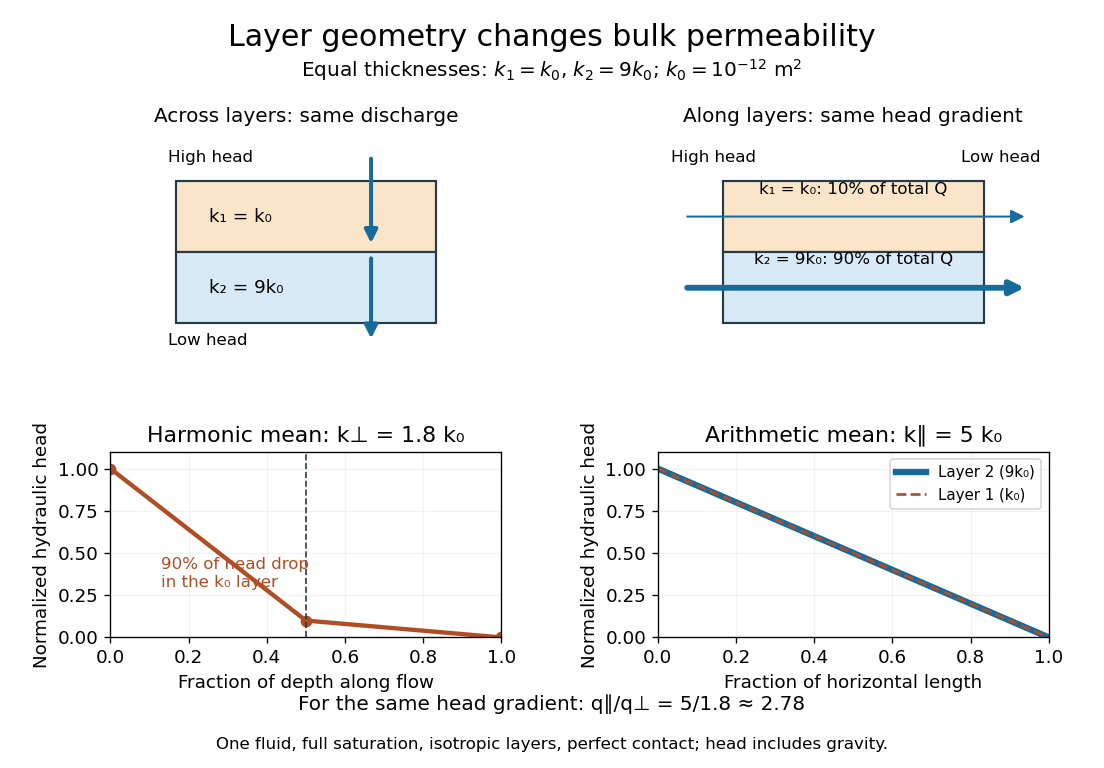

Regenerate the diagram by running
python ../layered-porous-permeability.py from _media; it writes its PNG into the current directory.At small areal number density , identical aligned cracks contribute independently the fixed-throughflow dissipation reduction of a conductive crack. Equating the mean dissipation density to gives the displayed first-order enhancement. Writing is an algebraic noninteraction estimate, not a claim of accuracy at higher density. The enhancement saturates as crack conductance becomes large compared with transport through the surrounding porous matrix.
In a slender layer, two parallel sublayers of fractions and have local effective permeability . Integrating their successive hydraulic resistance gives the logarithmic mean displayed above. A leading pressure gradient uniform across the thickness does not make parcel paths horizontal; a small transverse velocity preserves mass conservation as the cross-sectional conductance changes.
Porosity is the fraction of a representative bulk material volume occupied by voids:It is dimensionless and measures storage space. A sample with bulk volume and pore volume has porosity . If all its pores are saturated by one liquid, the liquid occupies ; partial fluid saturation instead gives liquid volume .
Porosity and permeability of a porous medium answer different questions: how much fluid fits, and how easily it flows. Isolated bubbles or cavities can contribute to total porosity while providing no throughgoing path. Even connected passages may be narrow enough to transmit very little discharge. In the simple fully participating saturated model, Darcy velocity is times pore velocity; changing porosity at a stipulated fixed Darcy flux changes ideal advective travel time, but porosity alone cannot predict the Darcy flux.
Effective porosity is the pore-volume fraction accessible to connected transport under the specified measurement or model. It excludes isolated pore volume and may also exclude poorly exchanging regions on the transport timescale, so for total porosity . In a simple mobile-volume model the mean pore velocity is ; the assumptions behind that model matter when interpreting tracer arrival times. A sample with total porosity but mobile pore fraction and Darcy flux has mobile mean pore velocity . Woessner and Poeter discuss the role of connectivity and slowly exchanging pores.[ref]
Articles by others on the same topic
There are currently no matching articles.