Porous-media flow is fluid motion through the interconnected voids of a porous medium, such as a sand bed, a rock or a filter. Individual passages can be tiny and tortuous, yet their combined discharge can be predicted without resolving every passage. Darcy law supplies this bulk description when viscous resistance dominates pore-scale inertia; porosity measures how much space stores fluid, while permeability of a porous medium measures how readily that space transmits it.
The basic fully saturated model assumes one Newtonian fluid fills the connected pore space of a stationary solid framework, with incompressible flow, a small pore-scale Reynolds number, and averaging volumes large compared with individual pores but small compared with macroscopic variations. These are assumptions of the model developed below, rather than a claim that Darcy law describes every porous-media flow. Two-phase porous-media flow and poroelastic aquifers require additional constitutive and storage information.
For a first calculation, see Darcy flow through a homogeneous slab: a pressure drop determines the discharge, but porosity determines the corresponding pore velocity. Layered porous permeability then shows how geometry alone can make the bulk response anisotropic.
An aquifer is a permeable geological formation containing and transmitting groundwater. A confined aquifer lies beneath a confining layer; an unconfined aquifer instead has a free water table.
An unconfined aquifer has a free groundwater table. In a shallow aquifer of thickness , hydrostatic pressure and Darcy's law give horizontal flux proportional to .
For pore fraction , permeability , liquid density , viscosity , rainfall recharge , and a shallow groundwater thickness ,This is a nonlinear diffusion equation with diffusivity proportional to the local thickness.
For with a drained boundary and a finite current vanishing at its nose, integration by parts gives . The outlet can have finite volume flux because its contribution to the first-moment flux is multiplied by . A positive prescribed boundary height instead gives , so drainage is essential to this invariant.
The conserved first moment of a draining porous current fixes in a self-similar solution . The Boussinesq equation for an unconfined aquifer supplies , giving , . Normalize and the nose at . Then is solved byThe square-root outlet has finite drainage flux and the nose has zero flux. This is a particular similarity solution and its scaling family, not an exact description of arbitrary initial data.
For the dipole similarity solution of a draining porous current, . Thus . A shifted similarity origin replaces by . Neither a positive rate nor a rate is compatible with this two-dimensional first-moment-conserving profile.
After recharge stops on a finite aquifer connected to a river, the late solution of the Boussinesq equation for an unconfined aquifer has the form . The profile solves a nonlinear eigenvalue problem, and river discharge decays as .
The Dupuit approximation treats flow in a shallow unconfined aquifer as predominantly horizontal, with hydrostatic pressure and horizontal pressure gradient independent of depth. Integrating Darcy's law over the saturated depth then gives a volume flux per unit width depending only on the groundwater height and its slope.
For saturated Darcy flow through a long dam occupying a channel of width , let hydraulic conductivity be and free-surface height . The Dupuit approximation gives . Fixed heads and give and the displayed steady discharge. Porosity relates pore velocity to superficial Darcy velocity but does not independently multiply this discharge when is intrinsic permeability. For depth-dependent permeability, integrate the horizontal conductivity over the saturated cross-section first.
With permeability of a porous medium , the Dupuit approximation givesHere is porosity and is recharge. The low-height limit has mobility proportional to , whereas large heights have mobility proportional to . This changes both the forced filling similarity for power-law diffusion and the separable draining profile for power-law diffusion.
Even when most of an unconfined aquifer with depth-dependent permeability is deep, its height vanishes at an absorbing outlet. Near that outlet, finite outward volume flux per unit width gives and hence . The high-depth outer approximation instead has . Their crossover lies at height of order and distance of order ; the thin inner boundary layer transmits the same leading discharge.
A poroelastic aquifer couples pore-fluid storage and flow to elastic compaction of its solid skeleton. Changes in gravity, surface loading, or pore pressure can therefore change groundwater discharge even without changing rainfall.
For a skeleton with Young modulus , undeformed solid fraction , grain-fluid density difference , and reference gravity , the hydrostatic poroelastic compaction length isIt is the depth over which self-weight changes the solid fraction appreciably.
For a fixed pressure difference across two noncommunicating layers, an activated viscous polymer segment of length adds hydraulic resistance in series with the remaining fluid. The Darcy flux is the displayed expression when polymer raises dynamic viscosity by a factor . Tracking particle entry time determines activation and exit, while gives each displacement front. Preferentially occupying the more permeable layer shifts the relative inflow toward the other layer, but cannot increase that layer's absolute flux at fixed pressure. It can delay its breakthrough and leave original reservoir fluid flowing after the unmodified reservoir would be fully swept.
A sharp advected temperature transition in a fluid-filled porous medium. If fluid and solid equilibrate locally in temperature, their effective heat capacity per total volume is , while the advected heat flux is with the Darcy velocity. Neglecting conduction gives , so the thermal front speed is with . The material pore velocity is , so thermal retardation relative to that speed is . Temperature-dependent viscosity couples thermal-front perturbations back to the Darcy flux.
A porous medium is a solid framework containing connected voids in which a fluid can reside and flow. Its porosity is the void fraction; its permeability of a porous medium measures the ease of pressure-driven flow through the connected pores. The averaged Darcy flux is measured per total cross-sectional area, whereas the pore velocity is that flux divided by porosity. Not every material with voids has connected permeable pores.
Without transverse exchange, a particle chosen uniformly from pore volume samples each streamline's transit time with resident-volume weight. This differs from the flux-weighted residence time in a porous layer, which samples at the inlet proportionally to . For constant porosity and a linear positive velocity , the two means are and , respectively. Their limits agree for uniform velocity.
A wetting liquid penetrates pore space under a pressure difference that includes capillary suction. With a planar front, fixed pressure drop and negligible gravity/inertia, Darcy's law and pore-volume storage give . The front pressure must be defined relative to the gas phase consistently; adding a positive suction to the inlet pressure is different from prescribing a positive liquid front pressure.
Radial capillary imbibition into a half-space has hemispherical flow area . Its radial hydraulic resistance is proportional to , so its inlet volume flux approaches . The growing front area gives late-time , unlike the planar law. Both results assume capillary-dominated geometry with negligible directional gravity effects.
When a hemispherical wetted front loses liquid at fixed volumetric flux per unit area , equilibrium balances inlet flow with . The displayed radius exceeds and is stable because inlet flow decreases while evaporating area increases with radius. Porosity affects the adjustment time but cancels from the equilibrium radius.
Immiscible fluids share pore space, with each phase's Darcy flux determined by its pressure, viscosity and relative permeability. Fluid saturation specifies how much pore space each phase occupies. A capillary pressure couples their pressures, while their individual mass conservation laws determine displacement and saturation evolution.
When a nonwetting phase recedes from pores, surface tension and pore geometry can retain a residual saturation . If is the mobile invaded thickness and its maximum past value, stored phase volume per plan area is . Newly invading pores have ; during recession remains fixed. With mobile Darcy velocity , conservation gives advance speed and recession speed . The latter is faster for .
When a thinning porous gravity current leaves fraction behind, receding storage changes by only after accounting for immobile fluid. Thus its advective thinning equation is . Advancing into previously unwetted pores still requires the full storage , so the nose moves at . With exponentially decreasing injection the mobile volume per unit well length is . It obeys ; the second term becomes immobile retained volume.
For residual fraction , differentiation of gives its unique positive maximum at the displayed time. The maximum volume is . When the mobile volume approaches monotonically, with no finite maximum. The limiting expression is with peak at .
For capillary residual trapping of an initial triangular current, the method of characteristics translates its leading and trailing faces at and . Their intersection has height . Extinction occurs at and position . These formulas require ; at zero residual saturation the triangle translates indefinitely.
For the triangular current with capillary retention, the initial trailing face is already the maximum for . Further upslope, the maximum occurs when the moving crest passes. HenceThe final trapped phase has saturation below this envelope. Its volume is , exactly the initial mobile volume. Maximum invaded thickness is distinct from residual saturation: multiplies occupied pore volume rather than shrinking the geometrical envelope.
Injecting water to displace oil through a porous reservoir. Spatial permeability contrasts cause preferential flow and early water breakthrough, while unswept slower regions retain oil. The recovery also depends on fractional flow, capillary pressure and phase mixing; a passive streamline model alone does not capture all two-phase effects.
The one-dimensional mass conservation equation for saturation when total Darcy flux is constant and capillary pressure and gravity are neglected. It is a scalar conservation law with dimensional characteristic speed . Shock speeds obey a Rankine-Hugoniot condition; physically admissible solutions satisfy an entropy selection. Capillary diffusion regularizes the saturation transition.
Eliminating phase pressures with gives . For decreasing capillary pressure, . This nonlinear diffusion broadens a saturation shock; it can degenerate where a phase mobility vanishes. Endpoint conservation retains the limiting Rankine-Hugoniot condition.
When a rarefaction wave attaches to a saturation shock, its terminal characteristic speed must match the Rankine-Hugoniot condition speed. This gives a tangent from the initial state to the fractional-flow curve at . It selects the upstream shock saturation; the actual dimensional shock speed still includes total flux divided by porosity.
The fraction of total advective Darcy flux carried by one phase when capillary and gravity corrections are omitted. For two phases it is . This quantity lies between zero and one for nonnegative phase mobilities. Its nonlinear dependence on fluid saturation determines characteristic speeds and shocks in the Buckley-Leverett equation.
The fraction of pore volume occupied by a fluid phase. For a completely fluid-filled two-phase pore space the saturations sum to one. Residual saturation refers to fluid remaining immobile under the modeled displacement; it can impose zero relative mobility at the endpoint.
For steady incompressible flow with no stagnant volume, partition the layer into streamtubes of volume flux . The pore volume in a streamtube is , so . This gives the mean residence time even when individual path times vary widely. Streamfunction labels measure flux in two-dimensional flow, so they supply the correct weighting.
A liquid layer of depth above a dry deep porous substrate drives a Darcy flux through its saturated depth , assuming negligible capillary pressure and negligible resistance from the displaced phase. The pressure head contributes and gravity contributes one. Volume conservation gives . For a finite column, and initiallyThe singular initial flux is an idealization; the continuum model requires penetration beyond the pore scale.
Darcy law is a linear relation between the bulk Darcy flux and the net driving force per unit volume. For an isotropic porous medium containing one fully saturating Newtonian fluid,Here is the Darcy velocity relative to the solid framework, is the intrinsic permeability of a porous medium, is dynamic viscosity, is averaged fluid pressure, is mass density, and is the downward gravitational acceleration vector. The pressure gradient exerts force density , while gravity contributes ; the minus sign makes the discharge follow their sum. The symbols and are both commonly used for Darcy velocity; neither denotes pore velocity here.
With upward coordinate and positive gravitational acceleration magnitude , . Constant and therefore giveThe hydraulic head combines elevation and fluid pressure, and hydraulic conductivity combines the medium and fluid properties. Hydrostatic pressure satisfies , so it produces zero Darcy flux even though fluid pressure increases downward. Conversely, equal pressures at the two ends of a vertical column do not imply zero flow: their elevations give different hydraulic heads.
The appeal of Darcy law is that a complicated connected pore geometry enters a macroscopic calculation through a measurable coefficient. It predicts filter discharge and aquifer flow; combined with mass conservation, it gives an equation for the evolving fluid pressure. Its simple linear form requires a small pore-scale Reynolds number, slow adjustment compared with pore-scale inertial relaxation, and a valid continuum approximation. For a characteristic pore size and mean pore velocity , one possible convention is ; conventions using grain size or Darcy velocity have different numerical thresholds. Merely calling flow laminar does not guarantee negligible inertia. Unsaturated pores, several fluid phases, appreciable inertia, or a fluid whose stress is not Newtonian require further modeling. Woessner and Poeter discuss these limits in their authored hydrology text.[ref]
Henry Darcy's 1856 book Les fontaines publiques de la ville de Dijon was published by Victor Dalmont; the University Grenoble Alpes digital collection verifies this bibliographic record and supplies a digitized copy.[ref] Woessner and Poeter's account connects Darcy law to experiments on water flowing through sand filters, relating discharge to cross-sectional area, hydraulic head difference and sample length.[ref] The modern intrinsic permeability of a porous medium notation above should not be read as a quotation of Darcy's original notation.
Hydraulic head is the sum of elevation and pressure head, measured in metres relative to a chosen height datum. For constant mass density and gravitational acceleration magnitude , the pressure head is the height of a column of the same fluid supported by fluid pressure . A water-filled open measuring tube records hydraulic head as the elevation of its water level when is gauge fluid pressure. Changing the common pressure reference or height datum adds a constant to hydraulic head and leaves its driving gradient unchanged.
For water with and , a point at with gauge fluid pressure has . A second point at with gauge fluid pressure also has : these values are compatible with a stationary column under hydrostatic pressure. It is a difference in hydraulic head, rather than a difference in fluid pressure alone, that drives saturated Darcy flow. This form uses constant mass density; one cannot generally pull spatially varying through the gradient.[ref]
Hydraulic conductivity is the coefficient in , with units . Because the gradient of hydraulic head is dimensionless, hydraulic conductivity has the dimensions of velocity, but it is not the actual Darcy velocity unless the driving gradient has magnitude one. Intrinsic permeability of a porous medium has units and describes pore geometry; hydraulic conductivity also depends on mass density, dynamic viscosity and gravitational acceleration.[ref]
For , , and , hydraulic conductivity is . Doubling dynamic viscosity while keeping pore geometry, mass density and gravitational acceleration fixed halves hydraulic conductivity without changing intrinsic permeability of a porous medium. Thus a value quoted as a material's hydraulic conductivity needs its fluid conditions.
Consider a horizontal slab of fully saturated sand with uniform intrinsic permeability of a porous medium , length , total cross-sectional area , and porosity . Use one Newtonian fluid with mass density and dynamic viscosity . Prescribe inlet and outlet gauge fluid pressures and , with no sources or leaks and steady incompressible flow. The two ends have the same elevation, so gravity has no component along the slab. Mass conservation makes the axial Darcy flux constant, and Darcy law then gives a linear fluid pressure profile:The measured volume flux and mean pore velocity areThe slab's total volume is , of which is pore volume. In the ideal uniform advective model, a nonreacting tracer has transit time , consistent with pore volume divided by volume flux, . The incorrect substitution of Darcy velocity for pore velocity would give , four times too long. Real passages have different path lengths and local speeds; these numbers describe a bulk mean rather than every particle's journey.
As an independent check, gravitational acceleration magnitude gives hydraulic conductivity , hydraulic head drop , and again. If a representative pore size is , the Reynolds number convention based on pore velocity gives , supporting neglect of pore inertia. This size is an illustrative extra measurement, not something determined by porosity and intrinsic permeability of a porous medium alone.
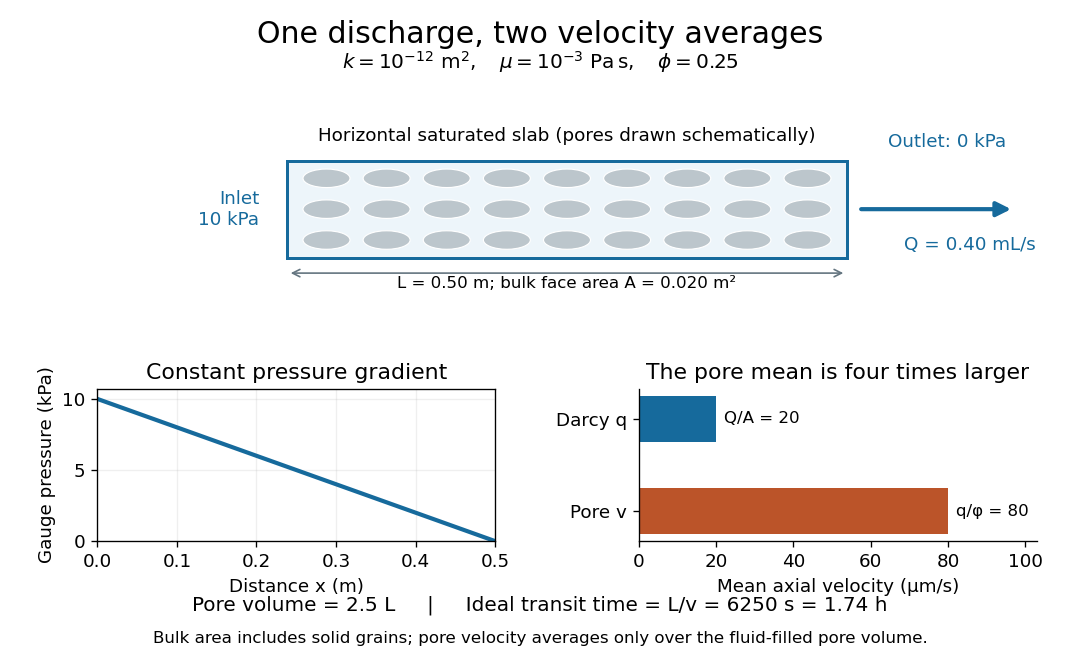
The same discharge gives different Darcy and pore velocities
. Details. Regenerate the diagram by running
python ../darcy-flux-and-pore-velocity.py from _media; it writes its PNG into the current directory.Darcy flow is slow flow through a porous medium whose averaged flux obeys the Darcy law. The Darcy velocity is the fluid volume flux per total cross-sectional area; it differs from the velocity averaged only over pore space.
In a thin fluid-filled crack, lubrication theory gives flux per unit depth . The surrounding Darcy flow has normal velocity . Conservation in the crack gives , yielding the displayed condition. Pressure is continuous across the crack. This reduced model neglects transverse pressure variation and assumes wall slip lengths are small compared with .
For , elliptic coordinates make constant on the upper crack face. Pressure continuity and harmonicity reduce the boundary condition to for the cosine mode, while uniform far flow gives . Solving yields the displayed pressure. The midpoint crack flux is ; small leaves the background pressure gradient nearly unchanged, while large makes the crack nearly equipotential.
Subtracting the uniform-flow pressure leaves . The coordinate map has , so , giving the displayed dipole coefficient. The one-half is essential. In the perfect-conductor limit the independent expression has the same far-field expansion.
For dipole pressure , choose a rectangular control volume whose transverse size tends to infinity faster than its streamwise size. Each end face contributes to , so fixed-throughflow boundary work gives , the displayed result. This control-surface choice removes the integrated far-field velocity correction. A circular cutoff of the pressure-only functional gives instead and does not implement the same throughflow normalization.
For constant wall heat-flux density , effective thermal conductivity , buoyancy mobility and thermal transport coefficient , a slender Darcy flow boundary layer has width . Writing , and gives the displayed equation with , and . The exact integral is . Consequently its kinematic Darcy momentum flux is and its buoyancy flux is . These are per span on one heated face.
Assume an exponentially decreasing temperature profile while imposing wall heat flux, impermeability and the exact integrated heat budget. For , the wall condition gives and gives . This yields the displayed integral approximation and discharge . It satisfies the boundary conditions and exact flux budget, but not the differential equation pointwise; its mass-flux coefficient is approximate.
For two incompressible fluids separated by a planar material front , the Darcy flux is uniform and the pressure drop sums the resistances of the two layers: . The front moves at the pore velocity . Integrating from yields the displayed relation. The formula holds up to breakthrough , with either sign of the viscosity difference; equal viscosities give constant speed.
If a thermal front has speed with the Darcy velocity, while a material front has speed , their position ratio from coincident initial locations is . Calling a retardation factor the ratio to pore velocity instead would give ; these conventions must not be mixed. With cold viscosity and heated viscosity , the displacement's effective viscosity is . In the pressure resistance the cold layer has length , the hot injected layer has length , and the displaced layer has length .
A slender planar plume in a saturated porous medium has buoyancy velocity , with . The leading heat equation retains both advection components and lateral thermal conduction: . Its convective heat input per span is conserved, . Defining gives width proportional to and vertical speed/temperature excess proportional to .
For a slender porous thermal plume, Darcy law gives , with . If and is the conserved excess convective heat flux per span, then the kinematic momentum flux is , and the buoyancy flux is . The hyperbolic-secant porous plume profile has . Multiplication of and by gives physical mass flux and the density-weighted Darcy second moment. Intrinsic pore-velocity momentum flux instead has an additional inverse-porosity factor. Momentum conservation here follows from the heat/velocity proportionality, not from an inertia balance: porous drag balances buoyancy locally.
The symmetric steady porous thermal plume has , and . Its exact normalizations are and , so and . The streamfunction supplies lateral entrainment required by continuity.
Truncating the steady porous thermal plume profile below a head height and conserving supplied heat gives . Thus . This is an integral bulk-head estimate, while fastest centreline parcels have characteristic speed ; the approximation does not resolve the transient nose.
A Darcy velocity driven by pressure in a stationary porous skeleton dissipates mechanical power per bulk volume. It follows by dotting Darcy law with the discharge: . Its contribution to a heat equation can be neglected only when it is small relative to the relevant thermal-energy transfer.
Darcy velocity, also called Darcy flux or specific discharge, is fluid volume flux relative to the solid framework per unit total cross-sectional area. For a uniform axial discharge through bulk area ,The area includes both solid and voids. Hence Darcy velocity is a superficial flux with units , even though no fluid travels through the solid part. For a nonuniform discharge, , with the unit normal; is the area average of the normal Darcy flux.
If porosity is , the pore-volume-averaged liquid velocity is , and the local solid framework velocity is , the convention used here is . In a stationary, fully saturated framework with all pore volume participating, . The notation for porosity is equally common. Darcy flow through a homogeneous slab gives but pore velocity at . Keeping these quantities separate lets Darcy law predict filter discharge while pore velocity predicts ideal advective travel time.[ref]
Pore velocity is the fluid velocity averaged over pore volume relative to the solid framework. For uniform porosity , full saturation and all pores participating, , with Darcy velocity defined per bulk area. The identity follows from volume averaging: extending the relative fluid velocity by zero in the solid gives a bulk average equal to the pore fraction times the pore-volume average. It does not assert that every local passage has open area or identical speed.
In a uniform advective model, travel over length takes . If some pore volume is inaccessible to transport, the corresponding estimate uses effective porosity and . A connected but nearly stagnant passage can exchange solute slowly, so even this mean does not describe all arrival times. Flux-weighted residence time in a porous layer explains one precise averaging convention.[ref]
Darcy-Bénard convection is thermal convection in a porous layer heated from below, with velocity governed by Darcy's law. With fixed temperatures and impermeable boundaries, a normalized two-dimensional model uses streamfunction and temperature :The control parameter is a porous-medium Rayleigh number. On with temperature values , the conductive state is , .
A tall porous column with square width , insulated impermeable sidewalls and a maintained upward temperature decrease admits nearly vertical, zero-net-flux overturning modes. Let be buoyancy mobility and the thermal transport coefficient accompanying Darcy flux. Neumann transverse modes have . In the long-column limit the lowest nonconstant modes have growth rate proportional to . They are warm ascending and cold descending columns with return flow at distant ends. The two lowest modes, varying along either side direction, are degenerate; linear theory alone does not select their nonlinear superposition.
In a unit square with prescribed conductive boundary temperatures and impermeable boundaries, the stream function convention gives linear equations , , with on all sides. The velocity equation follows by taking the vertical-plane curl of Darcy law, and the temperature equation by linearizing the heat equation about . Unlike a laterally unbounded Darcy layer, the conducting side boundaries produce a two-dimensional real marginal eigenspace at .
For , , the first-order equations are and . Multiply them by and integrate. Integration by parts and the leading equations cancel the homogeneous correction terms, giving . Since , the displayed title formula follows. The reciprocal norm ratio is incompatible with this solvability condition. Reflection parity diagonalizes the first-order splitting of the two marginal modes.
At zero growth rate put , . The coupled Darcy equations become . Substituting gives with homogeneous Dirichlet boundary conditions. The square Dirichlet Laplacian eigenvalues give , , whose minimum is . For , , the complex multiples give real pairs and , . Their reflection parities are opposite, yielding two independent physical modes.
With permeability , depth , kinematic viscosity and the relevant effective thermal diffusivity , the Darcy Rayleigh number compares buoyancy-driven Darcy advection to thermal diffusion. It differs from the clear-fluid Rayleigh number by replacing with . Effective heat capacity and porosity factors may be absorbed into the definition of and the thermal-time scale, and must be kept consistent with the chosen Darcy law convention.
A perturbation proportional to has growth rateMinimizing the neutral curve gives , and . Thus the first convection rolls have horizontal wavelength twice the layer depth.
For , fixed roll phase, and normalization , the Landau amplitude equation isThe mean-temperature correction in weakly nonlinear Darcy convection supplies the cubic negative feedback. Projection of the third-order equations onto the critical eigenfunction via the Fredholm solvability condition for a self-adjoint operator fixes both coefficients. The stable nonzero amplitudes are within the chosen phase, giving a supercritical pitchfork bifurcation in this real-amplitude reduction.
For , the first temperature mode is . The streamfunction advection bracket is , independent of . The second-order equations therefore have andThis modifies the vertical temperature gradient. Its interaction with the critical roll produces the cubic term in the amplitude equation.
The Saffman–Taylor instability occurs when a more mobile fluid displaces a less mobile fluid in a porous medium or Hele–Shaw cell. Viscosity contrast amplifies interface corrugations, while surface tension suppresses sufficiently short wavelengths.
For two fluids with dynamic viscosities , uniform permeability of a porous medium , porosity , and imposed Darcy velocity , the Saffman–Taylor instability of a planar interface has growth rate without capillarity. With constant interfacial tension and the stabilizing pressure-jump convention, a perturbation of transverse wavenumber instead hasThe fastest-growing mode satisfies .
For a sharp thermal front moving at fraction of the Darcy velocity , a cold fluid of viscosity displacing its hot counterpart of viscosity has the displayed growth rate in the local, unbounded planar approximation without thermal conduction. The harmonic pressure perturbations decay on either side. Pressure continuity and continuity of perturbed Darcy flux give the velocity response ; the thermal front's kinematic law is . The prefactor is the thermal-front speed, not the material pore velocity. Increasing viscosity with heating therefore makes the trailing thermal interface unstable even when the leading displacement of the original fluid is stable.
Let fluid 1 lie above fluid 2, with mass densities and dynamic viscosities . Define , , porosity , permeability of a porous medium , and downward interface speed . With Darcy flux , no capillarity, and two unbounded layers, Darcy's law givesFor a Fourier mode of interface displacement, the two perturbation pressures decay exponentially into the respective layers. The kinematic boundary condition makes their amplitudes proportional to and . Linearized pressure continuity adds the base-gradient difference . Eliminating the amplitudes proves the formula. The critical interface speed is ; the critical Darcy velocity is . Without surface tension this model has unbounded short-wave growth rate on its unstable side.
Suppose the apparent capillary pressure is , with normal towards the displaced fluid and positive apparent tension at the flat front . Linearizing the Darcy law interface problem gives the local growth rateThe pressure increase experienced by a forward protrusion is stabilizing when . It suppresses every positive wavenumber when . For a fixed spatial gradient, makes the rate time dependent; constant exponential growth is a frozen-position approximation.
Permeability of a porous medium is the coefficient that measures how readily its connected pore geometry transmits a fluid in Darcy law. Its units are , since converts a pressure gradient in into a Darcy velocity in . Large open, well-connected passages generally give larger permeability of a porous medium than narrow or winding passages. Porosity alone cannot determine it: two samples can contain the same void volume but have different passage sizes and connectivity.
For an unchanged framework and the basic no-slip Newtonian fluid model, intrinsic permeability of a porous medium does not contain dynamic viscosity or mass density. These properties instead enter hydraulic conductivity . At the same horizontal pressure gradient, replacing a liquid with another of twice the dynamic viscosity halves Darcy flux even though stays fixed. Structural changes, such as swelling or clogging, can change ; the independence claim assumes the pore geometry stays fixed.[ref]
An isotropic sample has scalar permeability of a porous medium. An anisotropic sample requires a tensor in , so discharge need not be parallel to the net driving force. Layered porous permeability gives a concrete example: arranging individually isotropic materials in horizontal layers produces different vertical and horizontal effective permeabilities.
A dimensionless reduction of a porous formation's intrinsic permeability of a porous medium for one fluid phase in multiphase flow. Its effective phase permeability is , and its phase mobility is . It depends on saturation and pore-scale phase configuration; it is not the magnetic use of relative permeability.
Relative permeability divided by the phase's dynamic viscosity. In the phase Darcy law, without body forces. Ratios of mobilities determine fractional flow when the phases have a common pressure gradient.
Effective permeability is a bulk permeability of a porous medium that reproduces the total Darcy flux through a heterogeneous sample under specified boundary conditions. For a horizontal sample with length , dynamic viscosity , and positive inlet-to-outlet fluid pressure drop , define by . The description is useful when individual layers or passages are smaller than the scale of the calculation. It depends on direction, geometry and boundary conditions; it is not generally the arithmetic mean of local intrinsic permeabilities.
Layered porous permeability illustrates the mechanism: when every path must cross a resistant layer, successive hydraulic resistances add; when more permeable paths span the whole sample alongside less permeable ones, their discharges add. This is the same organizing idea as series and parallel resistors. For fixed fluid properties the corresponding hydraulic conductivities average in the same way.
Consider planar horizontal layers with positive scalar intrinsic intrinsic permeabilities , thicknesses , and fractions . Assume each layer is uniform and isotropic, fully saturated by the same Newtonian fluid of constant mass density and dynamic viscosity, with perfect hydraulic contact and steady incompressible flow. Use boundaries that impose pure flow normal to the layers or a common gradient of hydraulic head along them; additional interface resistance and finite-edge effects are excluded.
For vertical flow normal to the layers, every layer carries the same normal Darcy flux by mass conservation. The hydraulic head drops add. Writing and taking positive as the drop along the flow direction givesThis is the thickness-weighted harmonic mean. It is hydraulic head, rather than fluid pressure alone, that accounts correctly for gravity in the vertical calculation. A thin layer of very small permeability of a porous medium can control the whole discharge because all flow must pass through it.
For horizontal flow parallel to the layers, each layer experiences the same gradient of hydraulic head. For width , each area is , and the individual volume fluxes add:This is the thickness-weighted arithmetic mean. A highly permeable layer can carry most of the horizontal flow because it supplies a continuous route from inlet to outlet. Woessner and Poeter derive both cases for hydraulic conductivity; identical fluid properties allow the common factor to cancel.[ref]
For two equally thick layers, take and , where . The values 1 and 9 are therefore permeabilities in units of , rather than dimensionless intrinsic intrinsic permeabilities. ThenAcross the layers, the less permeable half takes of the total hydraulic head drop and the more permeable half only . Along the layers, the more permeable half carries of the total volume flux. At the same magnitude of imposed gradient of hydraulic head, horizontal Darcy flux is times the vertical Darcy flux.
The arrangement thus creates physical anisotropy from locally isotropic ingredients. In coordinates with along the layers and normal to them, the effective permeability of a porous medium tensor is . A driving gradient of hydraulic head with both horizontal and vertical components generally produces a discharge in a different direction. This distinction matters when deciding whether a geological bed conducts aquifer flow along itself or acts as a barrier to flow across it.
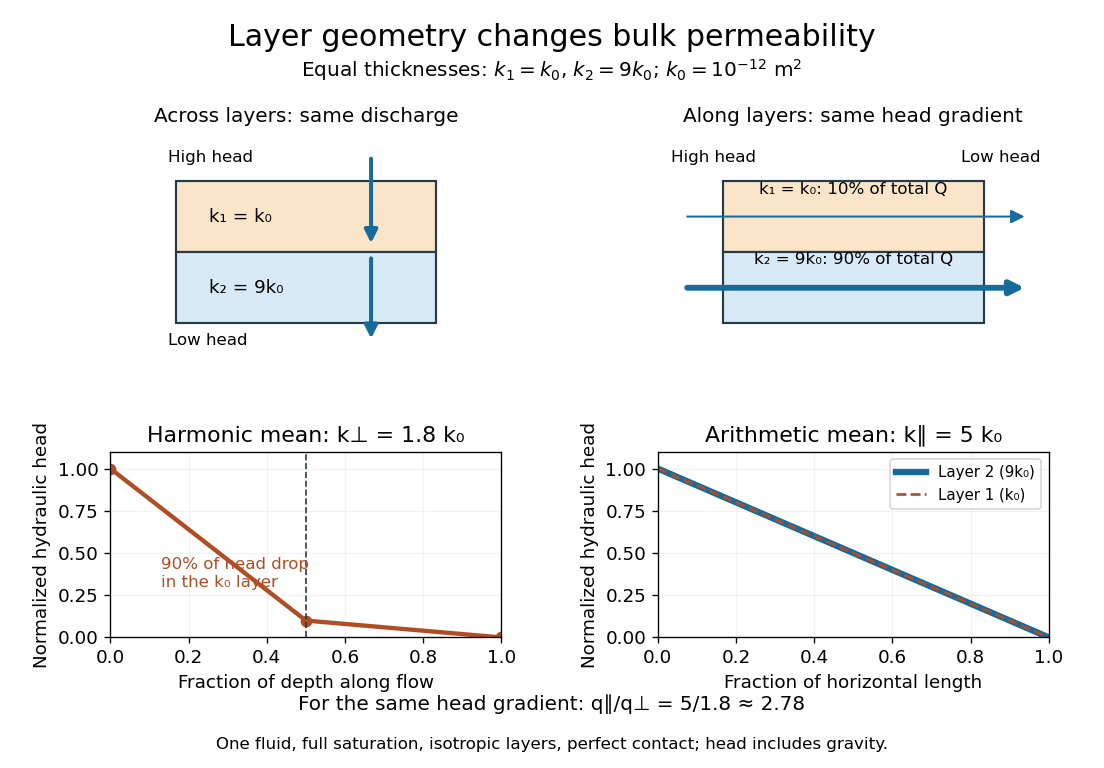


Regenerate the diagram by running
python ../layered-porous-permeability.py from _media; it writes its PNG into the current directory.At small areal number density , identical aligned cracks contribute independently the fixed-throughflow dissipation reduction of a conductive crack. Equating the mean dissipation density to gives the displayed first-order enhancement. Writing is an algebraic noninteraction estimate, not a claim of accuracy at higher density. The enhancement saturates as crack conductance becomes large compared with transport through the surrounding porous matrix.
In a slender layer, two parallel sublayers of fractions and have local effective permeability . Integrating their successive hydraulic resistance gives the logarithmic mean displayed above. A leading pressure gradient uniform across the thickness does not make parcel paths horizontal; a small transverse velocity preserves mass conservation as the cross-sectional conductance changes.
Porosity is the fraction of a representative bulk material volume occupied by voids:It is dimensionless and measures storage space. A sample with bulk volume and pore volume has porosity . If all its pores are saturated by one liquid, the liquid occupies ; partial fluid saturation instead gives liquid volume .
Porosity and permeability of a porous medium answer different questions: how much fluid fits, and how easily it flows. Isolated bubbles or cavities can contribute to total porosity while providing no throughgoing path. Even connected passages may be narrow enough to transmit very little discharge. In the simple fully participating saturated model, Darcy velocity is times pore velocity; changing porosity at a stipulated fixed Darcy flux changes ideal advective travel time, but porosity alone cannot predict the Darcy flux.
Effective porosity is the pore-volume fraction accessible to connected transport under the specified measurement or model. It excludes isolated pore volume and may also exclude poorly exchanging regions on the transport timescale, so for total porosity . In a simple mobile-volume model the mean pore velocity is ; the assumptions behind that model matter when interpreting tracer arrival times. A sample with total porosity but mobile pore fraction and Darcy flux has mobile mean pore velocity . Woessner and Poeter discuss the role of connectivity and slowly exchanging pores.[ref]
Suppose a porous layer has thickness and permeability of a porous medium , and the pressure drop acts across its thickness. Darcy's law gives the drainage volume fluxIf , then .
Reactive infiltration instability is the positive feedback in which reaction or melting increases permeability of a porous medium, focuses more reacting fluid into that region, and further increases permeability. Finite reaction-zone thickness, transport, and pore geometry can change the short-wave behavior; Interacting length scales in the reactive-infiltration instability analyzes transport and reaction length scales in a dissolution model.
A planar advection-driven melting front in a porous matrix with permeabilities ahead and behind has the ideal sharp-front growth rateThis follows by matching harmonic pressure perturbations and normal Darcy flux, then converting flux to front speed by the enthalpy balance. It predicts no finite fastest-growing wavelength when .
A porous gravity current spreads because a density difference creates a lateral hydrostatic-pressure gradient. For a two-dimensional current of thickness , density deficit , permeability , viscosity , and porosity ,
For a thin buoyant layer beneath an inclined impermeable roof, the hydrostatic approximation and Darcy's law give and the volume flux per unit width . The first term transports fluid upslope; the second spreads the layer through its hydrostatic pressure gradient. The porosity multiplies the stored fluid volume, so the advection speed is , not the Darcy velocity .
With constant porosity and , , a translating frame , has area Jacobian determinant . Actual fluid volume is , proving the displayed normalization. Replacing the cotangent factor by a tangent factor is incompatible with these coordinates except at a slope of .
For porosity and permeability of a porous medium above an inclined impermeable plane, stored liquid volume per area is . The depth-integrated Darcy flux is . Conservation of mass yields the displayed equation with , and .
In a slender steady porous gravity current, the dominant balance is . If its width and height scales are , fixed downslope volume flux gives , and transverse spreading gives . Eliminating yields the displayed width exponent. The porosity exponent affects transient storage but not this steady balance.
With exponentially decreasing injection, the advective approximation and inlet condition give and the displayed solution along characteristic curves. It applies behind the advective nose . The relative size of the discarded nonlinear spreading term for this profile is . Smallness of that quantity, and matching through a narrow leading layer, are necessary qualifications: elapsed time alone does not make the approximation uniform at the nose. In a translating frame the full equation remains a porous medium equation with coefficient .
A localized release of actual fluid volume per unit width on a reflecting half-line has the Barenblatt solution , where and . The mass conservation normalization is . Zero slope at the reflecting boundary gives zero Darcy flux. For symmetric spreading on the full line, the same formula has when denotes the total released volume. A finite initial patch is not determined by volume alone; this exact source profile has a concentrated initial release.
A buoyant phase beneath a sloping impermeable cap has a slope-driven Darcy velocity proportional to density deficit and slope. Far from thickness-adjustment regions, its uniform plateau speed is . With thickness measured normal to the slope, buoyant cap overpressure is . A complete depth model also includes the along-current gradient of thickness.
A buoyant current beneath an overlying low-permeability cap can enter it when current overpressure exceeds the capillary entry threshold. The plateau criterion compares to that threshold. Cold and warm portions can have different depths and mobilities, giving distinct onset injection rates. These onset criteria do not determine the depleted current after leakage begins.
A localized temperature adjustment separates regions with different fluid density, viscosity and Darcy speed. Mass conservation in the moving frame gives the displayed plateau-depth relation. A speed stated as with a Darcy velocity has effective retardation parameter . Setting both laboratory-frame mass fluxes equal neglects storage associated with passage of the temperature front.
A shallow buoyant porous gravity current in a deep aquifer with uniform imposed Darcy velocity obeys away from sources, where . Here is permeability of a porous medium, is porosity, and is dynamic viscosity. The pore-fluid drift speed is , and the gravity diffusion coefficient multiplying is . The sharp-interface model neglects capillary trapping and dissolution.
An instantaneous point release of actual volume per unit width in a porous gravity current with background flow has the Barenblatt solution , where . Its centre translates at pore speed and its radius grows as . The conserved physical volume is .
Constant actual volume input into a porous gravity current with background flow gives early symmetric scales and . For , drift dominates after . The late interior depth is and the steady upstream edge is , with upstream linear profile . Upstream volume flux is zero because background drift balances gravity spreading.
The downstream edge of a continuously fed porous gravity current with background flow has a transition width proportional to around drift position . Its similarity solution satisfies , , and . A finite front has . A clipped linear ramp is a useful mass-preserving approximation, but not an exact solution of this nonlinear transition equation.
A leaky porous gravity current loses flux through a localized fracture or a distributed permeable boundary. At a point fracture, mass conservation makes the horizontal Darcy flux discontinuous by exactly the leakage rate.
A dense porous gravity current of height places excess hydrostatic pressure on a basal seal. For seal permeability of a porous medium and thickness , Darcy law gives downward flux . Dividing the stored height-volume balance by porosity gives a linear drainage term . The coefficient has inverse-time units and does not contain an extra factor of the aquifer permeability.
The porous medium equation with constant becomes under the displayed transformation. Substitution gives and , so . This transformation applies to every solution with appropriately transformed initial and boundary conditions, not just a similarity solution. A one-sided constant-volume porous gravity current therefore has remaining physical volume and a limiting front . The finite transformed time means that arbitrary initial profiles need not reach the universal large-time source shape before drainage removes them.
For an impulsive leaky porous gravity current, write and , where . At a fixed lateral location, when . The maximum invaded thickness is the envelope , . The source solution is singular at the initial line release; finite source size and aquifer depth limit its near-source validity.
Articles by others on the same topic
There are currently no matching articles.