Kinetic theory describes many-particle systems through a distribution on phase space, retaining both position and velocity. In the number-density convention, is the expected number of particles in a small position–velocity region. For identical particles of mass , its integrals give the number density and bulk velocity :This is not normalized to one: its integral over the whole phase space gives the total expected particle number. Transport moves particles along trajectories, while collision or diffusion terms change the distribution. The Boltzmann equation, Hamiltonian Liouville equation and Fokker-Planck equation describe different physical assumptions, rather than interchangeable collision laws.
An ideal gas is a motivating example: the pressure on a wall comes from microscopic momentum transfers, even when the bulk velocity is zero. The Maxwell-Boltzmann velocity distribution separates this random molecular motion from bulk motion; see ideal gas pressure from wall collisions. The attractive feature of kinetic theory is that a distribution can describe two opposing populations where one average velocity hides almost everything. It also tells us when averaging into a continuum approximation loses essential information: compare the intermolecular mean free path with the apparatus scale using the Knudsen number. [ref]
https://farside.ph.utexas.edu/teaching/355/Surveyhtml/node212.html. Richard Fitzpatrick, Kinetic Theory: fundamental assumptions and wall pressure
A function specifying how a particle population is distributed over velocities. If is a number-density distribution, counts particles per unit spatial volume in that velocity element and . A probability-density convention instead has integral one. The normalization must be stated before adding populations or comparing their slopes.
An interaction making particle velocities approach those of their neighbors. Symmetric nonnegative weights conserve total momentum for equal particle masses and dissipate relative kinetic energy. Connectivity and quantitative lower bounds on the interaction matter for eventual consensus; nonnegativity alone permits noninteracting groups.
Neglect of pair correlations closes the first marginal equation of the dissipative Liouville equation. For unit-normalized marginal distributions, the acceleration is . With number-normalized , it is . The usual mean-field alignment equation neglects this relative correction. Independence at one time does not imply that interactions preserve independence.
The continuum velocity alignment equation with . For symmetric nonnegative , it conserves total mass and momentum while dissipating kinetic energy. Its force is affine in velocity, with a nonzero velocity-space divergence.
For the mean-field alignment equation in position and velocity coordinates, put . Its force has velocity-space divergence . Consequently integration by parts gives the nonnegative derivative in the title, assuming suitable positivity, decay and integrability. The fine-grained Gibbs entropy decreases because these dynamics contract phase space; the interaction is dissipative.
For the mean-field alignment equation, multiply by and use integration by parts. Exchanging with and averaging the two results gives the displayed nonpositive kinetic energy derivative. The factor accounts for counting ordered pairs twice. Total momentum is conserved, so the dissipated part is motion relative to the global mean velocity.
Conservation of probability under a deterministic characteristic flow map with velocity gives the displayed continuity equation on phase space. Along a characteristic, . Unlike the Hamiltonian Liouville equation, it allows contraction of phase-space volume and increasing density along trajectories. It still preserves total probability when boundary fluxes vanish.
The divergence of the vector field generating a flow on phase space. Its time integral determines the Jacobian determinant of the characteristic flow map: . A Hamiltonian vector field has zero phase-space divergence in canonical coordinates.
A weak-fluctuation closure retaining the averaged quadratic fluctuation flux while linearizing the fluctuating kinetic equation about a slowly evolving mean phase-space distribution function. One solves the fast linear response with the mean frozen, then inserts its covariance into the slow averaged equation. A short-memory stationary limit can yield quasilinear diffusion, but finite-time responses retain memory. Self-consistent collective fields enter through the dielectric function in homogeneous electrostatic problems.
The diffusive evolution of an averaged phase-space distribution function caused by weak fluctuating fields in the quasilinear approximation. In a stationary homogeneous one-dimensional electrostatic problem, if the potential's temporal power spectral density is with covariance , thenThis follows from the real part of the one-sided time correlation along an unperturbed particle trajectory. Both signs of the spatial wavenumber are included. The action-space counterpart for regular stellar orbits is quasilinear diffusion in action space.
Random changes of particle velocity described by a diffusion equation in velocity space. For constant , . With zero boundary flux it conserves number. For a number-normalized one-dimensional distribution, its kinetic energy production is , which reduces to for constant . Variable must remain inside the derivative.
A characteristic random particle speed. Here temperature is measured in energy units, and the factor-two convention makes a Maxwell-Boltzmann distribution proportional to . Other conventions, such as the one-dimensional standard deviation , differ by fixed factors.
A low-frequency kinetic reduction averaging over fast cyclotron motion while allowing perpendicular wavelengths comparable with the gyroradius. It retains finite Larmor radius effects absent from the leading long-wavelength drift-kinetic equation.
Modification of the plasma response because particles sample fields around a finite cyclotron orbit. Effects become order one at ; even at , the leading polarization correction can be essential to a slow dispersion relation.
The slow dynamics of charged-particle guiding centers after averaging over rapid cyclotron motion, assuming gyroradii much smaller than resolved perpendicular length scales. Depending on the ordering, the retained transverse motion may include just the common electric drift or also magnetic curvature drift, gradient-B drift and polarization drift. These choices give distinct limits, not interchangeable closures.
The inertial correction to the electric drift in a slowly varying magnetic field. In the simplest uniform-field electrostatic case it is . Its species-dependent current density supplies the perpendicular polarization response needed in many slow plasma instabilities.
The transverse guiding center drift produced by a magnetic field strength gradient, with first adiabatic invariant and signed cyclotron frequency . Together with magnetic curvature drift, it produces velocity-dependent transverse transport.
The transverse guiding center drift associated with magnetic field-line curvature. The signed cyclotron frequency makes oppositely charged species drift oppositely at fixed velocity. The resulting species-dependent response is retained in slow drift-scale instabilities.
The collisionless equation in the title transports a gyrophase-independent phase-space distribution function at fixed first adiabatic invariant. Its leading guiding center position has . The parallel acceleration includes and, when required, terms from motion of the local frame. Both and the parallel derivative refer to the exact perturbed magnetic field.
Integrating a phase-space distribution function against products of particle velocity components produces its velocity moments. The zeroth gives number density, the first gives number flux, and, after multiplying by particle mass, the second gives momentum flux. Replacing by , where is the mean velocity, defines central velocity moments; the second is the pressure tensor divided by particle mass.
For unit particle mass, this symmetric third-order tensor transports the pressure tensor in a kinetic fluid description. Its contraction gives the heat flux . It vanishes for a local Maxwellian, whose odd central velocity moments vanish, but it need not vanish for a general anisotropic or skewed phase-space distribution function.
Taking velocity moments of a kinetic transport equation couples the equation for a moment of order to a spatial derivative of a moment of order . A finite fluid description therefore requires closure. For example, the pressure tensor equation involves the third central velocity moment.
The hierarchy obtained by integrating the -particle Hamiltonian Liouville equation over successively fewer particle coordinates. Each marginal equation involves the next marginal, so an autonomous one-particle equation requires a closure. For a pair potential, its first equation couples the phase-space distribution function to the two-particle distribution function. Number-normalized factorial marginals and unit-normalized probability marginals have different explicit combinatorial factors.
For a slowly advancing piston in an isotropic gas, multiplying the stationary molecular arrival flux by the first-order energy gain gives . This is the microscopic form of adiabatic compression work. Higher-order terms matter for fast piston motion.
For isotropic velocity directions and normalized speed density , the number arriving at a plane per unit area and time is , over the incoming hemisphere. The cosine weights the normal speed, and the sine comes from solid angle.
The number of gas molecules striking unit surface area per unit time. For an ideal gas in thermal equilibrium, . A deposited monolayer additionally depends on site density, sticking coefficient and desorption.
In a dilute gas whose mean free path is short compared with macroscopic gradient lengths, particles carry properties from their previous collisions over distances of order . A first-gradient isotropic estimate gives a transported flux for a property carried per particle. Applying this reasoning to species abundance, directed momentum and thermal energy with per-particle heat capacity gives diffusivity , dynamic viscosity and thermal conductivity . These numerical prefactors are estimates, not exact collision-integral results.
For a constant hard-sphere diameter , and . Consequently , and . At fixed pressure the last scales as . The near pressure-independence of viscosity and thermal conductivity applies only while gas-gas collisions, rather than apparatus walls, determine the mean free path. Temperature-dependent cross-sections and internal molecular excitations change the simple power laws.
Thermal motion is microscopic random motion associated with a system's temperature; Brownian motion makes its effects on larger suspended grains visible.
A speed distribution is the probability distribution of the magnitude of velocity. When it has a probability density function , the fraction of particles with speeds between and is , and . The Maxwell speed distribution describes an equilibrium ideal gas; the effusive beam speed distribution weights that population by its rate of arrival.
For hard particles in a fixed macroscopic volume, shrink their diameter while keeping of order one. The occupied volume fraction tends to zero, but the mean free path stays macroscopic. Deriving the Boltzmann equation in this dilute limit requires control of recollisions and propagation of an incoming independence hypothesis related to molecular chaos for the Boltzmann equation. Its validity is not an automatic all-time consequence of small particle size.
The Knudsen number is the dimensionless ratio of an intermolecular mean free path to a specified characteristic length of the apparatus or flow. The mean free path measures the distance travelled between gas–gas collisions; measures the distance over which boundaries or macroscopic conditions matter. Wall encounters must not be counted as gas–gas collisions in this comparison: doing so would hide the very wall-dominated behavior we want to detect. The same gas can therefore have a small Knudsen number in a large vessel and a large Knudsen number in a tiny opening.
For a dilute hard-sphere gas of identical molecular diameter in thermal equilibrium, use the conventionHere is the number density, the pressure, the absolute temperature, and the Boltzmann constant; the second equality uses the ideal gas law. The collision cross-section is , and the accounts for both partners moving with independent equilibrium velocities. Mixtures and velocity-dependent collision cross-sections require a stated molecular model and mean free path convention; the displayed expression is not an exact formula for every real gas. [ref]
https://farside.ph.utexas.edu/teaching/355/Surveyhtml/node219.html. Fitzpatrick, Mean Free Path, equations 5.209–5.219
[ref]https://arxiv.org/abs/1309.1197. Steve T. Paik, Is the mean free path the mean of a distribution?, dilute hard-sphere equilibrium convention
As a numerical toy example, choose and , without claiming that this is a measured molecular diameter for a particular gas. The formula gives at . It yields for a vessel but for a gap. At the same toy gas has , comparable to the centimetre vessel. Reducing either pressure or apparatus size can thus expose molecular transport.
Choose for the question being asked: a tube diameter compares the mean free path with wall separation, while tube length describes a different geometric scale. For a positive macroscopic field , a local gradient scale can instead be , where its gradient is nonzero. A large vessel can contain a thin region with a large local Knudsen number. Small geometric Knudsen number alone does not guarantee a slowly varying near-equilibrium flow. The time, velocity and space scalings must also be stated when the Knudsen number appears as a coefficient in a Boltzmann equation. [ref]
https://ntrs.nasa.gov/citations/20230013741. NASA, Comparison Between DSMC and CFD for Hypersonic Planetary Entry Simulations (2023), local gradient-length breakdown analysis
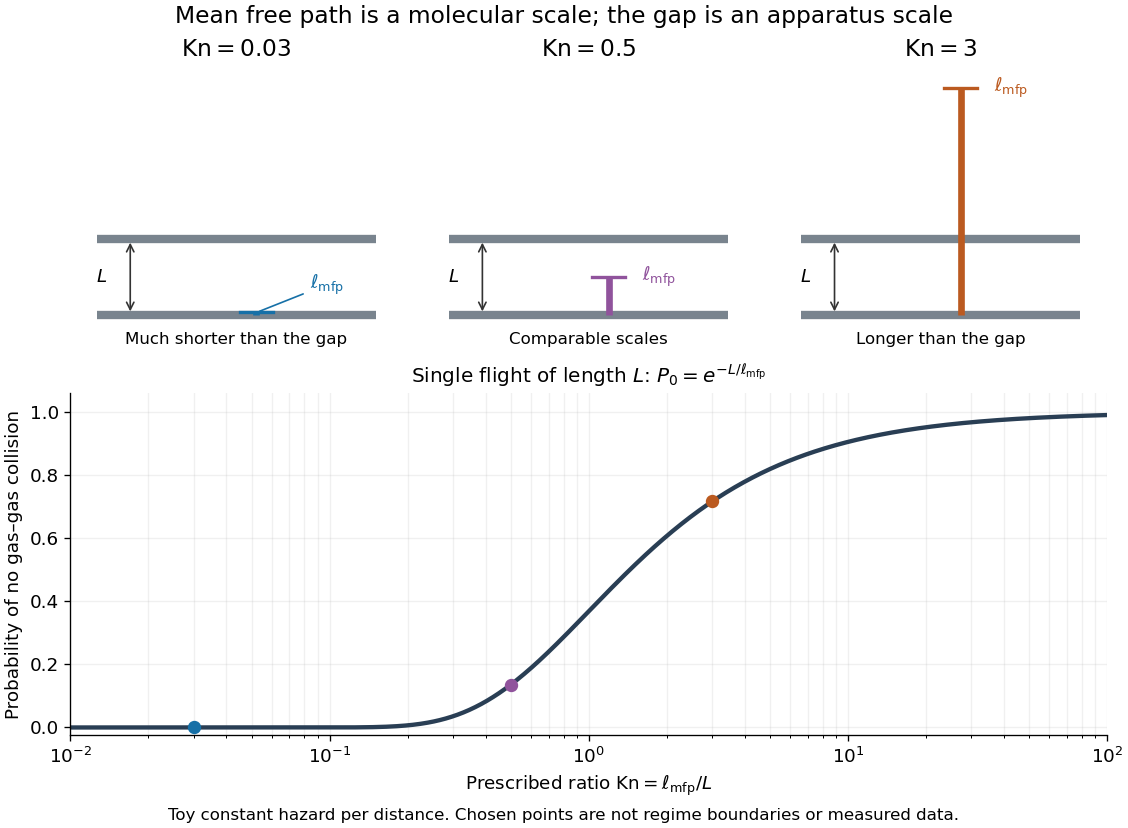

For , frequent gas–gas collisions can establish a local Maxwellian before macroscopic conditions change appreciably. Under this additional near-equilibrium assumption, the hydrodynamic limit of the Boltzmann equation motivates a continuum approximation with Navier-Stokes equations and heat conduction. A no-slip boundary condition is a leading wall approximation, not a statement about individual molecular velocities.
With a small but finite Knudsen number, a useful slip approximation retains continuum bulk equations and corrects wall velocity and temperature. A Navier slip boundary condition can represent the leading tangential velocity correction, but its slip length must come from the relevant gas–wall interaction model. A nearby Knudsen layer still requires kinetic treatment if its detailed structure is wanted. Slip corrections are perturbations; extending them into order-one Knudsen numbers has no general accuracy guarantee. At order-one Knudsen number, wall and intermolecular collisions both matter; this transitional situation calls for a kinetic theory model. At , free molecular flow becomes a useful limiting approximation. These are scale comparisons, with accuracy depending on geometry, flow conditions and the observable, rather than universal sharp numerical boundaries. [ref]
https://ntrs.nasa.gov/api/citations/19860015045/downloads/19860015045.pdf#page=3. Frank G. Collins (1985), Low Density Gas Dynamic Wall Boundary Conditions, introduction
A Knudsen layer is the gas region adjoining a boundary where the molecular distribution departs from the bulk near-equilibrium description over distances of order a few mean free paths. Continuum slip and jump conditions describe an effective boundary for the outer solution; they do not resolve this layer. [ref]
https://doi.org/10.1021/ie9600351. Rosner and Papadopoulos (1996), Jump, Slip, and Creep Boundary Conditions at Nonequilibrium Gas/Solid Interfaces
In free molecular flow, gas–gas collisions are negligible over the trajectories relevant to the observable. Molecules still encounter walls, whose scattering of momentum and energy must be modeled. In a long narrow tube, exceeding the diameter does not by itself prove that every complete transmission path is collision-free: repeated wall reflections can create much longer paths. The approximation must be checked against those paths as well as the width. [ref]
https://farside.ph.utexas.edu/teaching/355/Surveyhtml/node223.html. Fitzpatrick, Molecular Flow, wall encounters in a long tube
Effusion is molecular passage through a small opening whose dimensions, including its thickness, are much smaller than the intermolecular mean free path. For an equilibrium ideal gas, the one-way particle rate through a thin hole of area is . This weights molecules by their wall-normal velocity, rather than just counting all molecules in the reservoir. [ref]
https://farside.ph.utexas.edu/teaching/355/Surveyhtml/node224.html. Fitzpatrick, Molecular Effusion, equations 5.284–5.285
An equilibrium Maxwell-Boltzmann gas has number flux onto a plane. Molecules crossing the plane are weighted by their positive normal velocity, so their mean translational kinetic energy is , rather than the bulk value . The translational energy flux is therefore . Internal degrees of freedom contribute their mean energy per crossing molecule when independent of translational velocity.
For an isotropic two-dimensional velocity distribution, a straight opening of width in a region of number per area loses particles at the displayed rate. The angular integral is . At fixed equilibrium kinetic energy the speed distribution scales as , so the rate has the same scaling. A fixed second moment alone does not determine the first moment without a distribution assumption.
During collisionless effusion, selective loss changes the distribution of surviving particle velocities without collision-driven relaxation to a new Maxwell-Boltzmann distribution. The loss law depends on flight paths and on the wall-reflection rule. Speed-dependent depletion and, for specular walls, directional structure can remain.
If a classical monatomic gas re-equilibrates by collisions while losing atoms by effusion, the escaping atoms carry mean kinetic energy . Without wall heating, conservation of energy gives and therefore . This assumes a fixed container volume and a small aperture in the molecular-flow regime.
For a species in two well-mixed vessels of equal volume joined by a thin opening of area , the effusion law gives . Each species' total inventory is conserved. With fixed temperatures and total density sum , the left density relaxes exponentially with time constant to .
At equal temperatures, , and initially separated species mix at different rates. At unequal temperatures, the final density ratio is for every species, while the partial-pressure ratio is . The mass-independent final ratios do not imply mass-independent transient rates. Maintaining different temperatures requires external heat exchange even after net particle transfer vanishes.
Thermal transpiration is gas transport driven by an imposed temperature difference in a rarefied connection. Gas can move from cold to hot even when the two end pressures start equal. If the reservoirs are closed, redistribution builds a counteracting pressure difference until the net transfer stops. This final stationary state is not global thermal equilibrium: the two temperatures remain different. It explains why a heated pressure sensor can read a different pressure from the vessel to which it is connected. The correction depends on gas, connection geometry and molecular interaction with its surfaces. [ref]
https://arxiv.org/html/1308.6794. Daudé, Elandaloussi and Janssen (2014), thermal-transpiration corrections for diaphragm gauges, introduction
The simple molecular limit is beautiful: equal opposing particle rates need not mean equal pressures. Consider effusion through a thin hole connecting two locally equilibrated reservoirs of the same gas, at . Equating their one-way rates givesAt equal pressure, the hotter reservoir has lower number density; its faster molecules do not fully compensate for that reduction in outgoing particle rate. With and , the ideal zero-transfer ratio is . The hydrodynamic, zero-flow limit instead has equal pressures when other forces are absent. These are limiting models, not an interpolation formula for a glass capillary. [ref]
https://farside.ph.utexas.edu/teaching/355/Surveyhtml/node224.html. Fitzpatrick, Molecular Effusion, equations 5.286–5.287
In a real tube, incomplete exchange of molecular energy with the wall can alter the limiting ratio; a Knudsen number does not specify that exchange. [ref]https://arxiv.org/html/1308.6794. Daudé, Elandaloussi and Janssen, §I, limitations of the ideal Knudsen pressure ratio
Two equal sealed vessels of fixed volume, initially at , exchange an ideal gas through a thin effusive opening. Hold one at and the other at , with both interiors locally thermalized. Zero net particle transfer gives . Writing , conservation of total particle number gives and . Thus . The alternative , requires a cold reservoir whose pressure is externally held fixed; it is not the closed equal-volume problem.
Rojas Cardenas, Graur, Perrier and Méolans studied thermal transpiration in helium using a glass microtube of diameter and length in their 2012 experiment. They heated one reservoir, leaving the other near room temperature, and measured tube-end temperatures of and . Three contact thermometers and an infrared camera checked the thermal conditions; the hot reservoir was warmer than the adjacent tube end, so heater temperature was not an adequate substitute for tube-end temperature. Two capacitance diaphragm gauges recorded the reservoir pressures; a third gauge supported calibration. [ref]
https://www.jstage.jst.go.jp/article/jtst/7/3/7_437/_pdf/-char/en#page=4. Rojas Cardenas et al. (2012), An Experimental and Numerical Study of the Final Zero-Flow Thermal Transpiration Stage, §2.1
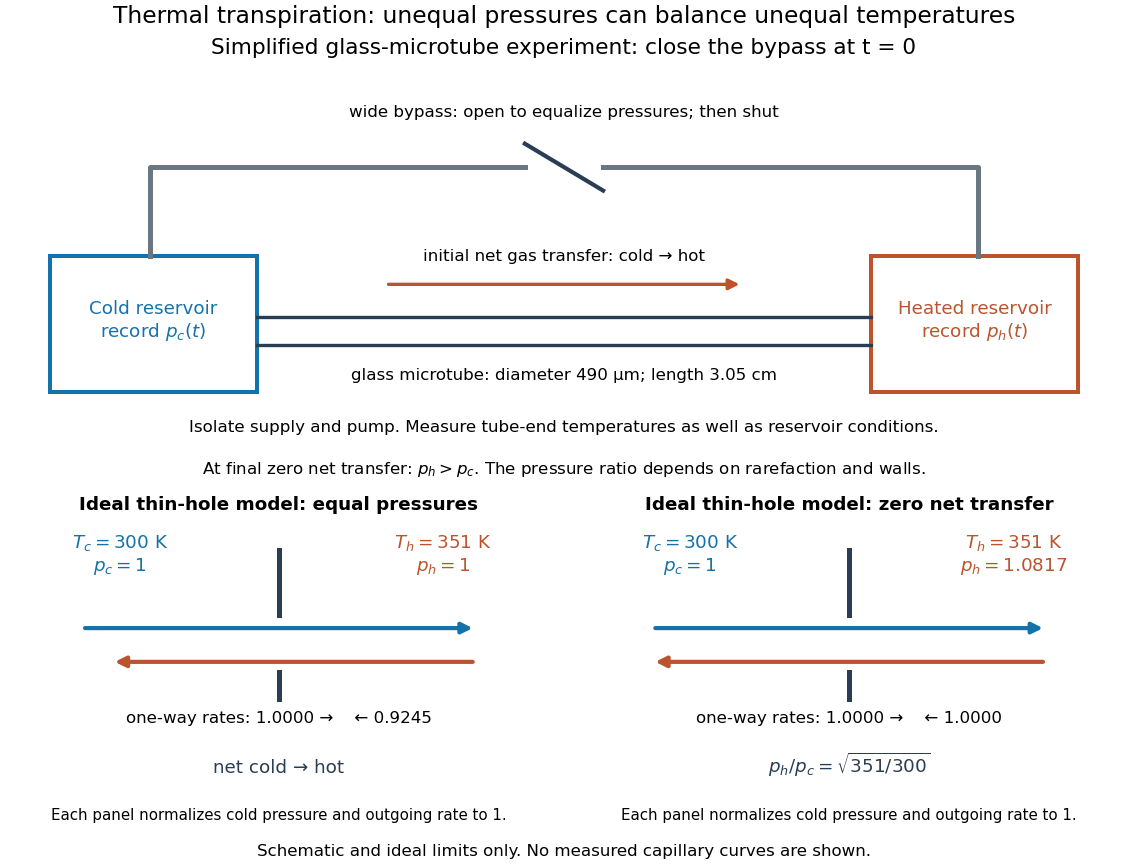

Their earlier 2011 paper explains the measurement sequence. A wide bypass links the reservoirs in parallel with the microtube. After isolating the gas supply and pump, keep the bypass open to equalize pressures with the temperature difference already established. Closing the bypass defines . The hot-side pressure rises and the cold-side pressure falls; ultimately their slopes approach zero at unequal pressures. Repeating at different initial pressures changes the degree of rarefaction without changing the microtube. The 2011 study also compared helium and nitrogen and imposed temperature differences of , and . [ref]
https://doi.org/10.1063/1.3561744. Rojas Cardenas et al. (2011), Thermal transpiration flow: A circular cross-section microtube submitted to a temperature gradient, measurement sequence
The quantities to record are both and , the reservoir volumes, and the temperatures relevant to their particle inventories. In an idealized reservoir of fixed volume and uniform fixed temperature , the ideal gas law gives , so opposite inventory changes test particle conservation. If temperature changes, differentiation instead gives : a thermal drift can imitate particle transfer. The authors' 2011 presentation explicitly checks this thermal correction when extracting an initial mass flow rate from the pressure slope. [ref]
https://www.itep.kit.edu/downloads/12_Rojas.pdf#page=25. Rojas et al., IUVSTA 2011 presentation, mass-flow extraction and thermal correction
The 2012 paper compares the final pressure ratio across near-free-molecular through slip conditions with a kinetic model and empirical corrections. It does not establish the thin-hole square-root law at every measured pressure. [ref]
https://www.jstage.jst.go.jp/article/jtst/7/3/7_437/_pdf/-char/en. Rojas Cardenas et al. (2012), abstract and comparison of final pressure ratios
For a replication, useful additional controls follow from the interpretation: remove the temperature difference to test the null signal; reverse it to test the direction; check gauge zero offsets and leaks; and wait for stable temperatures before closing the bypass. These are suggested controls, not claims that the cited paper performed each one. A reproducible pressure split at zero net transfer makes the failure of a single continuum wall model observable, while the Knudsen number organizes which molecular and apparatus scales are competing.A capacitance diaphragm gauge senses pressure through deflection of a diaphragm that changes a capacitor's capacitance. Its head can have a different temperature from the vessel being measured, allowing thermal transpiration in the connecting tube to change the head pressure. [ref]
https://arxiv.org/html/1308.6794. Daudé, Elandaloussi and Janssen, §I, diaphragm-gauge principle and thermal-transpiration effect
The incoming two-particle distribution at a collision is approximated by the product of one-particle distributions. This closes the binary collision term into the quadratic nonlinear Boltzmann collision operator. It does not assert exact independence after collisions: outgoing pairs can be correlated, and time reversal generally converts those correlations into incoming correlations. A rigorous kinetic limit needs propagation and convergence estimates rather than a bare independence assertion.
For a dilute phase-mixed population, an identical-species collision rate counts unordered pairs: . Different species have rate . Here uses the collision cross-section and relative speed. Destroying both identical particles gives , not . This distinction prevents inconsistent factors when using one kinetic kernel for several particle sizes.
This many-particle stochastic collision model rotates one uniformly selected velocity pair by a uniformly selected angle, conserving the sum of squared velocities. Its normalized angular averaging is the Kac collision operator, and its continuous-time evolution is the Kac master equation. In this version velocities range over and initial energy is not restricted to one sphere; the evolution preserves the initial energy distribution.
Use as the reference probability density. The relative entropy is nonnegative by writing and integrating . Its expansion is . Equality holds only at , whereas other radial densities may still be stationary for the Kac master equation.
For the Kac master equation and finite differentiable entropy, mass and energy conservation remove the non-logarithmic entropy terms. Symmetrizing each pair rotation then gives . The integrand is nonnegative by monotonicity of the logarithm, with the usual extended convention at zeros. Zero dissipation corresponds to radiality; it need not imply zero relative entropy.
A permutation-symmetric sequence of probability laws is chaotic with one-particle law when, for every fixed , its -coordinate marginal distributions converge weakly to the product law as . This is an asymptotic independence condition, not a consequence of symmetry alone. A rigorous kinetic limit also requires propagation of this property under the dynamics and sufficient convergence to pass collision integrals.
The jump process with total collision rate and normalized pair-angle operator evolves by . It preserves mass and the total squared velocity. Its one-coordinate distribution satisfies the Kac marginal evolution equation, and its Gaussian relative entropy in Kac's model decreases at the rate given by Kac entropy production.
For a permutation-symmetric density in the Kac master equation, integrate over all but the first velocity. Collisions among integrated coordinates cancel. The pairs containing the first coordinate give equal terms, with coefficient . The resulting exact evolution depends on the two-coordinate marginal distribution; it is not a closed equation for the first marginal without additional asymptotic independence.
For , uses the genuine two-coordinate rotation . Average it uniformly over angles and pairs to obtain . Rotation invariance of Lebesgue measure makes a bounded self-adjoint operator of norm one on . Each pair average is an orthogonal projection, but their full average is not in general a projection.
For the Kac collision operator, expanding the squared Hilbert space norm gives . The nonnegative form measures failure of invariance under the pair rotations. It vanishes precisely on the radial kernel of the Kac collision operator.
Zero Dirichlet form of the Kac collision operator forces invariance under every pair rotation; strong continuity upgrades almost every angle to every angle. Coordinate-plane rotations generate the special orthogonal group, whose action is transitive on each sphere for . Averaging over normalized Haar measure therefore identifies the invariant functions with radial functions. Conversely radial functions are fixed by every pair rotation.
On the unit-period spatial circle, free streaming has solution . With Fourier phase , its mixed Fourier transform is . A nonzero spatial mode of the velocity-integrated density therefore samples increasingly large velocity frequencies. The conserved spatial zero mode remains, while extra velocity regularity supplies quantitative decay of the other modes.
For integrable weak velocity derivatives on a unit-period spatial circle, the Fourier transform of a derivative gives for . Summing these modes uses . The resulting absolute Fourier summability gives the displayed uniform bound for the continuous representative of the density. For the same summation diverges, so this argument needs additional input.
The mass-normalized first velocity moment of a distribution on phase space. For a velocity-only distribution, omit the position integral. Nonzero finite mass and a finite first moment are required. For a probability distribution this is its expected value; its unnormalized counterpart is the momentum.
Transport a phase-space density along Hamilton's equations. The Hamiltonian vector field is and the equation is . Its zero divergence gives volume-preserving transport. For , the density is constant along characteristics; a source is integrated by the Duhamel formula for Hamiltonian transport. This is distinct from the elliptic Liouville equation.
The Hamiltonian gives , . Its characteristic flow map is multiplication by , with and determinant one. The backward map is . This expanding-contracting linear flow preserves phase-space Lebesgue measure and every finite- integral of a transported density, despite stretching its level sets.
If and a nonzero time-independent source is invariant along the Hamiltonian flow, then the Duhamel formula for Hamiltonian transport gives . For the nonzero-frequency oscillator, is smooth and belongs to all finite Lp spaces, yet its resulting solution has infinite space-time norm on .
The Duhamel formula for Hamiltonian transport, phase space preservation and Minkowski integral inequality give the displayed bound. A time-independent source in an Lp space yields finite space-time norm on every bounded interval; it need not yield integrability on infinite time.
Smooth forcing need not be integrable in phase space. For the hyperbolic characteristic flow for an inverted oscillator, the source accumulates as . Its smallest quadratic-form eigenvalue is for . Starting with a nonnegative integrable Gaussian function, the solution is therefore unbounded and outside every finite Lp space at positive times. Locally time-integrable forcing prevents this failure by the Minkowski integral inequality.
For a complete invertible Hamiltonian flow , integrate the source along the backward characteristic ending at at time . The displayed formula solves the Hamiltonian Liouville equation. Volume preservation makes each composition with an isometry of Lp spaces.
The Vlasov equation describes collisionless evolution of a phase-space distribution function in a self-consistent force field: . The force can be electromagnetic or gravitational; the Collisionless dark-matter Vlasov equation is the cosmological gravitational specialization.
Articles by others on the same topic
There are currently no matching articles.