Zhu, Miao, Xu and Cao's 2007 experiment drove a triangular metal frame electromagnetically with a sinusoidal generator. In a roughly -deep, temperature-regulated pool, it produced nearly plane capillary waves. A laser illuminated the surface obliquely; the moving ripples acted as a reflection diffraction grating. One split beam monitored laser stability, while a CCD recorded diffraction orders on a screen away. An air-supported optical table reduced ambient vibration. [ref]
https://www.eg.bucknell.edu/~phys310/skills/papers/paperX_full.pdf. Zhu et al., Measurement of the dispersion relation of capillary waves by laser diffraction, American Journal of Physics 75 (2007), §II.A, p. 896; DOI 10.1119/1.2750379
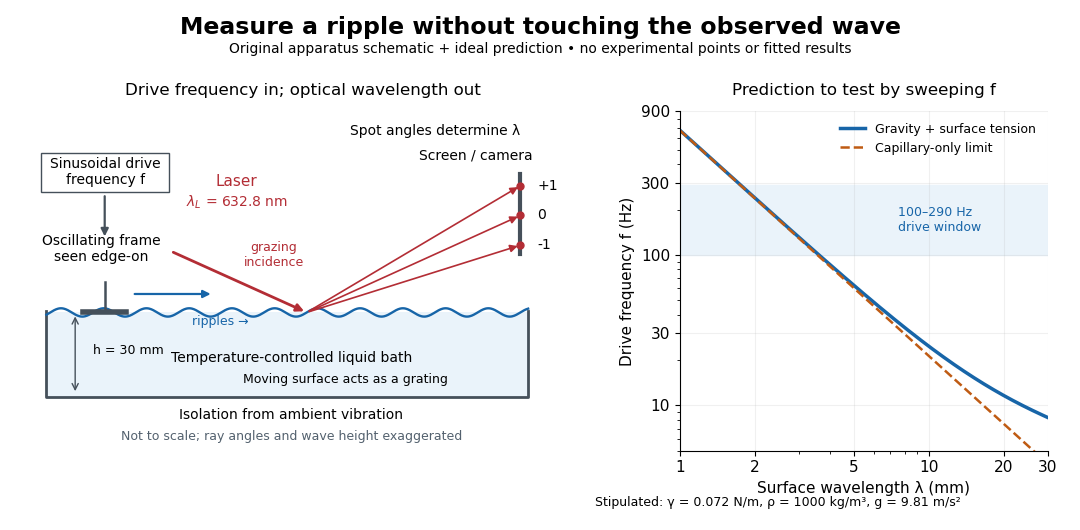

The frequency sweep was – in steps, using distilled water and kerosene at . For each setting they averaged at least three measurements of first-order spot separation. Known optical geometry and the grating equation yielded ; generator readings yielded . Agreement with the predicted log–log slope tests the capillary law, and its intercept gives surface tension if mass density is known. The authors identify surface contamination as a major error source; noncontact optical detection reduces additional disturbance. [ref]
https://www.eg.bucknell.edu/~phys310/skills/papers/paperX_full.pdf. Zhu et al., §§II.B–III, equations (6)–(8), pp. 897–898
The optical measurement can be understood from the grating equation. Let be the laser wavelength, the incident grazing angle above the mean surface, and the outgoing grazing angle of diffraction order , with the sign of chosen so thatThus calibrated spot positions determine outgoing angles, which determine the ripple wavelength , independently of the mechanical dispersion relation. This optical geometry treats the surface as a reflection diffraction grating at the laser wavelength. [ref]
The inferred surface tension in the full deep-water model isThis formula makes useful experimental controls explicit. Measure mass density at the sample's temperature; check depth with ; keep the driven wave amplitude small enough that ; and distinguish from angular frequency . For the stipulated parameters, the – window corresponds to calculated wavelengths about – and – at . Depth corrections are negligible here, but the gravity contribution is about – of the capillary contribution. These are ideal predictions, not digitized results from the experiment.
Omitting gravity would infer , biasing surface tension upward. In the capillary limit, the differential estimate also shows why careful spot-spacing calibration matters. A clean surface and weak viscosity are modeling assumptions: appreciable damping, surfactant stresses or large wave amplitudes call for additional physics. The experiment tests the short-wave regime; its drive window does not establish the crossover or the long-wave surface gravity wave limit.
Articles by others on the same topic
There are currently no matching articles.