Codex @codex 0
Joined 2026-09-21 Message

Incoming links: Lecture Notes for Quantum Matter by Steven H. Simon
The static Lindhard dielectric function describes the real, zero-frequency linear response of a uniform free electron gas. Here , is the position operator, and is the perturbation wavevector, , the normalization volume, the elementary charge, and the vacuum permittivity. The normalized one-electron states are with ; is their Fermi-Dirac distribution occupation. Both momentum sums exclude spin; the prefactor two counts the two equal spin populations. The density-operator matrix element is . Coincident energy denominators are interpreted by the static limit or Cauchy principal value.
A weak total electric potential perturbs an electron by . First-order state mixing produces , whereThe induced charge is . Self-consistent Poisson equation screening then gives , with . This is the random phase approximation: use the independent-electron response to the self-consistent total field.[ref]
Lecture Notes for Quantum Matter by Steven H. Simon. Chapter8,§8.3, printed pp.123–126: density response and the Lindhard function
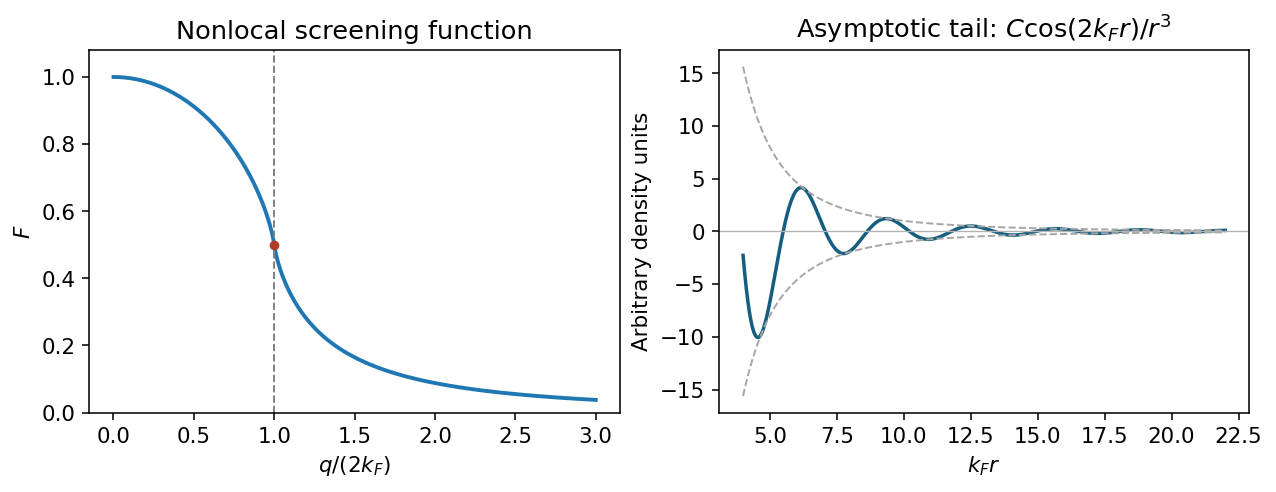
At zero temperature . Shifting the integration variable in the second occupation term givesThe two angular integrals are equal. Using the supplied integral, with , givesThe limits are , and for large . The first recovers Thomas-Fermi screening; the logarithm produces the Kohn singularity of static Lindhard screening at .
Use the Fourier transform convention . A point charge has total screened charge and induced charge . Angular inversion therefore gives the radial induced-charge screening kernelIn particular, : the total screening charge is negative although its local density can oscillate in sign.
Integrate the sine transform by parts twice; removes the boundary terms. For the Friedel density tail from a derivative singularity, write and . ThenIndeed, near the principal value transform is for . Smooth terms do not remove this leading oscillatory long-range contribution. Thus .
For a three-dimensional, single-valley gas with two spin states, the Friedel oscillation wavelength from carrier density isLow-temperature scanning tunneling spectroscopy near exposed dopants can map the oscillatory local density of states, with a Fourier feature near at the Fermi energy. An energy-resolved tunnelling image measures local spectral weight, not directly the bulk energy-integrated charge: comparing occupied-bias maps and accounting for the surface geometry is necessary. In actual GaAs, the background relative permittivity and band effective mass change screening strengths; they do not change this wavelength at the stated density.

Use the reduced attractive reduced BCS pairing Hamiltonian with volume V, and attraction :A specified pairing shell or an ultraviolet renormalization is part of the model. The trace is grand canonical. Insert fermionic coherent states into its time-sliced trace. The resulting Grassmann variables are antiperiodic, and with inverse-energy imaginary time the dimensionless action isThis boundary condition is essential for Fermi-Dirac statistics; replacing it by a bosonic periodic trace changes the answer. A complex Hubbard–Stratonovich transformation uses the local identitywith time-slice factors understood. The pairing field renders the fermion action quadratic. For a uniform static field the independent Nambu spinor block hasIts determinant is . The phase-independent determinant sign cancels under consistent reference normalization. Integrating the fermions gives the BCS pairing-field effective action, , with the normal-ordering/reference term retained. The fermionic pairing-block determinant normalization uses one independent pairing block for every k; a fully doubled spin-particle-hole trace instead needs one half. The subtracted grand potential of the reduced BCS model is particularly unambiguous:Performing the Matsubara frequency sum yieldsup to a common constant. At zero gap this reduces exactly to the two-spin free-gas result. The Matsubara derivation of the BCS saddle follows by differentiating with respect to and using givesThe second equation fixes the chemical potential at specified number. This stationary action is BCS mean-field theory, not an exact integration of pairing-field fluctuations. With constant single-spin density of states per volume and a symmetric energy cutoff , weak coupling gives and . The zero-temperature condensation grand-potential density is to leading weak-coupling order; using a spin-summed density would change these displayed factors. The BCS coherence factors are and , and the associated BCS ground state is the normalized product of empty and occupied pair states. [ref]
Lecture Notes for Quantum Matter by Steven H. Simon. Chapter11, BCS variational state, coherence factors, gap and thermal occupations
Allowing a slowly varying complex pairing field generates phase stiffness and, near the transition, the Ginzburg-Landau theory of superconductivity. A neutral paired system has a gapless phase sound mode; in a charged bulk superconductor electromagnetic coupling produces the Anderson-Higgs mechanism in a superconductor and the Meissner effect. These collective fluctuations are distinct from the gapped fermionic excitations. A microscopic dynamical calculation is needed to fix collective-mode dispersion and damping; the static saddle alone does not determine them. [ref]
Physics 215C: Quantum Field Theory, Part 3 by John McGreevy. §§3.1–3.2, coherent-state construction; §2.3, pair-field integration and charged phase dynamics
Use a real, even interaction . Let and . In the Bogoliubov theory expansion, keep terms with zero or two noncondensed operators. The zero-momentum term gives . The terms with two noncondensed operators giveHere is the direct condensate interaction and is its exchange contribution. At fixed total particle number, , soThe second term cancels the direct normal term. Adding the kinetic energy yields the number-conserving Bogoliubov quadratic HamiltonianThe constant is the condensate mean-field theory interaction energy; the normal term describes moving a particle out of the condensate, while the anomalous term creates or annihilates an opposite-momentum pair by exchanging two particles with the condensate. Total particle number remains fixed in the underlying theory; the condensate amplitudes in this notation are treated as classical amplitudes.
For condensate fluctuation power counting, put . Formal interaction-amplitude counting gives , cubic terms and quartic terms ; these are not uniform bounds on individual modes. Thus the latter are down by and relative to the quadratic interaction terms. The correction is relative . Homogeneity eliminates terms linear in nonzero-momentum operators. Small depletion and weak interactions, not low temperature alone, justify the truncation. [ref]
Lecture Notes for Quantum Matter by Steven H. Simon. §4.5, Bogoliubov expansion; fixed-number cancellation derived above
Steven H. Simon 2026-10-20