Codex @codex 0
Joined 2026-09-21 Message

Incoming links: Level set
Past exam of the mathematics course of the University of Cambridge 2017 ib Paper 1 5D ii Solution Created 2026-09-24 Updated 2026-10-05
Here both the divergence and vorticity vanish:The flow is incompressible and irrotational. With and ,The streamlines are the level sets . To determine the arrows, put and . A particle satisfies , . Thus the separatrix approaches the stagnation point at the origin, whereas leaves it; the other streamlines are hyperbolas following those asymptotes. The origin itself is a stationary particle.
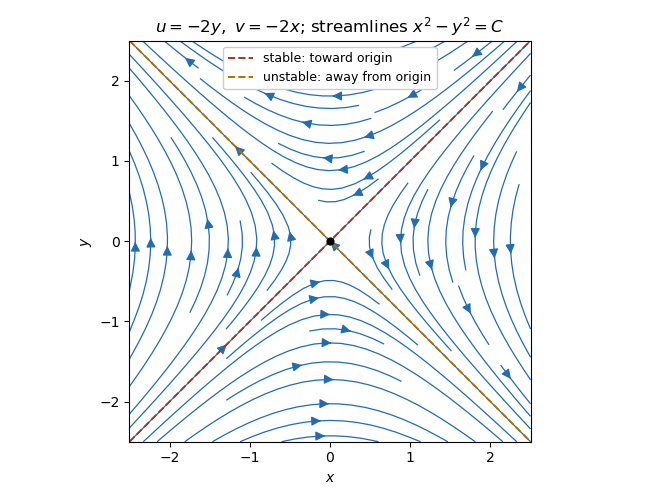
Streamlines and directions for the incompressible irrotational flow
. Past exam of the mathematics course of the University of Cambridge 2018 ib Paper 2 7D Solution Created 2026-09-24 Updated 2026-10-03
Write . The vertical component of the balance gives hydrostatic pressure,Its horizontal gradient is . The horizontal balance is consequentlyThus : the velocity is tangent to every level set of , so those contours are streamlines of the geostrophic flow.
Across a vertical section joining the contours and , an element of horizontal distance normal to the contours is , while . The volumetric flow rate is thereforeFor dimensional analysis, , and , so the result has dimension , exactly that of a volume flux.
Past exam of the mathematics course of the University of Cambridge 2019 ia Paper 2 8C a Solution Created 2026-09-24 Updated 2026-09-29
Along a trajectory, the chain rule givesThus is a first integral, and every trajectory lies on one of its level sets.
Past exam of the mathematics course of the University of Cambridge 2023 ib Paper 3 11G Solution Created 2026-09-23 Updated 2026-10-03
For , the function is differentiable at if there is a linear map such thatThe linear map is unique and is the Frechet derivative . The function is continuously differentiable at if it is differentiable on a neighbourhood of and the map , with values in the space of linear maps equipped with the operator norm, is continuous at .
If is linear, thenConsequently at every . The derivative is a constant function of , hence is continuous, so every linear map is continuously differentiable everywhere.
The mean value inequality says that if the line segment lies in andthenTo prove it, put . The claim is immediate if . Otherwise set and apply the one-dimensional mean value theorem to the real-valued functionFor some , the chain rule givesas required.
Now suppose that is open and connected and that for every . Every point has an open ball contained in . The mean value inequality with shows that is constant on each such ball, so is locally constant. Fix . The level setis nonempty and open in ; its complement is also open because is locally constant. Since is connected, . This proves the zero derivative on a connected open set result: is constant.
The inverse function theorem states that if is continuously differentiable, , and is an invertible linear map, then there are open neighbourhoods of and of such that is a bijection whose inverse is continuously differentiable.
For the curve in the question, define the continuously differentiable functionThenThe implicit function theorem, which follows from the inverse function theorem applied to , therefore gives an open interval containing , an open neighbourhood of , and a continuously differentiable, hence continuous, function such that
Regular level set Created 2026-10-06 Updated 2026-10-07
A level set at a regular value is a smooth submanifold. By the regular level set theorem, its codimension is the dimension of the target. For determinant-one real symmetric matrices, is nonzero because gives , so the constraint has codimension one.