The 1985 spectroscopy experiment used niobium-based tunnel Josephson junctions on silicon, thermally anchored with final bias low-pass filters to a dilution refrigerator. Calibrated germanium and cobalt thermometers measured temperature. A filtered coaxial cable injected microwaves; repeated switches to nonzero electric potential difference measured escape with irradiation on and off. Bias scans at fixed microwave frequency resolved separate enhancements matching calculated unequal energy level spacings. Raising temperature merged the structure toward classical response. Junction parameters were calibrated in the classical regime; reducing the superconducting critical current with a magnetic field checked thermal readout. Parameter uncertainties limited absolute resonance positions.[ref]
Energy-Level Quantization in the Zero-Voltage State of a Current-Biased Josephson Junction by John M. Martinis and others. Original paper, pp.1543–1545, apparatus and Figs.2–4; p.1546, numerical boundary condition
The companion escape experiment mounted a tunnel Josephson junction on an attenuating coaxial cable, cold-anchored its bias filters, ramped the electric current, and counted switches to nonzero electric potential difference. Rapid current shutoff limited heating. Classical escape and microwave resonance calibrated the superconducting critical current, capacitance and environmental loading. Low-temperature escape agreed with the quantum prediction using these calibrated parameters. A magnetic field reduced the superconducting critical current to keep the same apparatus thermally activated at lower temperature, testing excess noise. Frequency-dependent loading contributed uncertainty; the predicted damping correction was smaller than combined errors, so the experiment did not resolve that correction.[ref]
Measurements of Macroscopic Quantum Tunneling out of the Zero-Voltage State of a Current-Biased Josephson Junction by Michel H. Devoret and others. Original paper, pp.1909–1910, calibration, Fig.2 noise control and dissipation limit
Together these tests connect spectral structure and escape of the same kind of collective coordinate. They do not constitute a demonstration of coherent gate operations on a qubit, or prove that every macroscopic coordinate retains quantum behavior under arbitrary environmental coupling. The attraction is more concrete: a fabricated electrical circuit admits both an independently measurable classical model and quantitative quantum tests of its phase dynamics.
A switching-current distribution of a Josephson junction records the bias electric current at the first detected transition to a sustained nonzero electric potential difference. Interpret it using a stipulated monotone ramp , a reproducible initial trapped state, and an instantaneous escape hazard function . Neglect retrapping and readout delay. The survival function obeys , so changing variable from time to electric current givesHere is a probability density function per unit electric current, not a rate per unit time. Division by the surviving population is essential: only trials still trapped can escape. A typical switching current is consequently not identical to the noiseless superconducting critical current.
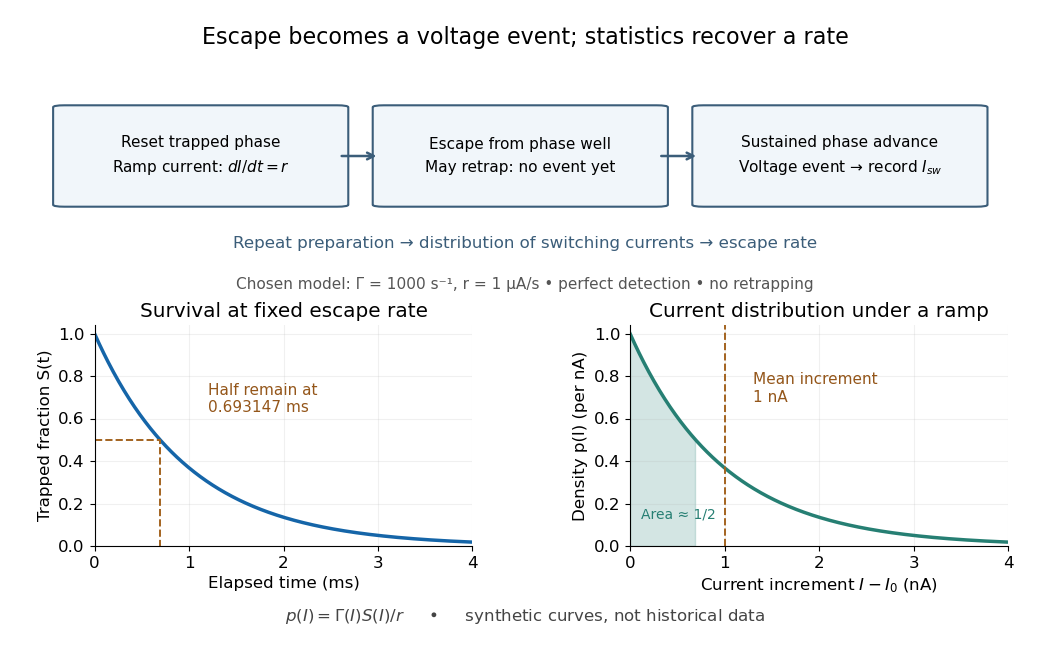

For an independent illustrative check, choose constant and . ThenHalf the trials have switched after , corresponding to of ramp. Doubling doubles the mean increment without changing the underlying escape rate. Real junction rates vary sharply with bias; this example isolates the statistical conversion.
Repeating the preparation, measuring the ramp, resolving the voltage onset, and allowing cooling after each dissipative event are prerequisites for this interpretation. Missed events, finite detection delay, changing temperature and retrapping alter the measured distribution. Even a correctly reconstructed rate needs the independent thermal and spectral checks before identifying its escape mechanism.
Articles by others on the same topic
There are currently no matching articles.