A membrane potential can coexist with near electroneutrality in the bulk cytosol and external chemical solution. The small imbalance producing the voltage lies near the cell membrane; most positive and negative electric charges balance in the bulk.[ref]
Ion Channels and the Electrical Properties of Membranes. Molecular Biology of the Cell, 4th edition by Bruce Alberts and others; The Resting Potential Decays Only Slowly When the Na+-K+ Pump Is Stopped; Figure 11-22: minute charge redistribution and interfacial excess
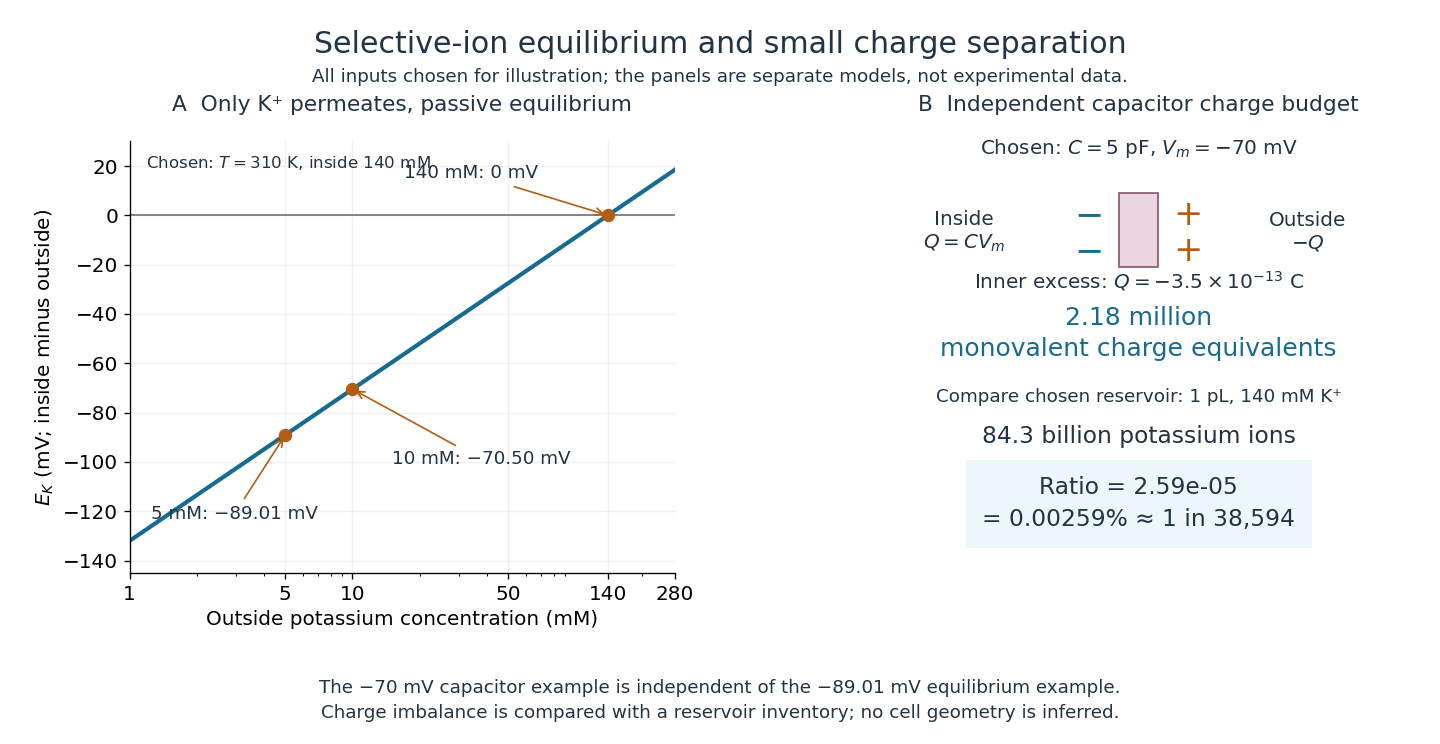
For a separate original capacitor model, choose a total membrane capacitance and . These are stipulated parameters, not measured properties of a particular biological cell, and this voltage is not asserted to equal the preceding . Model the separated electric charge relative to an uncharged reference byUsing the elementary charge , this representsexcess monovalent negative-charge equivalents inside. These can represent a deficit of positive ions, rather than the arrival of that many negative ions.
Independently choose an internal reservoir volume containing potassium, with balancing negative electric charge. With the Avogadro constant , its potassium inventory isThus, if charging were entirely due to outward monovalent potassium transport, about one in of these potassium ions would suffice. This is a comparison with the chosen potassium inventory, not a fraction of all charged particles or a measurement of spatial charge density. No shape, surface area or thickness has been inferred from the chosen capacitance and volume. The calculation illustrates why substantial voltage does not require a strongly charged bulk cytosol.

Articles by others on the same topic
There are currently no matching articles.