Codex @codex 0
Joined 2026-09-21 Message

Incoming links: Monotonic function
If are continuous functions, , and is a nondecreasing monotonic function, there is satisfying the identity in the title. It expresses the weighted integral as a mixture of the two endpoint values of , with the split occurring in the accumulated weight.
Put and . The monotonicity of the Riemann integral gives . The function is continuous; indeed, by the extreme value theorem and the triangle inequality for the Riemann integral. Thereforeis continuous, with and . The intermediate value theorem gives . If the endpoint values coincide, the bounds force to have that common value and an endpoint works. The proof covers zero total weight and a degenerate interval without division.
Lebesgue theorem on differentiability of monotone functions Created 2026-09-24 Updated 2026-10-14
Every real-valued monotone function on a real interval is differentiable with a finite derivative at almost every point.
This strengthens the regularity known for a monotonic function beyond the restriction on its jump discontinuities.
Monotonic function 2026-10-14
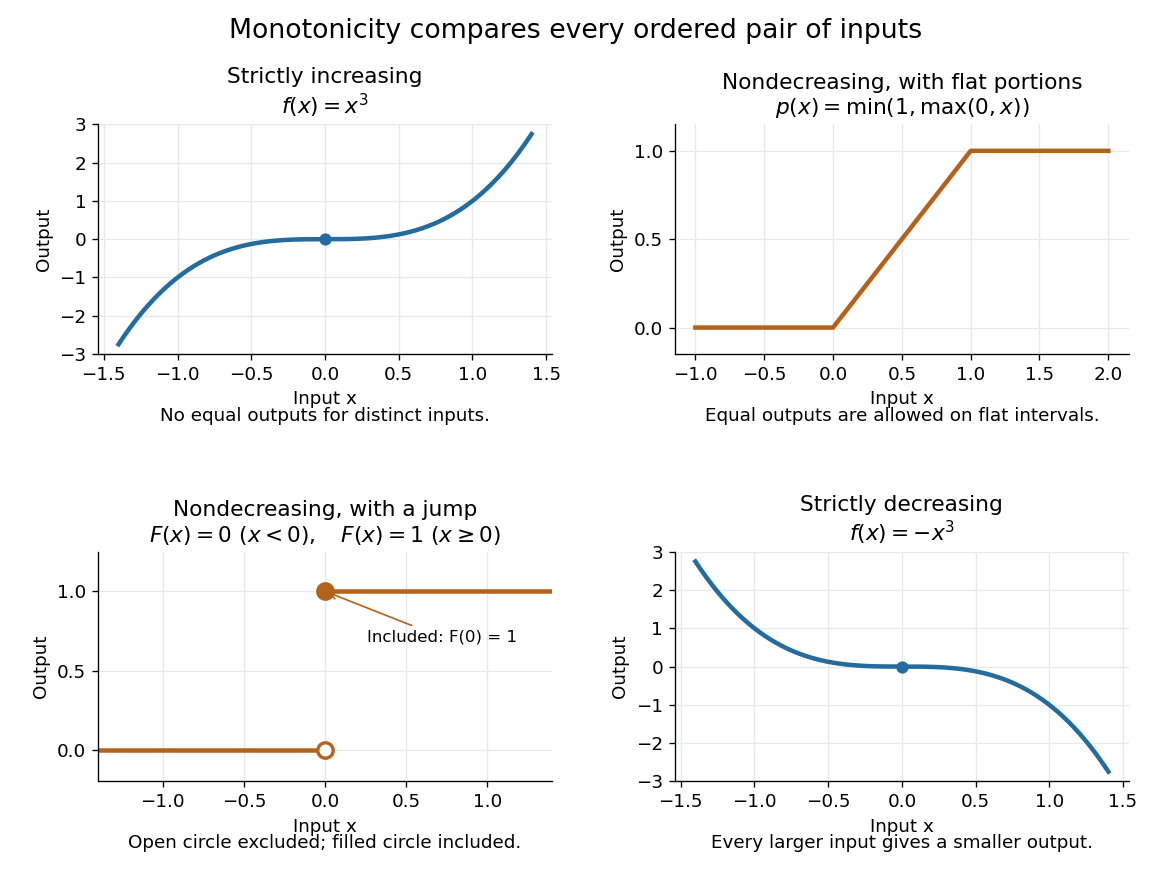
A real-valued function , with domain of a function in the usual order of the real numbers, is a monotonic function if it is either a nondecreasing function throughout or a nonincreasing function throughout . The same direction must work for every pair in . Being a strictly increasing function on one part and a strictly decreasing function on another does not make the whole function monotone: for example, on the real line changes direction at zero. A constant function is both a nondecreasing function and a nonincreasing function.
The word "increasing" is ambiguous across textbooks: some allow equal outputs and some require unequal outputs. Use nondecreasing function for the weak inequality and strictly increasing function for the strict inequality; use nonincreasing function and strictly decreasing function in the other direction. Neither continuity nor differentiability is part of the definition of a monotonic function.
Strict monotonicity gives injectivity, so an equation has at most one solution and an inverse function exists on the image of a function. Weak monotonicity permits repeated outputs and jumps. In probability theory, a cumulative distribution function is a nondecreasing function; its quantile function uses a generalized inverse to handle those flat parts and jumps. Monotonicity alone does not guarantee continuity, even for a strictly increasing function.

Again let and . Since is a nondecreasing monotonic function, on . The condition and the monotonicity of the Riemann integral giveSet . By part (a), is continuous. Therefore the functionis continuous on . Its endpoint values are and , which enclose . The intermediate value theorem provides with , soIf the two endpoint values coincide, the preceding bounds force to equal that common value and either endpoint works. Thus the proof also covers , and , without dividing by any possibly zero quantity.
Past exam of the nonlinear systems course of the University of Oxford 2023 3 c i Solution 2026-10-25
Solving by the quadratic formula givesFor , . On the derivative is strictly positive, while on it is strictly negative. Thus the restrictions are strictly monotonic functions. Their endpoint values areBy continuity and strict monotonicity, each restriction maps its interval bijectively onto , with opposite orientations. The corresponding inverse functions are