A net ionic equation retains the chemical species changed by a chemical reaction and cancels spectator ions present unchanged on both sides. Dissolved strong electrolytes are represented by their separated ions, while a solid product retains its chemical formula. Cancellation preserves both elemental inventories and electric charge conservation.[ref]
Chemistry 2e by Paul Flowers and others. Chemistry 2e, §4.2, Precipitation Reactions and Solubility Rules: molecular and net ionic equations for silver chloride
For the calcium carbonate example, the complete ionic account isCanceling the sodium cations and chloride anions yields the net ionic equation above. Neither cancellation nor the conventional sodium chloride formula implies that the remaining dissolved ions have become paired molecules.
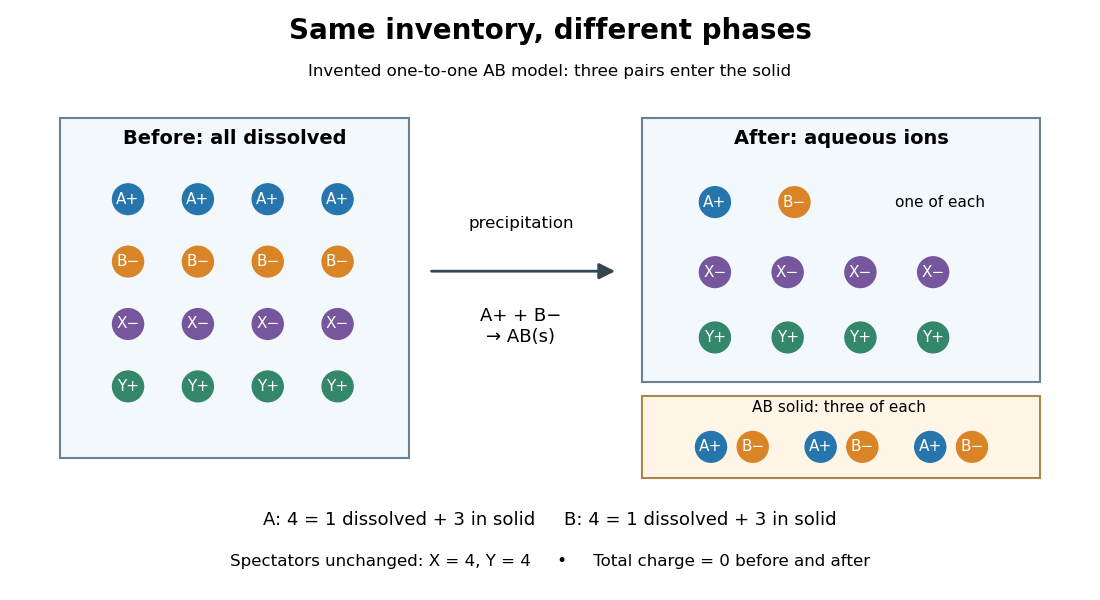

For this schematic, let be the amount of substance of AB formed. With no competing chemical reactions or losses,Adding each dissolved inventory to its contribution in the solid recovers its initial total. Each dissolved pair has net electric charge zero, so transferring a pair into neutral AB also preserves electric charge conservation. This is a short stoichiometry argument; choosing the actual additionally needs chemical equilibrium or chemical kinetics information.
Articles by others on the same topic
There are currently no matching articles.