Nuclear DNA content is the amount of DNA in a specified cell nucleus. Define relative to one unreplicated haploid set of the chosen species. It includes coding and non-coding DNA and excludes DNA outside the cell nucleus, such as a mitochondrion's genome. is an amount, whereas is a chromosome count; neither fixes the other across different species.
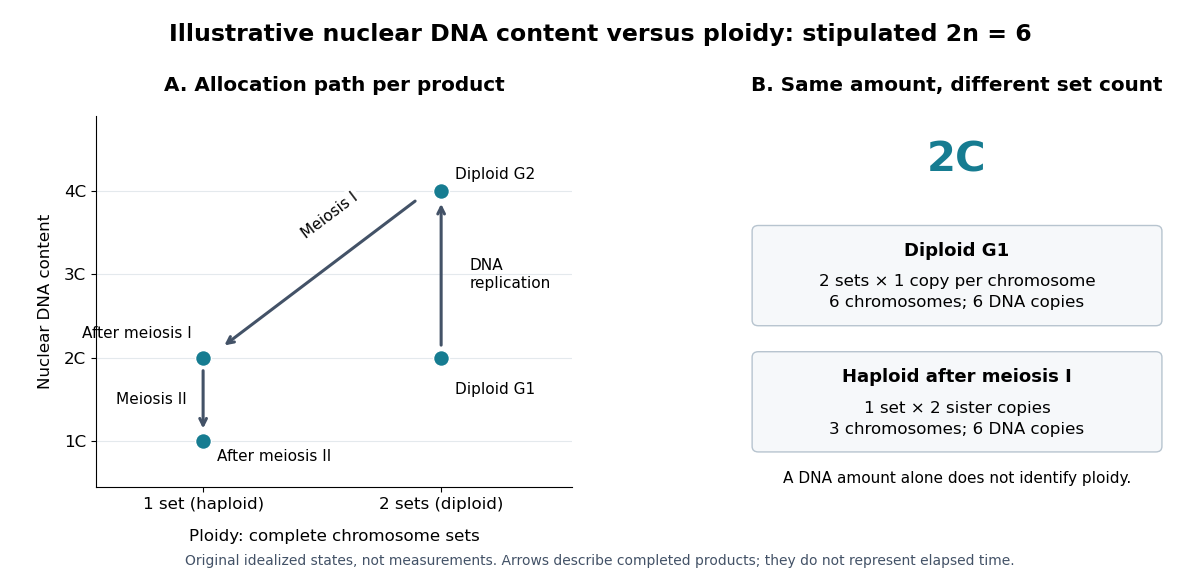
For an original numerical model, assign the three chromosome types unreplicated DNA amounts of 3, 2 and 1 arbitrary units. Then units: diploid G1 phase contains 12 units, G2 phase 24, each completed meiosis I product 12, and each completed meiosis II product 6. The totals and check conservation after copying. Equal chromosome counts alone would not justify equal DNA amounts if the sets had different sequence lengths.

How can an experiment measure the amount independently of chromosome counting? UCL's Cell Cycle Analysis by Propidium Iodide Staining, pp. 1–2, specifies a flow cytometric DNA-content assay. Washed biological cells receive cold 70% ethanol dropwise while vortexing, then at least 30 minutes on ice. After centrifugation and two washes, ribonuclease A removes RNA that would also bind the dye. Propidium iodide stains the preparation. A flow cytometry instrument such as the listed BD LSR II records individual-event fluorescence on a linear scale. Signal area versus height or width excludes doublets and clumps; acquisition is below 400 events per second, retaining at least 10,000 single-cell events. These are protocol settings, not measured results.[ref]
For a ploidy comparison, add a known diploid G1 phase reference processed with the same staining and detector settings, and an unstained background control. These are proposed comparison controls, beyond the protocol's clump-exclusion procedure. Proportional fluorescence then estimates relative Nuclear DNA content; it does not count chromosomes. A event could be a diploid G1 phase product or a replicated haploid product; could be replicated diploid material or an unreplicated four-set cell nucleus. Peaks alone therefore cannot establish ploidy or cell cycle stage without a reference and biological context. Uneven staining, residual RNA and unresolved doublets limit this inference; two particles can mimic one event.
Articles by others on the same topic
There are currently no matching articles.