The cell cycle is the sequence of events by which a biological cell prepares for and completes division, including DNA replication and distribution of chromosomes. In Saccharomyces cerevisiae, changing bud appearance provides an accessible readout; see the Burgess, Powers and Mell account and Hartwell, Culotti and Reid's primary study cited there.
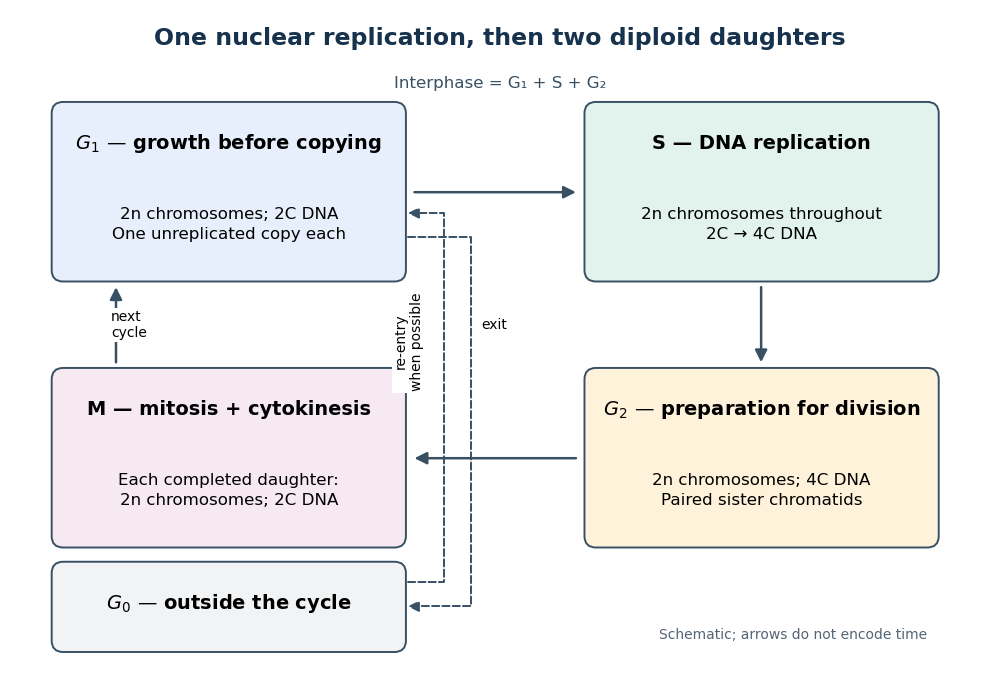
For a typical cycling diploid eukaryotic biological cell, the order is G1 phase, S phase, G2 phase, then M phase. DNA replication doubles nuclear DNA amount during S phase; mitosis distributes the copies, and cytokinesis separates the daughters. The useful distinction is between copying a library and allocating its copies: DNA replication changes how much material exists, whereas division changes which biological cell contains it.
Gene expression continues to supply RNA and proteins as the biological cell grows; it is different from duplicating the genome. In the yeast cross-species complementation experiment, restored growth requires successful repeated cell cycles, but growth alone does not locate a defect within a phase. Bud appearance in Saccharomyces cerevisiae provides another readout, while a flow cytometric DNA-content assay asks how much nuclear DNA is present and DNA pulse labeling asks whether new DNA was synthesized during an exposure.

