A nuclear emulsion is a photographic emulsion prepared for recording charged particles. The sensitive material serves as both target and record: a particle may slow, stop, decay or cause a nuclear reaction inside it. Reading that record requires track reconstruction, not recognizing a miniature picture of a particle. Unlike a cloud chamber photograph, the exposed nuclear emulsion itself retains the record until it is developed and examined.
In 1947, Cesare Lattes, Hugh Muirhead, Giuseppe Occhialini and Cecil Frank Powell reported charged particle tracks in which a stopping particle was followed by a secondary particle. Their paper treated the interpretation as provisional.[ref]
Processes Involving Charged Mesons by Cesare Mansueto Giulio Lattes and others. Lattes, Muirhead, Occhialini and Powell, Processes Involving Charged Mesons, Nature 159 (24 May 1947), pp. 694–697, abstract and byline
The eventual distinction between pions and muons made a striking use of photography: a tiny permanent record could distinguish particles by how they slowed and transformed.The method already had a history. In their jointly authored 1937 report, Marietta Blau and Hertha Wambacher described photographic plates exposed for five months at Hafelekar, above sea level.[ref]
Disintegration Processes by Cosmic Rays with the Simultaneous Emission of Several Heavy Particles by Marietta Blau and Hertha Wambacher. Blau and Wambacher, Disintegration Processes by Cosmic Rays with the Simultaneous Emission of Several Heavy Particles, Nature 140 (1937), p. 585, opening paragraph and joint byline
Neither shared the 1950 Nobel Prize in Physics, awarded to Cecil Frank Powell.[ref]Research Profile: Cecil Powell by Luisa Bonolis. Opening award statement: Powell's 1950 prize concerned development of the method and meson discoveries
This was a development of photographic particle detection, with earlier contributors, rather than its invention by one person.In his own later account, Cesare Lattes recalls calibrating emulsion shrinkage and the particle range–energy relation with accelerator-produced particles. Giuseppe Occhialini took borax-treated and untreated plates to Pic du Midi for about a month. The untreated plates provided a control; the treated plates retained more events because latent image fading was reduced. Later, Cesare Lattes exposed plates at the higher Chacaltaya station in Bolivia and obtained more candidate events.[ref]
Meu Trabalho em Física de Mésons com Emulsões Nucleares by Cesare Mansueto Giulio Lattes. Lattes, Meu trabalho em física de mésons com emulsões nucleares, 1984 recollection in Portuguese translation, paragraphs beginning “Foi-me dada a tarefa”, “Occhialini e eu decidimos”, “Quando Occhialini revelou” and “Assim, propus”; the recollection's altitude estimate is not adopted here
The Pic du Midi cosmic ray exposure was roughly above sea level.[ref]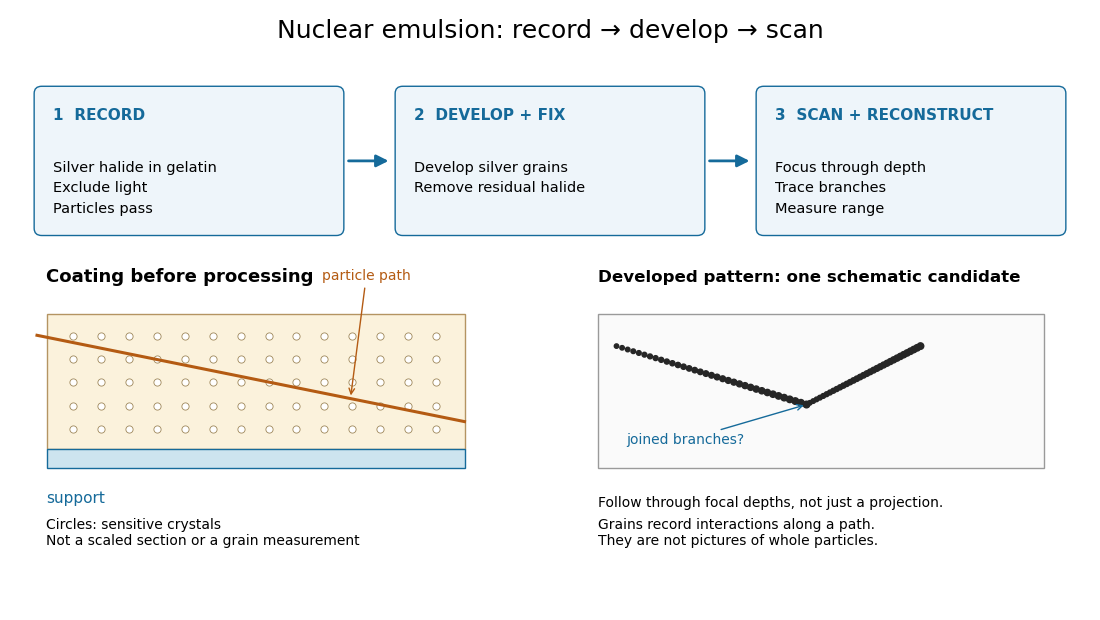
An emulsion range measurement follows a stopping charged particle through the coating to estimate its complete particle range. A projected length on one image can underestimate the distance travelled. In an original geometry example, a straight segment with projected length and corrected depth change has lengthUsing the projection alone would underestimate this length by . A bent track requires a sum over reconstructed segments. These are stipulated coordinates, not measurements of a historical track.
Suppose photographic processing contracts the coating only in depth, with shrinkage ratio . Then an observed depth difference corresponds to . For , an observed becomes the used above. This correction assumes uniform contraction and unchanged lateral dimensions; it cannot repair a track that leaves the coating before stopping.
A simple continuous-loss model connects particle range to kinetic energy through stopping power :This describes the mean trend for a specified particle and material. Fluctuating energy loss produces a spread of stopping distances, called range straggling. An exit point supplies only a lower bound on particle range. Consequently, a narrow distribution from fully contained tracks and one assembled by treating exits as stops answer different questions.
Range straggling is the event-to-event spread in particle range for otherwise similar incident particles, caused by fluctuations in their energy loss and transport through matter. It must be distinguished from measurement uncertainty and from the incomplete recording of particles that escape.
The track grain density is the number of resolved developed grains along reconstructed track length , divided by . It is a response variable, not a universal conversion from darkness to energy. Overlapping developed grains, exposure fading, processing and optical spatial resolution can all change what is counted. Calibration must use comparable material and viewing conditions.
Cesare Lattes specifically recalls distinguishing meson tracks from proton tracks using their greater deflection by scattering and changing track grain density toward the stopping point. He also recounts a secondary track that left the coating, requiring extrapolation rather than a directly measured stopping distance.[ref]
Meu Trabalho em Física de Mésons com Emulsões Nucleares by Cesare Mansueto Giulio Lattes. 1984 recollection, paragraph beginning “Devo adicionar”: scattering, grain density and an escaping secondary; no numerical grain count is reported here
For a candidate joined track, the useful questions are whether both branches actually meet in depth, whether the incoming branch is consistent with stopping there, and whether the outgoing branch has the expected particle range and track grain density. A visible change of direction alone cannot distinguish a decay from scattering or an accidental crossing. Examining successive focal depths tests a projected crossing; comparison with ordinary stopping tracks tests the identification. These are measurement checks, not a claim that the original plates provided time-resolved movies.
A nuclear emulsion integrates exposure over time. It does not by itself supply the time between two apparently joined branches. Finite spatial resolution also limits how tightly one can establish their common origin: developed marks and the microscope response are much larger than a subatomic particle. There is no single resolution number applicable to every emulsion, developer and optical arrangement.
Cecil Frank Powell's 1950 lecture illustrates the successive decays of pions and muons through their tracks and explains why the nearly fixed secondary muon range, allowing for range straggling, supports a single neutral decay partner. He describes its identification as a neutrino tentatively. The neutral particle itself leaves no recorded track. He contrasts this decay with the nuclear reactions caused by stopped negative pions, connecting the latter with the nuclear force.[ref]
Here is a modern special relativity derivation for the dominant leptonic pion decay, assuming a free pion at rest, a massless muon neutrino, and no emitted photon. Write and for the pion and muon masses. By conservation of momentum the daughter momenta are opposite with equal magnitude . By conservation of energy and the energy–momentum relation,Substitute , square, and cancel . This givesThe resulting is fixed, although the muon's direction is not set by the incoming stopping track. Thus the kink angle relative to that earlier track is not the angle between the two daughters: in the pion rest frame, the daughters are back to back. A neutral-partner arrow in a diagram represents inferred momentum, not an observed string of grains.
For an original calculation, adopt rounded input values and . They give , and . Their sum satisfies . These are rounded calculation inputs and outputs, not a fit to the 1947 plates.
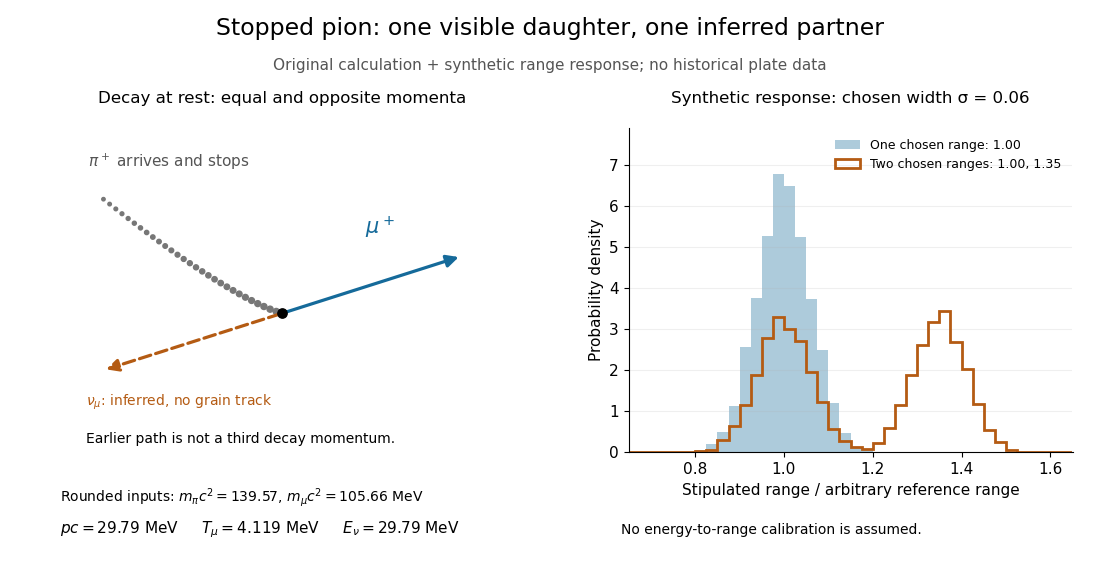
At fixed material and particle identity, a fixed initial kinetic energy suggests a narrow particle range distribution broadened by range straggling and measurement uncertainty. The synthetic example convolves a single chosen range with a normal distribution; a second example superposes two such chosen ranges. It explains why repeated comparable stopping distances can be informative, without pretending to extract a historical spectrum.
The decay equations do not identify the neutral partner as a neutrino on their own: a massless photon would satisfy the same energy and momentum equations. Nor does any isolated kink establish the pion's identity. The inference gains force from calibrated particle range, track grain density, repeated decay patterns and independent particle properties. Historical particle names should not obscure the distinction: a muon is a lepton, whereas a pion is a meson.


